Environmental Protection Agency (EPA) Projections Show Ireland Off Track for 2030 Climate Targets.
Ireland is projected to achieve a reduction of up to 23 per cent in total greenhouse gas emissions by 2030, compared to a National target of 51 per cent.
To achieve a reduction of 23 per cent would require full implementation of a wide range of policies and plans across all sectors and for these to deliver the anticipated carbon savings.
The first carbon budget and second carbon budget are projected to be exceeded with almost all sectors on a trajectory to exceed their national sectoral emissions ceilings for 2030.
Ireland will not meet its EU Effort Sharing Regulation target of 42 per cent reduction by 2030, instead a maximum reduction of 22% is projected.
Total emissions from the Land Sector are projected to increase by up to 95% and Ireland is unlikely to meet our European commitments in this area.
EPA analysis shows that planned climate policies and measures, if fully implemented, could deliver up to 23 per cent emissions reduction by 2030 compared to 2018, down from the 29 per cent reduction projected last year. This widening gap to the emissions reduction target of 51 per cent in Ireland’s Climate Act is driven by updated information provided by Governmental bodies.
The first Carbon Budget (2021-2025) of 295 Mt CO2eq is now projected to be exceeded by between 8 to 12 Mt CO2eq. The second budget is now projected to be exceeded by a significant margin of 77 to 114 Mt CO2eq, including carryover from the first Carbon Budget.
Transport, Industry and the Buildings (Residential) sectors are projected to be the furthest from their sectoral emission ceilings in 2030, with emission reductions of up to 21%, 12% and 22% respectively. Agriculture emissions are projected to reduce by up to 16%. A direct comparison of the Agriculture sector against its Sectoral Emission Ceiling is no longer viable due to the impact of updated science underpinning the estimated agriculture greenhouse gas emissions.
Ms Laura Burke, Director General, EPA said: “The EPA’s projections show that full delivery of all climate action plans and policies could deliver a 23 per cent reduction in greenhouse gas emissions. Although emissions trends are going in the right direction, the gaps to our European and National emission reduction targets are now projected to be larger than last year. This highlights the economy-wide effort needed to decarbonise our society and the focus must shift from policy aspiration to practical implementation.”
Ms Burke added: “As we get closer to 2030 and receive more information on the impact of agreed policies and measures, it is concerning to see projected reductions and lack of progress in the delivery of actions to reduce emissions including in the electrification of our transport sector and the expansion of renewable electricity powering our homes and businesses and the implementation of carbon reduction measures in agriculture. Momentum is building for Ireland’s low carbon society, but we need to accelerate it and scale up the transition.”
Agriculture Depending on the level of implementation of measures outlined in Climate Action Plans, AgClimatise and Teagasc MACC, total emissions from the Agriculture sector will range from a 1 per cent increase to a 16 per cent decrease over the period of 2018 to 2030. Savings are projected from a variety of measures including limits on nitrogen fertiliser usage, switching to different fertilisers and bovine feed additives.
Transport Emissions from the sector are projected to reduce up to 21 per cent over the period 2018 to 2030 if the measures set out in plans and policies are implemented. These include over 640,000 electric vehicles on the road by 2030, increased biofuel blend rates and measures to support more sustainable transport. Road freight is projected to be the biggest source of road transport greenhouse gas emissions by 2030.
Residential Emissions Emissions from the sector arise from fuel combustion for domestic space and hot water heating. These are projected to decrease by up to 22 per cent by 2030. Emission reduction measures in this sector include 571,000 domestic heat pumps are projected to be installed by 2030. Industry Fuel combustion in manufacturing is the primary source of emissions in this sector; process emissions from mineral, chemical, and metal industries contribute the next largest portion. Emissions from this sector are projected to reduce by 12 per cent over the period 2018 to 2030 with full implementation of measures including the accelerated uptake of carbon-neutral heating technologies for low and high temperature heating, and increased use of biomethane.
Energy Driven by a reduction in fossil fuel usage and increased net importation of electricity from interconnectors, there was a marked drop of over 21 per cent in emissions from electricity generation between 2022 and 2023. In combination with planned increases in renewable energy generation from wind and solar, energy sector emissions are projected to reduce by up to 68 per cent (over the period 2018 to 2030) and are projected to achieve over 68 per cent renewable electricity generation by 2030.
Land use Emissions from this sector are projected to increase between 39 per cent to 95 per cent over the period of 2018 to 2030 as our forestry reaches harvesting age and changes from a carbon sink to a carbon source. Planned policies and measures for the sector, such as increased afforestation, water table management on agricultural organic soils and peatland rehabilitation are projected to reduce the extent of the emissions increase.
Commenting, Ms Mary Frances Rochford, Programme Manager said: “The Agriculture sector has made some progress in reducing emissions through the successful rollout of actions on nitrogen fertilisers, low emission spreading technologies and national liming programmes. In parallel, in line with new research, the EPA refined the information underpinning the agricultural figures which has led to a reduction in the overall agriculture emission estimates. It is imperative that this new research and information is incorporated into updated carbon budgets and sectoral ceilings to ensure that they reflect latest science, data and knowledge on greenhouse gas emissions in Ireland and alignment with the national reduction target for the sector of 25%.”
EPA Highlights Significant Increase In Government Green Procurement, But ICT Sector Lags Behind.
Of €1.24 billion spend by government departments on contracts in 2023, 82 per cent included green criteria, up from 34 per cent in 2022. There are, however, inconsistencies across sectors.
ICT Products & Services contracts included green criteria in only 29 per cent of cases, indicating the need for wider adoption.
In contrast, all reported procurement of Food & Catering Services and Heating Equipment, included green criteria, with a total value of €583,447.
Eight government departments lacked a formal system for tracking Green Public Procurement (GPP) implementation.
The Environmental Protection Agency (EPA) has today published its fourth report on Green Public Procurement (GPP) adoption by government departments. GPP allows public authorities to source goods, services or works that have a reduced environmental impact throughout their life cycle while also achieving value for money.
A total spend of €1.24 billion across 18 government departments was reported. Of this, 82 per cent of contracts, valued at €1.02 billion, included green criteria (compared to 34 per cent in 2022).
GPP implementation varied widely across government departments, with the number of contracts incorporating GPP ranging from zero to 100%. There was an inconsistency in application of green criteria across product & services sectors, with high adoption reported for Food & Catering Services and Heating Equipment (100%), but low adoption in contracts for ICT Products & Services (29%).
Launching the report Ms Laura Burke, Director General, said: “This report shows a welcome increase in the use of green public procurement by central government. Full adoption across all government departments is a powerful lever to achieve better economic and environmental value as well as showing leadership in a transition to a greener, more circular economy. The EPA has developed practical guidance to support Government Departments and other public bodies to accelerate green purchasing.”
Tracking of GPP remains an issue to be addressed with eight of the 18 Government Departments lacking a formal system for tracking GPP implementation.
Mr David Flynn, Director, EPA Office of Environmental Sustainability added: “Government, local authorities and other public sector organisations collectively procure over €18 billion worth of goods, services and works. Whilst it is important that GPP is used by government departments, a broader adoption across the entire public sector will ensure that public funds are used effectively and responsibly while reducing the environmental impact of our public services.”
The report ‘Green Public Procurement: Monitoring and Reporting by Government Departments, 2023 Reference Year’ is now available on the EPA website HERE.
Half of septic tanks failed inspection, putting householders’ health and environment at risk, says EPA.
Local authorities completed 1,390 septic tank inspections in 2024, targeted near rivers and household drinking water wells which are most at risk of contamination by faulty septic tanks.
56% of septic tanks failed inspection. It is critically important that householders maintain their septic tanks as such failures have the potential to be a risk to their family’s health and the environment.
82% of septic tanks that failed during 2013–2024 were fixed by the end of 2024, which shows continued improvement. This has been aided by an increased uptake in grants.
The Environmental Protection Agency (EPA) today released the report on Domestic Waste Water Treatment System Inspections 2024, which details the findings of septic tank inspections completed by local authorities in 2024.
Domestic waste water treatment systems, mostly septic tanks, are used by householders to treat sewage. There are nearly half a million systems in Ireland. The EPA’s National Inspection Plan 2022-2026 requires local authorities to complete a minimum of 1,200 inspections annually, targeted near rivers and in areas where septic tanks are co-located with household drinking water wells. 1,390 septic tanks were inspected in 2024 with 56% (773) failing because they were not built or maintained properly.
When septic tanks fail inspection, local authorities issue advisory notices to householders setting out what is required to fix the problem. The EPA report found that 82% of septic tanks that failed during 2013–2024 were fixed, (81% in Co. Tipperary) up from 75% at the end of 2021. The number of advisory notices open more than two years decreased for the first time, from 576 at the end of 2023, to 523 at the end of 2024.
Water Authority.
Inspections Required 2024
Inspections done 2024.
Failure rate 2024
Systems failing 2013-2024.
Percent fixed at end 2024.
Tipperary.
40.
42.
31%
182.
81%
Commenting on the report, Dr Micheál Lehane, (Director of the EPA’s Office of Radiation Protection and Environmental Monitoring) said: “The reduction in the number of old advisory notices (over two years) is to be welcomed, however, the number not resolved remains unacceptably high, allowing risks to public health and the environment to continue. Greater and sustained enforcement effort is needed by local authorities during their annual septic tank inspections, checking that faulty septic tanks are fixed and taking legal action where necessary.”
The grant schemes for remediation of septic tanks were changed at the start of 2024 to increase the amount from €5,000 to €12,000 and remove the requirement to have registered the septic tank in 2013. There were 265 grants awarded in 2024, totalling nearly €2.5 million, up from 194 grants in 2023.
Mr Noel Byrne, (EPA Programme Manager) said: “More than half of septic tanks failed inspection, which is a real concern. Householders’ water supplies and local rivers may be exposed to contamination from faulty septic tanks, which can pose a serious health risk to individuals and the local environment. By maintaining their septic tank and fixing any problems identified, householders will protect their health and the environment. Householders should take advantage of the enhanced grants where applicable.”
The National Inspection Plan for Domestic Waste Water Treatment Systems 2022 – 2026 was published by the EPA in 2021. The plan requires a minimum of 1,200 inspections from 2023 onwards. There was a shortfall in inspections by four local authorities (Limerick, Donegal, Wexford and Leitrim) in 2024 and these need to be completed in 2025. The EPA will continue to monitor local authorities that are required to make up these shortfalls in 2025.
Spotted here in Thurles on Monday last, the first Cinnabar moth (Tyria jacobaeae) of the season. Native to Ireland and indeed Europe, Cinnabar moths are daytime-flying moths, with distinctive pinkish-red and black wings.
Cinnabar moths measure about 20mm (0.79in) in length with a wingspan of some 32–42mm (1.3–1.7in) and acquires its named from the red mineral Cinnabar, because of the red patches on its predominantly black wings.
Interesting to note that this moth has been introduced into New Zealand, Australia and North America to control Ragwort (latter poisonous to horses and other livestock), on which its larvae feed. This Ragwort diet, eaten by their pale yellow and black striped larvae, leaves them unpalatable to their would-be predators. Females can lay up to 300 eggs, in batches of 30 to 60 on the underside of Ragwort leaves and their caterpillars being voracious eaters; a large population can strip entire patches of ragwort clean, within a very short period of time.
Though not considered very rare in Ireland, the Cinnabar moth remains, annually, in grave danger due to the Noxious Weeds Act of 1936, which makes it an offence for the owner or occupier of lands not to prevent the growth and spread of Ragwort. In 2020, some 52 “notices to destroy” were issued to land owners, by the Department of Agriculture, for the presence of Ragwort being on their property and in 2021, some 22 such notices were also issued. Many caterpillars will starve if their food runs out before they are fully grown, so as competition intensifies the caterpillars become more aggressive and may even turn to cannibalism in their quest for calories.
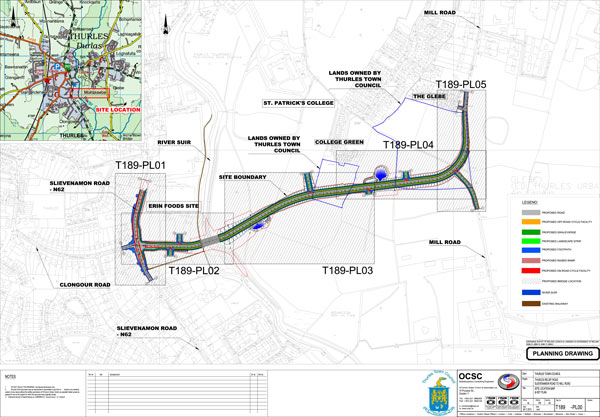
Speaking in Dáil Éireann the newly elected north Tipperary Fianna Fáil TD Mr Ryan O’Meara, has concurred that the town of Thurles is being strangled by traffic issues; requiring immediate attention for an inner relief road. Same, if funding was provided, would link the N62 at Slievenamon Road to the Mill Road, thus providing a third vehicle bridge.
Proposed Inner Relief Road for Thurles
[Funny that, VIEW HERE. Back in 2021, we here in Thurles were previously informed that funding had already been acquired.]
However, many residents believe that Mr Ryan O’Meara has been fed false or inaccurate information and most business leaders see the proposed inner relief road as further waste of public funding. An inner relief road already exists via the Mill Road, same entering and exiting south of Thurles at Turtulla Cross on the N62, which has seen 3 vehicles crash and be written-off, within the past 12 months.
Any new inner relief will only permit the exit and entering of vehicles closer into the town centre, with HGV traffic still required to travel to the four corners of Ireland, directly through our medieval streetscapes, which for the past 4 years have become a bottle neck, currently existing for all vehicles attempting to pass through Thurles town centre.
The only piece of common sense and perhaps even a small glimmer of hope was expressed by An Taoiseach, Mr Micheál Martin TD, responding to our misinformed, raw recruit, Mr Ryan O’Meara. Mr Martin stated that the long queues of traffic being experienced, would become a thing of the past, if Thurles had a ring road/bypass and he would try to feed that into an expected review of the present National Development Plan.
As for Fianna Fáil TD, Mr Ryan O’Meara’s speech interjection in Dáil Éireann; same was perceived and smelled of the scent of a vote catching press release, same greedily accepted from his Nenagh office by local press, who were obviously experiencing a slow news day.
This website uses cookies to improve your experience. We'll assume you're ok with this, but you can opt-out if you wish.AcceptRead More
Privacy & Cookies Policy
Privacy Overview
This website uses cookies to improve your experience while you navigate through the website. Out of these, the cookies that are categorized as necessary are stored on your browser as they are essential for the working of basic functionalities of the website. We also use third-party cookies that help us analyze and understand how you use this website. These cookies will be stored in your browser only with your consent. You also have the option to opt-out of these cookies. But opting out of some of these cookies may affect your browsing experience.
Necessary cookies are absolutely essential for the website to function properly. This category only includes cookies that ensures basic functionalities and security features of the website. These cookies do not store any personal information.
Any cookies that may not be particularly necessary for the website to function and is used specifically to collect user personal data via analytics, ads, other embedded contents are termed as non-necessary cookies. It is mandatory to procure user consent prior to running these cookies on your website.





Recent Comments