Scientific facts published by Local Authority Waters Programme (LAWPRO). See HERE.
Water Quality in River Suir in Thurles only 33% satisfactory down from 61% in 2010-2012 which equals a relative drop of 46% in about 12 years.
Almost no aquatic life.Samples taken down stream of Thurles Bridge in town centre (Barry’s Bridge) on 11/09/24, result in no invertebrates typical of clean water such as Mayflies or Stoneflies – essential food for trout and salmon.
A few water shrimps (Gammarus), some biting Midge larvae (Simuliium) Extensive Cladophora algae.
Current data raises a harsh question: if our drinking water is so delicately balanced, how much “extra load” can rivers accept without tipping into crisis?
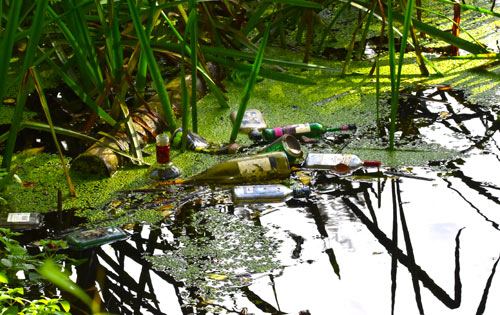
A small sample of floating bottles, River Suir, Thurles town centre. Pic: G. Willoughby. (Image taken Sept. 29th 2025)
Slurry Spreading: Tipperary’s Silent Pollution.
Hypocrisy is very much alive and well in Ireland, with the strict promotion of standards loudly proclaimed, yet quietly ignored when it comes to agriculture.
If an individual is caught illegally dumping a mattress or a bag of household rubbish, the law comes down hard. The penalties are steep: on-the-spot fines, €4,000 if convicted in the District Court, and up to €130,000 on indictment for more serious offences. Add to that the local authority’s investigation and legal costs, plus extra charges for continuing offences, and the message is crystal clear — thesepolluters will pay.
But here is the contradiction: when sewage or agricultural slurry is allowed to seep into our rivers, with the blessing of Tipperary Co. Council itself, the penalty is nothing, zero, zilch, no costs, no fines, no legal prosecution, and no accountability.
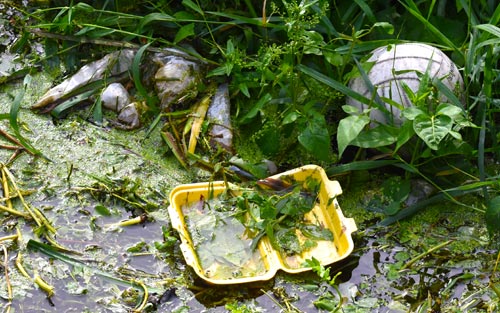
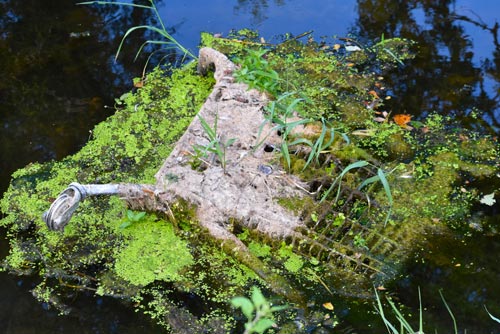
Just a small sample of the discarded litter at Barry’s Bridge, in River Suir, Thurles Town centre. Pic: G. Willoughby. (Image taken Sept. 29th 2025)
This double standard undermines public trust, punishes the ordinary citizen while shielding powerful interests, and leaves communities to live with the consequences — polluted drinking water, fish kills, and waterways turned into toxic drains. The rules are strict when it suits, yet curiously silent when the polluter is a farmer or an industry player with political influence.
Until agricultural slurry is treated as seriously as other forms of dumping, Tipperary and the rest of Ireland will continue to suffer the hidden, silent pollution that seeps into every stream and spring water well.
Tipperary was renowned for its rivers and lakes, the Suir winding through Thurles, the Shannon and its tributaries, and countless smaller streams supporting fish, wildlife, and local communities. Yet these waters are under increasing pressure, largely from the way slurry is managed on farms.
Slurry, a liquid mix of animal waste, provides a quick nitrogen boost to grass, making it popular among farmers. But its environmental costs are severe. Being liquid; slurry runs off easily during rainfall, carrying nutrients into rivers and lakes, triggering algal blooms, oxygen depletion and fish kills. Strong odours signal ammonia emissions, while heavy tankers compact soils, further increasing runoff.
By contrast, traditional dung releases nutrients slowly and enriches the soil with organic matter, improving structure, fertility, and biodiversity. Though slower to handle, it poses far less risk to water quality.
Evidence from EPA and Local Water Authorities The EPA’s 2023 report shows that many Irish rivers are failing to reach “good ecological status,” often due to nutrient pollution. In Tipperary, seven public water supplies, including Borrisokane, Nenagh, and Roscrea, are on the EPA’s Remedial Action List, meaning urgent improvements are needed. Dr. Fran Igoe from LAWPRO reports that water quality satisfaction in Tipperary has dropped from 61% to 33% over a 12 year period, with rivers around Thurles and Templemore particularly badly affected.
Voices from the Field Local anglers and fishing clubs have become strongly outspoken. Mr Joe O’Donoghue of Ormond Anglers says, “It’s doing untold damage to the river – the ecosystem is disappearing. Fly life we used to see in the evenings … it’s gone.” Inland Fisheries Ireland has prosecuted companies in Tipperary for slurry-related pollution. Ms Lynda Connor, regional director, states: “Ensuring clean and healthy water is not just a responsibility, but a necessity for the survival of fish and the ecosystems they thrive in.” Now the leading question “So why has Inland Fisheries Ireland not prosecuted Tipperary County Council for permitting sewage to flow into the River Suir?
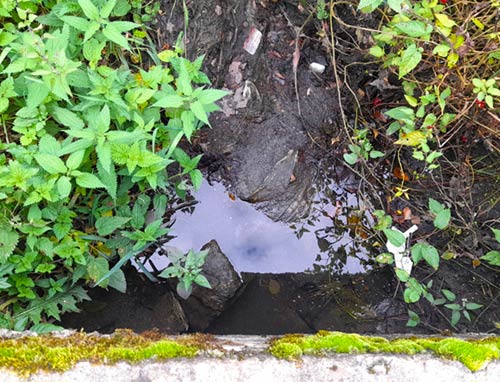
Mixed effluent flowing from a pipe on the river walk close to the rear of Thurles shopping centre. Pic: G. Willoughby (Image taken Sept. 29th 2025)
Time for Action. Tipperary as a county can no longer rely on excuses. The County Council, Uisce Éireann, and the Department of Agriculture must now act together and this will require:
Enforcement of slurry regulations with inspections and severe penalties.
Support for farmers to adopt safer alternatives, including dung use and low-emission spreading technologies.
An investment in water infrastructure, buffer zones, and monitoring.
An engagement with stakeholders such as anglers, environmental groups, and local communities in oversight and planning.
Short-term gains from slurry can no longer be allowed to outweigh the long-term damage to rivers, drinking water, and local ecosystems. Tipperary’s waters deserve decisive action now, before more fish die, more rivers are polluted, and the county’s natural heritage is irreversibly harmed.
Now regarding my last communication, which further updated details of the 12 year old River Suir pollution problem in Thurles; seven emails in total were sent 10 days ago, on Friday September 19th 2025 to:-
(1)Ms Sinead Carr(CE Tipperary Co. Council), [sinead.carr@tipperarycoco.ie]; ) Result: No Reply or acknowledgementreceivedto date.
(2)Ms Sharon Scully, (Thurles Municipal District Admin)[sharon.scully@tipperarycoco.ie]; Result: No Reply or acknowledgementreceived to date.
(3)Mr Darragh O’Brien (darragh.obrien@oireachtas.ie) (Minister for Climate, Energy and the Environment & Minister for Transport). Result: Correspondence acknowledged. (Ref: HPLG-MBO-03271-2025). Reply “Your correspondence is currently receiving attention and a further reply will issue as soon as possible”.
(4)Mr Alan Dillon (alan.dillon@oireachtas.ie) (Minister of State with responsibility for Small Businesses and Retail and Minister of State with responsibility for Circular Economy). Result: No Reply or acknowledgementreceived to date.
(5) Mr Timmy Dooley (timmy.dooley@oireachtas.ie) (Minister of State with responsibility for Fisheries, Minister of State with responsibility for the Marine). Result: Correspondence acknowledged. (Ref: CCAE-MOSD-00280-2025). Reply:“I would like to acknowledge your recent correspondence regarding Pollution of the River Suir. The contents of your email have been noted and I will bring this to the Minister’s attention and we will respond accordingly”.
(6)Environmental Complaints section EPA[E.Complaints@epa.ie], Result: Reply received as shown hereunder.
(7)Mr Robert O’Brien(A/Executive Scientist, Environment & Climate Action, Tipperary County Council, Civic Offices, Clonmel, Co. Tipperary).[robert.obrien@tipperarycoco.ie]. Result: Reply received as shown hereunder.
Hello George, You are correct to highlight the seriousness of the pollution of our rivers and the priority that must be given to public health and safety. Any immediate actions that could have been taken are completed. To address the overall issue and root cause will require a longer-term approach. The consultative process is not intended to be a talking shop, but this pilot study ensures accountability, coordination and long-term protection of the river and community. I appreciate this can be frustrating but reversing water quality decline often takes years to be realised. Any information you request must be formally applied for under the Freedom of Information Act 2014. Regards……….
‘We need to do more to protect clean air in towns, villages and cities across Ireland’ says EPA
Air quality in Ireland is generally good and was compliant with 2024 air quality standards, meeting all EU legal requirements.
It will be more challenging for Ireland to meet new and more stringent air quality limits that will come into force from 2030.
Clean air is essential for our health. Around 1,700 premature deaths occur in Ireland each year because of poor air quality.
The Environmental Protection Agency (EPA) has published its report, Air Quality in Ireland 2024, which is based on data from Ireland’s extensive air monitoring network of 115 stations. It reveals that while Ireland currently meets EU air quality standards, we are projected to fall short of the stricter air quality standards set for 2030 under the new Ambient Air Quality Directive.
The new EU Directive, part of the Zero Pollution Action Plan, aims to reduce premature deaths from air pollution by 55 per cent by 2030. Ireland faces significant challenges in meeting these targets, with projected compliance levels of only 93 per cent for fine particulates (PM2.5) and 78 per cent for nitrogen dioxide (NO₂). Ireland also continues to fall well short of achieving the more stringent World Health Organization (WHO) health-based 2040 guidelines for several key pollutants.
The primary sources of air pollution in Ireland are solid fuel burning and traffic emissions. The European Environment Agency estimates that in Ireland, more than 1,700 premature deaths annually are attributable to air pollution, with links to cardiovascular and respiratory diseases, dementia, type 2 diabetes and neonatal mortality. Vulnerable groups, including children and older adults, are particularly at risk.
Mr Pat Byrne, Director of the EPA’s Office of Radiation Protection and Environmental Monitoring, stated: “Many of us have grown up with the comfort of an open fire and limited alternatives to travelling by car—but these familiar habits contribute to poor air quality. Supporting people to shift towards cleaner heating and more sustainable travel isn’t about giving something up—it’s about gaining healthier air and healthier lives.”
Air pollution in Ireland is not confined to cities — towns and villages are also affected. The EPA website www.airquality.ie provides hourly-updated information on air quality and a 3-day air quality forecast. Having these online tools can help us make choices to protect our health during periods of poor air quality. Ms Roni Hawe, EPA Programme Manager for Environmental Monitoring and Surveillance, added: “Ireland is facing considerable challenges in its efforts to meet the more stringent air quality standards set for 2030, as well as the World Health Organization targets for 2040. Achieving these goals will require a decisive shift away from solid fuel burning, alongside the adoption of electric vehicles, efforts to reduce traffic and encouraging the use of public transport.” To find out more about how we can improve air quality read the EPA’s “How we can improve the air we breathe“infographic or check out the “Government of Ireland Clean Air“, which highlights some simple steps we can all make and help reduce pollution from solid fuels. The Air Quality in Ireland 2024 report is available on the EPA website HERE.
Ireland is predicted to miss targets for recycling municipal and packaging waste for 2025.
An additional 400,000 tonnes of recycling is needed to reach our targets.
Packaging waste generation has increased almost four times faster than recycling since 2016.
Plastic packaging recycling rate is just 30 per cent, significantly below the required target for 2025 of 50 per cent.
Construction waste is Ireland’s largest waste stream, reaching nine million tonnes in 2023.
The Environmental Protection Agency (EPA) has published its latest data on municipal, packaging and construction and demolition waste for the 2023 reporting year. EPA data shows that in 2023:
Ireland’s municipal recycling rate is 42 per cent, significantly below the 55 per cent target.
Ireland’s packaging waste recycling rate is 59 per cent and the 65 per cent target is at risk.
Ireland’s plastic packaging recycling rate is 30 per cent, significantly off the 50 per cent target.
While 1.3 million tonnes of municipal waste were recycled, this represents no improvement in recycling rates over the past decade. Investment in waste infrastructure is needed to reduce our reliance on overseas facilities with 1.2 million tonnes of municipal waste exported in 2023.
Opportunities to reduce, reuse and recycle valuable materials and resources are also being missed. Packaging waste generation is excessive, and our rate of waste generation is increasing more than we are increasing recycling capacity.
It is now almost certain that mandatory recycling targets that apply from 2025 will be missed.
Commenting, Mr David Flynn, Director of the EPA’s Office of Environmental Sustainability, EPA said: “Ireland’s waste generation is too high. Our report highlights that Ireland needs to make measurable progress on stalled recycling rates and reduce overall consumption. Ireland needs to recycle 400,000 more tonnes of waste each year than we currently do. To address this we need investment in recycling infrastructure and to stop exporting a significant amount of our municipal waste to other countries.”
Construction is the most wasteful sector with nine million tonnes of construction waste generated in 2023. As the industry grows, companies need to urgently prevent waste and maximise the use of recycled and recyclable products.
Commenting, Mr Warren Phelan, Programme Manager of the EPA’s Circular Economy Programme said: “Ireland’s economy uses significant raw materials producing valuable products and materials – but also lots of waste. If we are serious about moving to an economy which values resources and materials, we need to support innovation for low waste businesses as well as lean production, remanufacturing and circular supply chains. Materials and wastes are a cost to businesses, we need to value and retain materials, and our policies must incentivise circular businesses.”
The EPA’s national waste statistics are published on the EPA website HERE where more information on all of the waste streams is now available.
Communications update on pollution of the River Suir In Thurles town centre as received, up until today, September 23rd 2025.
Regarding my last communication updating details on the 12 year old River Suir pollution problem, four emails were sent on Friday last September 19th 2025 to:- Ms Sinead Carr(CE Tipperary Co. Council), [sinead.carr@tipperarycoco.ie]; Environmental Complaints section EPA [E.Complaints@epa.ie], Ms Sharon Scully, (Thurles Municipal District Admin) [sharon.scully@tipperarycoco.ie]; Mr Robert O’Brien(A/Executive Scientist, Environment & Climate Action, Tipperary County Council, Civic Offices, Clonmel, Co. Tipperary).[robert.obrien@tipperarycoco.ie]
To date we have received only two replies shown hereunder.
A reply from the Environmental Protection Agency, latter supposedly a public body responsible for protecting the environment in Ireland has sent the following email.
Dear Mr Willoughby, The EPA acknowledges receipt of your further correspondence relating to this matter. We have written to Tipperary County Council and await their response on any actions taken or planned regarding the matter. We will provide you with an update in four weeks. In the interim, we recommend you continue to report any further issues relating to this matter to Tipperary County Council. Please use the reference numberabove (COM021813) in any further communication with the EPA regarding this matter. Kind regards etc.
Today, I have received a reply from Mr Robert O’Brien, (A/Executive Scientist, Environment & Climate Action, Tipperary County Council, Civic Offices, Clonmel, Co. Tipperary), acknowledging my previous email sent on September 19th. We understand that Mr O’Brien who is on holidays since Friday last has also communicated as follows:-
Hello George, I acknowledge your email sent Friday 19th September. We need time to review your questions, and we will respond in due course. Kind regards etc.
My email sent to the above named on Friday last September 19th has now been sent to the following elected personnel this evening:-
Mr Darragh O’Brien (darragh.obrien@oireachtas.ie) (Minister for Climate, Energy and the Environment & Minister for Transport). Mr Alan Dillon (alan.dillon@oireachtas.ie) (Minister of State with responsibility for Small Businesses and Retail. Minister of State with responsibility for Circular Economy) Mr Timmy Dooley (timmy.dooley@oireachtas.ie) (Minister of State with responsibility for Fisheries, Minister of State with responsibility for the Marine).
Plans to build 60 new homes in Thurles, Co. Tipperary have been appealed to An Coimisiún Pleanála.
Tipperary County Council who had granted permission to O’Ceallaigh Westfield Ltd for a 60 home development on the Brittas Road, which would see 5 four-bedroom, 27 three-bedroom, and 12 one-bedroom houses built. Two duplex blocks were also proposed, providing eight additional units — four one-bed and four two-bed apartments, together with plans to include a creche with space for 47 children.
Marlstone Manor Residents Association have now appealed the granting of this permission to the Irish planning appeals board.
In a letter to An Coimisiún Pleanála, the group have stated that the development would raise concerns about traffic flow on the Brittas Road.
The appeal stated that the proposed entrance to the estate is on the N62 road, which links Thurles and Templemore, is a particularly busy corridor with agricultural, heavy goods and significant levels of commuter traffic.
The residents have also raised concerns about the potential for a “haphazard approach” of building works given that the 60 house development is the first phase of development at the site.
We understand that Tipperary County Council also granted permission for 52 further homes on the site as part of a second phase of works.
However, the Marlstone Manor Residents Association said that there is no agreement of a phasing of the development. This has the potential to allow for a haphazard approach to dwelling completions which would be driven solely by sales demand. They add that a partially completed development in such a haphazard way will not set a desirable precedent.
Despite their appeal of the development, the neighbouring residents say that they are aware of a significant need for housing, both locally and nationally.
An Coimisiún Pleanála are due to make a decision on the case by January 20th, 2026.
This website uses cookies to improve your experience. We'll assume you're ok with this, but you can opt-out if you wish.AcceptRead More
Privacy & Cookies Policy
Privacy Overview
This website uses cookies to improve your experience while you navigate through the website. Out of these, the cookies that are categorized as necessary are stored on your browser as they are essential for the working of basic functionalities of the website. We also use third-party cookies that help us analyze and understand how you use this website. These cookies will be stored in your browser only with your consent. You also have the option to opt-out of these cookies. But opting out of some of these cookies may affect your browsing experience.
Necessary cookies are absolutely essential for the website to function properly. This category only includes cookies that ensures basic functionalities and security features of the website. These cookies do not store any personal information.
Any cookies that may not be particularly necessary for the website to function and is used specifically to collect user personal data via analytics, ads, other embedded contents are termed as non-necessary cookies. It is mandatory to procure user consent prior to running these cookies on your website.





Recent Comments