In 2022 local press and radio raised the issue regarding over growth, algae, and the wholesale neglect of the River Suir in Thurles, by Tipperary Co. Council.
In a press release, back then, the local authority confirmed that plans were currently being developed in conjunction with Inland Fisheries, LAWPRO and the OPW River Drainage, to carry out maintenance works on the local River channel in an effort to mitigate potential flooding. In tandem with this work the above named organisations claimed, according to the local authority, that same would look to enhance the area down-stream of the Barry’s Bridge crossing in Thurles, including the installation of deflectors, which supposedly would eradicate algae bloom.
Thurles.Info had highlighted this problem as early as November 2013; almost 12 years preciously, yet to-date nothing has happened, other than reed cutting just days before the last two local elections; which saw trimmed Reeds, Rushes, Switch grass and Sedges left to float and rot in the water, while blocking areas further downstream.
In January 2024, a Local Authority Waters Programme (LAWPRO) representative informed Nenagh Municipal District councillors, of a major decline in the water quality of Tipperary’s rivers and streams. Ms Catherine Seale-Duggan, the newly appointed Community Water Officer with LAWPRO warned that the quality of watercourses in Co. Tipperary had dropped “substantially” and “worryingly” over the past 10 years.
Ms Seale-Duggan further confirmed then, that only 1/3 of rivers in Tipperary were in the category of “Good and High Status”, whereas ten years previously almost 2/3 of the counties rivers fell into that same stated category.
A small number of pictures taken on Sunday last, must surely highlight the present need for immediate action in relation to the cesspool that is the river passing through Thurles. The stench/odour which presents itself to the nostrils of those walking in the area between the Swinging Gates and Thurles Shopping Centre for the past number of years, must now be immediately be eradicated.
In January 29th of 2024, a Local Authority Waters Programme (LAWPRO latter first setup in 2016), representative informed Nenagh Municipal District councillors, of a major decline in the water quality of Tipperary’s rivers and streams. Biologist and spokesperson Mr Fran Igoe, agreed that what is happening in Thurles and the river Suir is ‘shocking‘. On that same date, now 17 months later, Mr Igoe stated that test results showed that while one should expect to find a broad range of aquatic insects and bugs, he could only find two species in our river Suir.
Local councillors back 17 months ago were talking of a plan which was to be drawn up by July 2024. Since then with the situation has become totally unacceptable, with the local electorate not aware of any future possible solution.
So what is this white substance trapped in reeds on the surface of the river water?
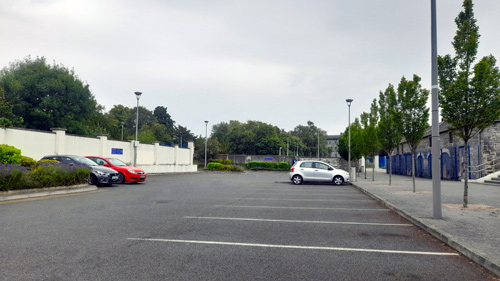
In early September 2024, we wrote that in recent weeks we had watched 10 mature trees being ripped out from their allocated space, in the now closed ‘The Source’ car park. Same were re-sown close by, behind Thurles Swimming pool.
10 trees removed from ‘The Source’ car park.
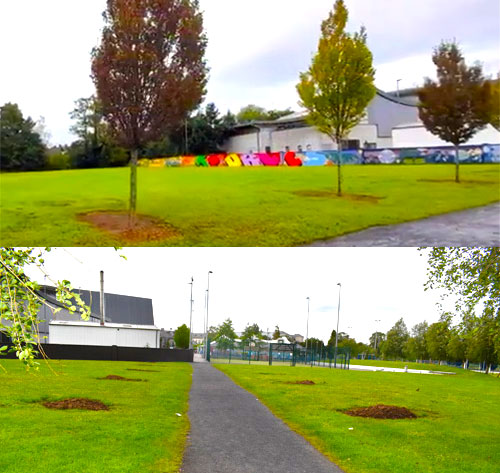
Sadly the outer bark and the roots of these 10 mature trees were extensively damaged by heavy machinery, used to rip apart the tree heel mesh grills at their base. We forecast then that at least two of these 10 mature trees were unlikely to survive the coming winter. It would now appear that all ten of these trees, so savagely uprooted, have vanished without trace, leaving behind small hillocks of bare earth. (I hasten to add not the work of Beavers or giant Moles).
Thurles Park – “Going, Going, Gone”.
But then another shock! The costly mural, lauded by local councillors, (who had suffered a bad announcement week), has also vanished from the same area.
We were aware that in their annual report in 2019, ‘Tidy Towns’ judges had been rather critical of this art work; unjustifiably so to my mind, again positioned to the rear end of Thurles Swimming pool. Their report had stated, quote – “with all due respect there are parts of the mural that look as if they were done by a graffiti artist”.(Obviously a prominent, leading, art critic was in their midst.)
It has taken until 2025, (six years later), to have this mural painted over, using a colour identified by locals as being “Rectum Defecatious”, same an inspirational neutral brown colour, but as yet not unveiled on this years ‘Colourtrend‘ colour card. Same colour I understand was chosen to reflect the hue projected by the River Suir from Barry’s Bridge, latter situated in the centre of Thurles town.
WARNING: Residents, with things vanishing without electors knowledge, do be very careful travelling through this area of Thurles Park, especially at night.
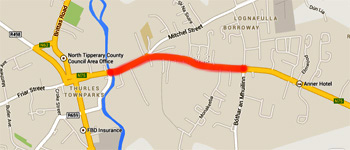
It has taken 7 years for the state agency known as Transport Infrastructure Ireland(TII) to locate funding for a 1200 metres stretch of the busiest section of roadway in Thurles, Co. Tipperary.
1200 metre stretch Of Kickham Street (N75) shown in red.
Despite two Teachtaí Dála (Dáil Deputies), namely MrMichael Lowry and Mr Jackie Cahill, latter both with constituency offices in Thurles town; combined with the mission statement by TII claiming, quote: “Our mission is to provide high quality transport infrastructure and services, delivering a better quality of life and supporting economic growth”, a 1200 metre stretch of the N75, gained limited attention for the past seven years.
Issues on the busy roadway, best known locally as Charles J. Kickham Street, were first raised in January 2021, by Thurles.info, and sadly resulted in the wasteful practice of large water-filled potholes being topped up, every couple of days, using cold tarmac. (View Here).
The issue was again raised on no fewer than 14 seperate occasions beginning between February 2021 and March 2024. We even highlighted where most of the cold tarmac gravel could be located, after it was dislodged hours later from newly filled potholes (View Here).
The 7 year abject failure to have issues improved, forced local residents to refrain from painting the exterior of their homes, due to attacks from flying stones and dirty, filthy water; same water which today still flows down the street’s centre like a shallow river, due to the lack of basic drainage and blocked shores. Despite consistent serious flooding, and complaints highlighted, still no response came from our idle councillors, local officials and lazy resident politicians. In last year’s local elections, the Thurles electorate who bothered to vote, returned all of these double jobbing individuals back into office.
See links hereunder which raised the issues of neglect with regard to route N75.
In the last fortnight one local councillor, Mr Jim Ryan, announced on local radio that TII, after 7 years, had no funding for this N75 project, yet Thurles.Info and Tipperary County Council had already been notified that funding had been sanctioned.
Today, it was officially confirmed to the general public that funding has been secured for this Thurles Kickham Street Improvement Scheme, but now 7 years later, we are none the wiser as to when or what year this same project will eventually commence.
Work proposed for this future upgrade will supposedly include:
Road re-surfacing for a distance of approximately 1200m.
Footpath improvement works at defined locations.
Improvements to existing surface water drainage to alleviate existing surface water drainage issues.
Traffic calming works.
Improved pedestrian facilities including installation of additional uncontrolled pedestrian crossings.
Provision of revised road signage and markings.
Narrowing of carriageway running lanes to 3.25m wide (10.66273ft) on the mainline N75 approaches to the Mill Road roundabout.
Minor design change to existing layout of Mill Road roundabout.
Minor realignment of a section of N75 mainline carriageway to facilitate roundabout improvements.
As well as “Justice” and “The mills of the gods”; we can now confirm that the wheels of “Tipperary Co. Council” and “TII” also grind exceedingly slowly.
Major new EPA report assesses Ireland’s vulnerability to climate change impacts.
The EPA has today published the National Climate Change Risk Assessment which provides the first comprehensive assessment of where, when and how climate risks are likely to impact Ireland over the coming decades.
The National Climate Change Risk Assessment provides government, business, communities and other stakeholders the best available evidence and analysis to inform climate adaptation and resilience in Ireland at a national level. The National Climate Change Risk Assessment identifies 115 risks from projected changes in climate conditions, including in energy, transport, communications, water security, public health, food production and supply and ecosystems.
The significant risks identified by the report as requiring urgent action within the next five years are:
The risk of disruption and damage to communications and energy distribution infrastructure due to extreme wind.
The risk of disruption and damage to buildings and transport infrastructure, due to extreme wind, coastal erosion and coastal flooding.
The Environmental Protection Agency (EPA) has today published the findings of Ireland’s first National Climate Change Risk Assessment (NCCRA). This major study was undertaken by the EPA in collaboration with government departments, state agencies, and other stakeholders to assess where, when and how climate risks are likely to impact Ireland over the coming decades.
The National Climate Change Risk Assessment provides government, business, communities and other stakeholders with the best available evidence and analysis to inform climate adaptation and resilience in Ireland at a national level. The risk assessment will support the development of Sectoral Adaptation Plans by key government departments, will guide the development of local authority adaptation plans and inform other national level adaptation responses.
The Risk Assessment identifies 115 risks from projected changes in climate conditions. Of these, 43 are deemed significant risks. The risks span all sectors of our economy, society, and environment from energy, transport and communications to water security, public health, food production and supply and ecosystems.
Speaking about the report, Ms Laura Burke, EPA Director General said: “We know that Ireland is being impacted by climate change already. This comprehensive assessment highlights the need for additional urgent action to ensure Ireland is sustainably resilient to the risks that we currently face, and will increasingly experience, in the coming decades.”
She added: “This report, the first National Climate Change Risk Assessment, clearly shows how risks cascade across sectors. Recent events, such as Storms Darragh and Éowyn, demonstrated how damage to critical infrastructure such as energy, water supply, transport and communications networks in turn give rise to impacts on human health, biodiversity and the financial system. Addressing these risks in an integrated and consistent way is key to achieving our national climate resilience objective.”
The significant risks identified by the report as requiring urgent action within the next five years are: (A) The risk of disruption and damage to communications and energy distribution infrastructure due to extreme wind. (B) The risk of disruption and damage to buildings and transport infrastructure due to extreme wind, coastal erosion and coastal flooding.
Additional significant risks that should be prioritised for further investigation in the next five years include risks to the built environment and human health from flooding and heat.
Commenting on the report, Dr Eimear Cotter, Director of the EPA’s Office of Evidence and Assessment, said: “Assessing climate risk is a key component of risk management and strategic planning. The National Climate Risk Assessment underscores the need for immediate action in the next five years to enhance the resilience of Ireland’s critical infrastructure to climate change. The risks with the most consequential and highest urgency ratings relate to extreme wind, coastal erosion and coastal flooding. These must be prioritised in adaptation and resilience actions to address climate risks and provide a basis for ensuring adaptation planning in Ireland is appropriately integrated across sectors.”
Environmental Protection Agency (EPA) Projections Show Ireland Off Track for 2030 Climate Targets.
Ireland is projected to achieve a reduction of up to 23 per cent in total greenhouse gas emissions by 2030, compared to a National target of 51 per cent.
To achieve a reduction of 23 per cent would require full implementation of a wide range of policies and plans across all sectors and for these to deliver the anticipated carbon savings.
The first carbon budget and second carbon budget are projected to be exceeded with almost all sectors on a trajectory to exceed their national sectoral emissions ceilings for 2030.
Ireland will not meet its EU Effort Sharing Regulation target of 42 per cent reduction by 2030, instead a maximum reduction of 22% is projected.
Total emissions from the Land Sector are projected to increase by up to 95% and Ireland is unlikely to meet our European commitments in this area.
EPA analysis shows that planned climate policies and measures, if fully implemented, could deliver up to 23 per cent emissions reduction by 2030 compared to 2018, down from the 29 per cent reduction projected last year. This widening gap to the emissions reduction target of 51 per cent in Ireland’s Climate Act is driven by updated information provided by Governmental bodies.
The first Carbon Budget (2021-2025) of 295 Mt CO2eq is now projected to be exceeded by between 8 to 12 Mt CO2eq. The second budget is now projected to be exceeded by a significant margin of 77 to 114 Mt CO2eq, including carryover from the first Carbon Budget.
Transport, Industry and the Buildings (Residential) sectors are projected to be the furthest from their sectoral emission ceilings in 2030, with emission reductions of up to 21%, 12% and 22% respectively. Agriculture emissions are projected to reduce by up to 16%. A direct comparison of the Agriculture sector against its Sectoral Emission Ceiling is no longer viable due to the impact of updated science underpinning the estimated agriculture greenhouse gas emissions.
Ms Laura Burke, Director General, EPA said: “The EPA’s projections show that full delivery of all climate action plans and policies could deliver a 23 per cent reduction in greenhouse gas emissions. Although emissions trends are going in the right direction, the gaps to our European and National emission reduction targets are now projected to be larger than last year. This highlights the economy-wide effort needed to decarbonise our society and the focus must shift from policy aspiration to practical implementation.”
Ms Burke added: “As we get closer to 2030 and receive more information on the impact of agreed policies and measures, it is concerning to see projected reductions and lack of progress in the delivery of actions to reduce emissions including in the electrification of our transport sector and the expansion of renewable electricity powering our homes and businesses and the implementation of carbon reduction measures in agriculture. Momentum is building for Ireland’s low carbon society, but we need to accelerate it and scale up the transition.”
Agriculture Depending on the level of implementation of measures outlined in Climate Action Plans, AgClimatise and Teagasc MACC, total emissions from the Agriculture sector will range from a 1 per cent increase to a 16 per cent decrease over the period of 2018 to 2030. Savings are projected from a variety of measures including limits on nitrogen fertiliser usage, switching to different fertilisers and bovine feed additives.
Transport Emissions from the sector are projected to reduce up to 21 per cent over the period 2018 to 2030 if the measures set out in plans and policies are implemented. These include over 640,000 electric vehicles on the road by 2030, increased biofuel blend rates and measures to support more sustainable transport. Road freight is projected to be the biggest source of road transport greenhouse gas emissions by 2030.
Residential Emissions Emissions from the sector arise from fuel combustion for domestic space and hot water heating. These are projected to decrease by up to 22 per cent by 2030. Emission reduction measures in this sector include 571,000 domestic heat pumps are projected to be installed by 2030. Industry Fuel combustion in manufacturing is the primary source of emissions in this sector; process emissions from mineral, chemical, and metal industries contribute the next largest portion. Emissions from this sector are projected to reduce by 12 per cent over the period 2018 to 2030 with full implementation of measures including the accelerated uptake of carbon-neutral heating technologies for low and high temperature heating, and increased use of biomethane.
Energy Driven by a reduction in fossil fuel usage and increased net importation of electricity from interconnectors, there was a marked drop of over 21 per cent in emissions from electricity generation between 2022 and 2023. In combination with planned increases in renewable energy generation from wind and solar, energy sector emissions are projected to reduce by up to 68 per cent (over the period 2018 to 2030) and are projected to achieve over 68 per cent renewable electricity generation by 2030.
Land use Emissions from this sector are projected to increase between 39 per cent to 95 per cent over the period of 2018 to 2030 as our forestry reaches harvesting age and changes from a carbon sink to a carbon source. Planned policies and measures for the sector, such as increased afforestation, water table management on agricultural organic soils and peatland rehabilitation are projected to reduce the extent of the emissions increase.
Commenting, Ms Mary Frances Rochford, Programme Manager said: “The Agriculture sector has made some progress in reducing emissions through the successful rollout of actions on nitrogen fertilisers, low emission spreading technologies and national liming programmes. In parallel, in line with new research, the EPA refined the information underpinning the agricultural figures which has led to a reduction in the overall agriculture emission estimates. It is imperative that this new research and information is incorporated into updated carbon budgets and sectoral ceilings to ensure that they reflect latest science, data and knowledge on greenhouse gas emissions in Ireland and alignment with the national reduction target for the sector of 25%.”
This website uses cookies to improve your experience. We'll assume you're ok with this, but you can opt-out if you wish.AcceptRead More
Privacy & Cookies Policy
Privacy Overview
This website uses cookies to improve your experience while you navigate through the website. Out of these, the cookies that are categorized as necessary are stored on your browser as they are essential for the working of basic functionalities of the website. We also use third-party cookies that help us analyze and understand how you use this website. These cookies will be stored in your browser only with your consent. You also have the option to opt-out of these cookies. But opting out of some of these cookies may affect your browsing experience.
Necessary cookies are absolutely essential for the website to function properly. This category only includes cookies that ensures basic functionalities and security features of the website. These cookies do not store any personal information.
Any cookies that may not be particularly necessary for the website to function and is used specifically to collect user personal data via analytics, ads, other embedded contents are termed as non-necessary cookies. It is mandatory to procure user consent prior to running these cookies on your website.







Recent Comments