|
|
 It is not often you get a chance to have your say nowadays living in a ‘Nanny Republic’ as we do. However Europe Direct Ireland are inviting you to enter a national soapbox competition and by doing so, win some fantastic prizes!
To highlight the importance the European Union places on ‘Climate Change’ they are holding a soapbox competition on “Wind energy – the future or a blot on the landscape?”
You will have a chance to share your views and to win some fantastic prizes. Regional finalists will win an iPad, a trip to Brussels and will be entered for the National Final with a prize of €1,000. Soapbox events will be held in 7 regional locations followed by a national final in Farmleigh, Dublin on 19th November 2010.
Your 3 minute speech will be less impromptu – you will get to research it and prepare it in advance. The topic is wind energy, so like it or loathe it, agree or disagree, wind farms generate a lot of controversy, as well as potential energy.
They want to hear your views! You will deliver your speech at your local Europe Direct Centre, at an event in November in front of a local audience and a panel of judges who will include someone with an expertise on the subject – so do your research!
Your local Europe Direct Information Centre is at the Source Library, Cathedral St., Thurles, Co. Tipperary. They are holding their regional final on Friday 12th November at 7 p.m. and this event will be chaired by Alan Kelly M.E.P.
There will be also be runner-up 2nd and 3rd prizes of €150 and €100 respectively to be won.
To help get your thinking cap on, they will be holding information sessions with the Tipperary Energy Agency in Nenagh Library (19th October, 12.30 p.m.), Thurles Library (19th October, 6.30 p.m.) and Clonmel Library (28th October, 6.30 p.m.).
They will also be paying a visit to a working wind farm, at Ballinveny near Templemore, on Friday 22nd October at 2.30 p.m.. This free trip is open to all but booking is necessary. Why not call Thurles Library on 0504 29720 to book your place now.
You can pick up an entry form in any of the public libraries in Tipperary or enter online at www.europedirect.ie.
 Deputy Noel Coonan has welcomed the news that last Friday’s deadline for receiving applications under the Warmer Homes Scheme has been extended.
Due to a large demand for the scheme, no closing date has been decided for acceptance of forms. The local Fine Gael TD said North Tipperary people can still apply by ringing his office on 0504 32544 or contacting Sustainable Energy Ireland on 1800 250 204.
“My constituency offices have been inundated with queries about the scheme and in my conversation with Sustainable Energy Ireland I was informed last week that last Friday’s deadline was scrapped. This is welcome news for people who were anxiously trying to apply before week’s end,” said Deputy Coonan.
The Warmer Homes Scheme aims to improve the energy efficiency and warmth of homes that are lived in by people on low incomes. It is operated by the Sustainable Energy Authority of Ireland (SEAI), Ireland’s national energy agency. To qualify, you must live in a privately-owned home and be eligible for fuel allowance. A standard cost of approximately €150 may be charged for the work with the rest covered by the scheme.
Regional and community-based organisations are funded to carry out the work, which includes:
• Attic insulation
• Draught proofing
• Lagging jackets
• Energy efficient lighting
• Cavity wall insulation
• Energy advice.
 Teagasc Agri Environment Conference 2010 in Tipperary On September 7th next at Ballykisteen Hotel, Tipperary, the Teagasc Agri-environment Conference 2010 will provide a forum for those working in the agri environmental arena to receive an update on the most topical environmental issues affecting agriculture in Ireland today.
This is a departure from previous conferences (formerly known as the National REPS Conference) in the sense that discussions will not be limited to agri-environmental schemes.
The Conference will focus on practical outcomes from current agri-environment research, advisory experience as well as examining policy drivers and their potential impacts.
This year’s event will comprise an indoor conference in the morning followed by a farm walk on the Solohead Research Farm in the afternoon. The morning conference will hear from experts on environmental research and policy while the afternoon farm walk will consist of a number of stations located on the Solohead Research Farm which will provide delegates with a practical insight into the work carried out by Teagasc Environmental Programme.
Amongst the subject matter for discussion is included:-
Fertilizer Use in Ireland – “Getting the Balance Right” – Speaker Mr Stan Lalor, Research Officer, Teagasc, Johnstown Castle.
Phenology – ” How Natural Cycles of Wildlife are Changing” – Speaker Dr. Alison Donnelly, Botany Department, Trinity College Dublin.
The keynote address will be delivered by broadcaster Duncan Stewart on the topic “Sustainability in Agriculture – Rising to the challenge.”
This year the afternoon session will be in the form of a farm walk at the Solohead Research Farm which is located five minutes from the Ballykisteen Hotel. Due to parking restrictions, delegates will be transported by coach to and from the farm. Delegates are therefore advised to bring suitable footwear and clothing for the farm walk.
Conference Fee is just €80 per person which includes refreshments and lunch. Click here for on line booking form.
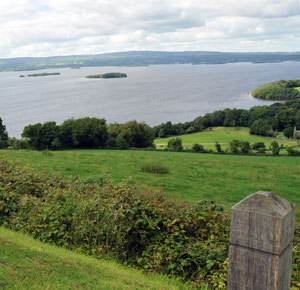 Part of the beautiful Lough Derg shore line viewed from Co.Tipperary Branches of the Shannon Protection Alliance in Nenagh, Co Tipperary and Athlone Co. Westmeath have welcomed the setting up of a further lobby group in Limerick, which oppose the plan to extract millions of litres of water from Lough Derg’s shoreline in Co.Tipperary. This new opposition comes as a result of Dublin City Council unveiling plans to extract 500 million litres of water from Lough Derg to supply the greater Dublin region.
This controversial plan would envisage water being extracted at a rate of 500 million litres per day from an extraction point, possibly to be constructed at Terryglass, a village situated in North Tipperary.
Dublin City Council plans to pipe this water to Garryhinch Bog in Co. Offaly, where it intends to design “an innovative water based eco-park with fishing, boating, cycling, water and leisure sports on 500 acres, with a major water storage reservoir.”
The council expect that the water stored at this reservoir will not only be a new water source for the greater Dublin area, but will also supply counties Westmeath, Offaly, Meath, Wicklow and Kildare.
The project is set to cost €540m and will create an estimated 1,000 construction jobs over three years as well as generating ongoing, sustainable, long-term jobs in the Midlands in the management of the eco-park activities and a water plant.
Originally the plan was to extract the water from Lough Ree, but following massive public pressure from local communities in Athlone and despite the fact that the distance between Athlone and Dublin is shorter than that between Lough Derg and our capital city the vision has now changed, with Lough Derg becoming the favoured target for this extraction point.
Opposition to Dublin City Council’s vision for North Tipperary has been relatively muted, when compared to the military precision of organised opposition mounted from the Lough Ree area, where groups marched on our Dail last year demonstrating strong resistance to taking water from their local pond.
Continue reading Lough Derg To Supply Dublin’s Water ?
 Phytophthora Ramorum or Sudden Oak Death IRELAND’S trees could soon be under serious attack from a recently identified deadly disease, which experts have warned, poses a huge threat to Irish biodiversity and could spell disaster for the country’s few remaining native forests.
The Department of Agriculture confirmed this week that it was investigating an outbreak of the fungal disease phytophthora ramorum, (Common Name – Sudden Oak Death) which so far has affected only a small number of Japanese larch trees, Beech trees and Noble Fir trees in the Tipperary/Waterford region.
The department further confirmed that the disease had also been found in Northern Ireland and it was liaising closely with the North’s Department of Agriculture and Rural Development. The Japanese larch variety represent 3% of the total tree population in Ireland and it is believed that the disease may have spread from the US, where it killed millions of trees, travelling first to Britain and then into Ireland.
The outbreak of this fungus, which is related to the potato blight, Phytophthora infestans , could pose a particular threat to the 1% of Ireland’s remaining precious oak forests if Irish oaks proved susceptible to the strain. It would also have a disastrous effect on plantations of single tree species and eventually effect on the insects and birds life that these trees support. Tourism could also be effected with scenic areas being prohibited to visitors as part of controls.
Phytophthora Ramorum was first discovered in California in 1995 when large numbers of Tanoaks died mysteriously. This disease which can be transmitted by wind and rainwater, also infects a great number of other plant species, significantly rhododendrons, causing a non-fatal foliage disease commonly known as ‘ramorum dieback’.
The disease is a fungus-like organism and its spores enjoy 100% survival rates at temperatures of 0°C and 20°C. The first recognisable symptom is a burgundy red or thick black sap liquid, bleeding from cankers on the tree’s bark surface. The disease trives in cool, wet climates.
Just one of the major mechanisms of dispersal for this fungus, is rainwater splashing its spores onto other susceptible plants and into watercourses. Over use of man made drainage schemes, which must take responsibility for a great deal of recent flooding in Ireland, can insure spores can be carried for great distances. Hikers, mountain bikes, those involved in equestrian persuits and people engaged in other various outdoor activities, may also unwittingly move the pathogen into unaffected areas. In most cases, cleanliness practices involve the cleaning of all potentially infested surfaces of all foliage and mud, before leaving an infested area, e.g. shoes, transport vehicles and animals, etc.
Interesting to note that phytophthora ramorum (Phytophthora comes from the Greek word phytón, meaning ‘plant’ ), the relative of phytophthora infestans or Potato Blight, was one of more than seventeen agents researched by the United States as potential biological weapons, before it suspended its biological weapons program, latter completed in 1973.
|
Support Us Help keep Thurles.info online by donating below. Thank you.
Total Donated 2026: €300.00
Thank You!
Daily Thurles Mass Livestream
|



Recent Comments