|
|
 Casino Gambling Architect Mr Brian O’Connell told the third day of An Bord Pleanála’s hearing into the Tipperary Casino proposed for Two Mile Borris that the project “is predicated on the licensing regime” and would depend on the present Government’s decision regarding the upgrading of Casino Laws. “There’s a new economic opportunity within the market for providing conference facilities within a casino hotel, the one wouldn’t proceed without the other” he stated.
However, he confirmed this would not affect the rest of the proposed complex, as the horse-racing aspect of the project is supported by Horse Racing Ireland, which invited expressions of interest for the development of an all-weather track in the Munster region some years ago. Existing tracks in Thurles and Tipperary (Limerick Junction) are expected to close, if this Tipperary Venue now is given the green light.
During questioning by sustainable planning expert and barrister James Nix, representing An Taisce, Mr O’Connell stated that the urban locations of venues such as the O2 in Dublin and the Odyssey Arena in Belfast were “inappropriate“, due to the influx of large numbers of people flooding into an urban setting for a short period of time. This situation now offered “strong argument” for the building of such venues outside existing city locations.
North Tipperary County Council granted planning permission for the project last year but the case was appealed to the board by some local residents and An Taisce who expressed concerns, include the level of traffic generated by this venue. Other concerns include noise, carbon emissions, helicopter use, the distance from public transport and the sustainability of such large-scale development.
However, presently across Europe, cash-broke governments have the impression that their way to reduce widening budget defecates are by taking up online gambling, a source of revenue they once viewed with justifiable distrust. Lot of European countries are currently planning to legalize online gambling and these include Greece, Switzerland, Spain, Germany, Denmark and France. Europe is the biggest online gambling market in the world and when this business is properly taxed, it will yield billions of euros to State coffers each year.
Presently large numbers of gamblers are being attracted towards Online Casino’s for the playing of Internet Poker and are moving sharply away from the land based Casino’s, as proposed for Two Mile Borris, Thurles, Co.Tipperary. This is since tax liability, in land based Casino’s is high and most of the offshore Online Casino’s remain out of reach of the dreaded tax collector. European governments are trying to bring this now indistinguishable business into the mainstream, by regulating and taxing them and bringing back worsening finances.
The Council of the European Union last December in their ‘Conclusions on the Framework for Gambling and Betting in the EU Member States,’ reminded us that major financial contributions, in particular from State Lotteries or Lotteries licensed by competent state authorities, play an important role in society, via for example the funding of good charitable causes, as presently with our ‘National Lottery’. People have only, even in the best of times, limited funds for gamboling. Their is now a real fear of the destabilizing of our state sponsored lottery, by allowing small monopolies and private gambling operators to hijack this arena, without considering the well being of all our citizens, particularly under the guise of providing imaginary future employment and at any cost.
It is interesting also to note that those now pushing this agenda are amongst those that benefited greatly from exceptional treatment, doled out during the ‘Celtic Tiger’ era, namely those in the Horse breeding industry, e.g. “covering fee,” which the European Commission have now deemed as an illegal form of state aid.
The hearing concluded yesterday, and a decision is expected by the end of this month.
Councillor John Hogan (Moyne) has stated that the community of Moyne/Templetuohy are very concerned over the future of the Lisheen Mines and of the environment in the locality.
Mr Hogan stated: “I wrote to the C.E.O. of Anglo American, Ms. Cynthia Carroll, expressing the communities concerns over the terrible reputation that Vedanta Resources have in India. Amnesty International has written an in depth report on human rights and serious environment violations carried out by Vedanta Resources. The company also had the Tuticorin Smelter in India closed by the Indian courts. According to the Indian Judges Vedanta Resources violated the company’s operation permissions from the Tamil Nadu Pollution Control Board. In their verdict, Judges said the smelter was emitting noxious air pollution, that the plant’s effluents were hazardous and caused high levels of heavy metals, arsenic and fluorides in the groundwater and that the entire plant site was now “severely polluted”.
Another example of our fears in June 2009 a prestigious World Environmental award the “Golden Peacock” was withdrawn at the last minute after
demonstrators protested about the company’s highly polluting alumina refinery on the land of Kondh tribes in Orissa, India. Government pollution inspectors have commented on the ‘alarming’ and ‘continuous’ seepage of toxic waste from the refinery. Kondh people living near the refinery have told Survival International that they have suffered skin problems after bathing in polluted water, that their crops are choked by dust from the refinery and that cattle have died after drinking from polluted streams.”
Councillor Hogan added: “So far I have received a reply from Mr. Hennie Faul, Chief Executive Officer Zinc with Anglo American. Mr. Faul chose not to answer any of the allegations in connection with Verdanta Resources and instead stated that the costs associated with the Mine closure and rehabilitation plan, as well as the perpetual aftercare of Lisheen Mine are fully secured. This reply from Anglo American has added to the community fears, firstly because they sold us out to a company with issues that Anglo American are not willing to comment on. Also Anglo American are disingenuous in claiming that perpetual aftercare costs of Lisheen are secure when as a stake holder our community has not even entered discussions on the perpetual aftercare.”
Moyne/Templetuohy Community Parish Forum are meeting next Monday night to discuss and decide a future plan of action in relation to these issues.
Fine Gael TD Noel Coonan today contacted Minister for Communications Pat Carey TD, asking him to further clarify the situation regarding Lisheen Mines.
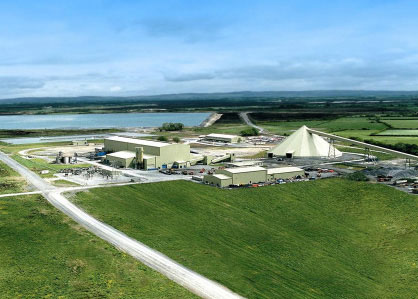 Lisheen Mine, Moyne, Co Tipperary Newspaper reports suggest that owners, Anglo American are putting huge pressure on Minister Pat Carey to finally approve the mining company’s planned sale of Lisheen Mines, before the dissolution of the Dail tomorrow.
Anglo has indicated that it plans to sell the zinc mine to Indian company Vedanta for €308m. However, Deputy Coonan said there have been widespread concerns about Vedanta’s poor environmental and human rights record.
The Tipperary North / South Offaly TD said: “I contacted Minister Carey and the Secretary General of the Department of Communications and Natural Resources to convey my concern about the sale of Lisheen Mines. Serious questions have been raised at the highest political level about Vedanta’s record in other countries. My fear is that the musical chairs in Cabinet at the moment could put at risk not only the future of the mines, which employs around 370 people, but also the future of the local environment.”
Deputy Coonan further stated: “The Department has informed me this afternoon that any sale will be ‘conditional on the new owners continuing to ensure strict compliance with the terms of the State Mining Lease and all other statutory permits and enactments, including the planning permission and Integrated Pollution Prevention and Control Licence (IPPCL), not only during the remaining life of the mine but also in its closure, restoration and aftercare.’
The future of Lisheen Mines is something which I have campaigned on throughout my political career. It is vital that this is not put in jeopardy, by the current political paralysis in Government. Lisheen mines must to be safeguarded.“
There have been calls for further investigation in to the Company which is set to take over Lisheen Mines, near Moyne, Thurles, Co Tipperary.
Ministerial approval is currently being sought by Anglo American and Hindustan Zinc Ltd, a division of the Indian mining conglomerate Vedanta Resources plc.for the transfer of the mining leases.
However, locals as well as some of the workers at the Lisheen mines have expressed grave concern about the companies previous operational behaviour, which, last Feburary 2010, was criticised by Amnesty International, for its safety and environmental record in India, as well as its treatment of indigenous people.
Indian owners of the Vedanta Resources Division, earlier last year, purchased the Tipperary zinc mine along with other bigger mines in South Africa and Namibia from previous owners Anglo American Zinc as part of a €1.34bn deal, latter which estimated Lisheen’s value at €242m. Vedanta won out in a bidding war with the Anglo-Swiss mining group Xstrata and China Metallurgical. However, London analysts are speculating that the FTSE listed Vedanta could seek to sell on Lisheen quickly, with one possible buyer being discussed, rival Xstrata which Verdanta outbid, which has a joint lead and zinc venture with Minco at Pallasgreen, on the border between counties Limerick and Tipperary.
A number of Lisheen’s 370 workers have aired genuine concerns regarding the eco-sensitive nature of the Lisheen Mines site.
Concerned workers state: “We would like it confirmed that our new owners have plans to protect the local environment, the life of this mine is finite and the plan is to continue mining here at Lisheen only until 2013, before we begin closure. Lisheen is presently one of Ireland’s most eco-sensitive mining sites”
The environmental fears of Lisheen workers have been aggravated by the Vedanta chairman, Anil Agarwal, who told reporters at a press conference in London recently that the company is looking at “debottlenecking” or removing obstacles that are presently preventing the mining process from being more efficient or workable, at the Anglo American Lisheen Zinc mine.
Amnesty International have claimed people living near the Lanjigarh refinery in Orissa breathed polluted air and were afraid to drink from or bathe in local rivers. Last year it called on Vedanta Resources not to expand the refinery or mine for bauxite nearby, before resolving the problems.
Kate Allen the UK Director of Amnesty International stated “People have a right to water and to a healthy environment but Vedanta has failed to respect these rights in Orissa”
The Church of England last February sold its shares in the blue-chip Indian mining company Vedanta, in protest over a controversial Indian bauxite mining project that activists say was destroying the livelihoods and spirituality of a mountain tribe. The officially established Christian Church in England said that it had sold £3.8m ($5.9m) of shares in Vedanta after a six-month dialogue with its management and a visit in the previous November by the church’s ethical investment advisers, to project sites in the east Indian state of Orissa.
There have been claims of homes being illegally seized in the Niyamgiri hills, without consent, while hired goons, police and other administration beat up those locals who protested.
A firm managing pensions for more than two million people in the Netherlands has sold its €13million (US$ 16million) stake in the mining conglomerate. The investment firm of PGGM made ‘intensive efforts‘ to engage with the British company Vedanta, over its plan to mine the sacred mountain of India’s Dongria Kondh tribe for aluminium ore. But according to PGGM, Vedanta refused to participate in a roundtable discussion on the issue.
Note: Vedanta has consistently rejected all allegations against it and the Vedanta offices in London and Bombay have yet to comment regarding the Lisheen workers concerns.
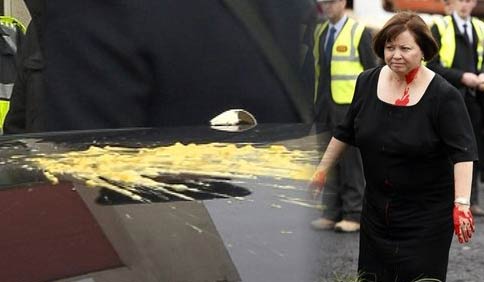 Mary Harney - The unnecessary victim of paint and eggs Health Minister Mary Harney has offered her resignation on Tuesday last, to the Taoiseach Brian Cowen. The former Progressive Democrats leader also confirmed she will not be contesting the next general election.
Minister Harney stated “I have reached my decision after considerable reflection and having taken into account the advice and constant support offered over many years by my family, friends and colleagues and accordingly I have offered my resignation as Minister for Health and Children.”
Currently a TD for Dublin Mid West, Ms Harney had served as minister of state for the Department of the Environment from 1989 to 1992 and Minister for Enterprise from 1997 to 2004, before becoming Minister for Health since 2004, to current date.
Ms Harney visited Tipperary and Thurles officially on many occasions. As Minister of State for the Department of the Environment, she was a guest of Thurles Tidy Towns Committee and officially switched on the then new fountain in the river Suir, sponsored to Thurles by Cantwell Electric Engineers, and currently still enjoyed at Cathedral Street in the town. One achievement often cited from her role in Environmental Protection was the banning of bituminous coal in Dublin in 1990.
It was at a Progressive Democrats meeting the Anner Hotel, Thurles, Co Tipperary that news of her engagement to Brian Geoghegan of An Foras Áiseanna Saothair (FÁS), was made public, first revealed by local Thurles photographer George Willoughby.
Ms Harney, a native of Ballinasloe, Co Galway, was first elected to the Dáil in 1981. She became the youngest ever member of the Seanad Éireann, when nominated by the Late then Taoiseach Jack Mary Lynch in 1977. She became a founder member of the Progressive Democrats together with Limerick born Desmond Joseph O’Malley in 1985 and became leader of the party in 1993. As leader of the PDs, she was Tánaiste from June 1997 to September 2006. She then stepped down as PD leader at that time and was replaced by Mr Michael McDowell, however following his defeat in the 2007 general election, Ms Harney stepped back in as acting party leader.
It was possibly on her last visit to Tipperary in November 2010, that a group of about 30 people protesting, threw eggs and cheese at Mary Harney’s car as she arrived at the Mid Western Regional Hospital in Nenagh, Co Tipperary. The minister was then officially at the Tipperary hospital to open a new Endoscopy Unit and speaking afterwards, the Minister said she was not upset, that she has had other things thrown at her that were probably worse, adding, ‘I think it’s a great pity that in a democracy people don’t use the opportunity to put their perspective forward in a different way. Politics is about choices, it’s about argument and debate. It’s not about engaging in public disorder offences or engaging in activity of that kind. I understand that many of those involved are politically motivated by a different persuasion than the mainstream parties in this country and maybe that’s part of the motivation.‘
The week previous to this, the Minister had been targeted with red paint, as she turned the sod at a mental health centre in Dublin.
It is expected that changes to the cabinet, including the vacancy created by rebel Foreign Affairs Minister, Micheál Martin, will be announced by the Taoiseach Brian Cowen in the next few days.
|
Support Us Help keep Thurles.info online by donating below. Thank you.
Total Donated 2026: €300.00
Thank You!
Daily Thurles Mass Livestream
|



Recent Comments