Applications for International Protection, from Pakistan, will be accelerated and prioritised with effect from today, Tuesday July 29th.
The Irish government has today announced that Pakistan will be added to the list of countries subject to accelerated processing for international protection applications.
Under an accelerated decision-making process, introduced in November 2022, international protection applicants that fall under this procedure are receiving first decisions in around four months and this is expected to reduce in the coming months.
Applications from Pakistan have grown considerably in recent years and in each of the last two quarters, Pakistan nationals have ranked as the second highest nationality for applications for international protection.
Section 73 (1) of the International Protection Act 2015 allows for the Minister to accord priority to any application, or to request the Chairperson of IPAT to accord priority to any appeal, having regard to criteria set down in Sec. 73 (2). Section 73A, allows for accelerated processing of cases having regard to the criteria set down in Sec.73 (2).
Accelerated processing for certain IP applications was introduced in November 2022. From today, Tuesday, July 26th 2025 it applies to: Applicants from 15 safe countries of origin, namely Albania, Algeria, Bosnia & Herzegovina, Botswana, Brazil, Egypt, Georgia, India, Kosovo, Malawi & Morocco, Macedonia (latter former Yugoslav Republic), Montenegro, Serbia, South Africa, Nigeria and Pakistan.
The table hereunder shows the number of international protection applications from Pakistan from 2021 to July 24th, 2025.
Year.
2021.
2022.
2023.
2024.
2025.
Total.
Pakistan.
68.
242.
624.
1,391.
905.
3,230.
All figures shown above are correct at time of issue, however, all statistics may be subject to data cleansing.
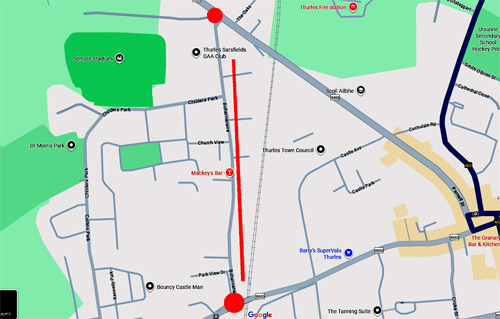
New four day Traffic Management set for west of Thurles Town, Co. Tipperary.
L-4027, Bohernanave, Thurles, Co. Tipperary
Temporary four day traffic management expected on the L-4027, Bohernanave, Thurles, Co. Tipperary, from Tuesday July 29th, 2025, until Friday August 1st2025.
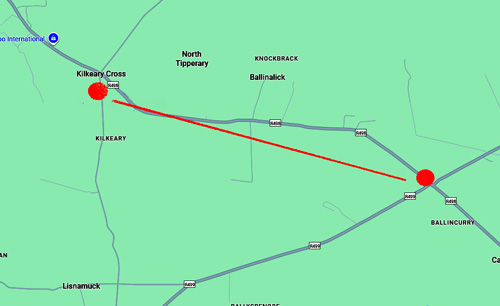
Intention To Close R-498-175 Kilkeary, Nenagh, Co. Tipperary.
Road closure expected from Kilkeary Crossroads to Ballinamona Crossroads.
Notice is hereby given that Tipperary County Council propose to make an order closing: the R-498-175 Nenagh to Borrisoleigh road at Kilkeary. The road will be closed from Kilkeary Crossroads to Ballinamona Crossroads.
Period Of Closure: From 7:00am to 7:00pm, for three days, commencing from Monday August 25th 2025 to Wednesday August 27th 2025.
Alternative Routes: South Bound traffic from Nenagh to Borrisoleigh: At Kilkeary crossroads, divert north on the L6078 to Norwood, east on the R445 to Toomevara, south on the R499 to Ballinamona and re-join the R498 at Ballinamona crossroads.
North Bound Traffic from Borrisoleigh to Nenagh: At Ballinamona crossroads, divert north on the R499 to Toomevara, west on the R445 to Norwood, south on the L6078 to Kilkeary and re-join the R498 at Kilkeary crossroads. Alternatively, Nenagh bound traffic can continue straight ahead on the R445 at Norwood.
Reason For Closure: To facilitate the resurfacing works.
Note: Objections to the proposed temporary closure may be submitted, in writing, to Road Closures, Roads & Transportation, Tipperary County Council, Civic Offices, Limerick Road, Nenagh, Co. Tipperary, not later than 12:00 noon on Thursday 31 July 2025 or by e-mail to roadclosures@tipperarycoco.ie
The 49 page 2025 National Development Plan Review, which sets out departmental capital ceilings up to 2030 and overall capital investment to 2035 was published yesterday.
Having briefly glanced through this document; to most people, I expect it will read like something a political party would publish having left office, in the hope of gaining re-election.
With Tipperary Co. Council unable to even fill a pothole in Thurles presently, residents of the town had, perhaps somewhat naively, expected some mention of funding for the long promised “Ring Road for Thurles”, but alas, once again the silence remains deafening.
One glimmer of hope perhaps, now stated in this National Development Plan review, states: “Over the coming months, individual Ministers will set out their priority programmes and projects within their capital allocations. A clear focus will be on providing greater certainty on the projects and programmes that will advance and get delivered in the next five years, with realistic timelines and budgets. The development of project pipelines will assist the construction in planning and capacity over the coming years.”
Are we to take it that this long sought after “Ring Road” could be delivered within the next 20 years, given the present poor quality political representation currently available in the town?
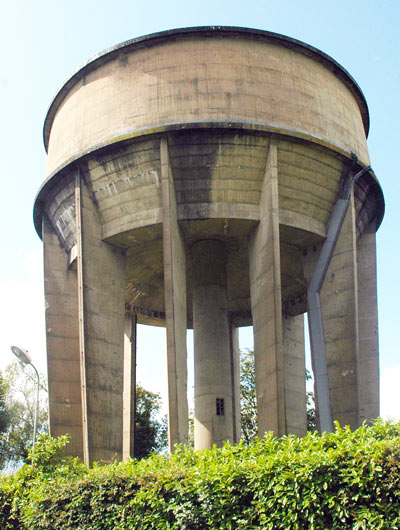
Uisce Éireann is appealing to customers across Tipperary to be mindful of their use of water. Every drop counts, especially as we move into what is expected to be a warmer, drier period.
There has been a notable increase in demand for water across Tipperary since the summer arrived. With warmer, drier weather forecast, we are appealing to everyone to conserve water to safeguard the water supply.
While recent weeks have brought cooler and wetter weather, water supplies in Glenary, Poulavanogue, Ardfinnan, Galtee, Coalbrook, Commons, Dualla and Fethard remain under significant pressure. These Water Supply Schemes serve over 45,000 customers across a large area of South Tipperary including Clonmel, Ardfinnan, Goatenbridge, Caher, New Chapel, Grange, Rossaddrehid, Bansha, Aherlow, Lattin, Emly, Limerick Junction, Coalbrook, Commons, Dualla, Ballinard, Mullinahone, Drangan, Moyglass, Killenaule, Ballinure, Gortnahoe.
Mr Pierce Faherty, (Uisce Éireann Water Operations Manager in Tipperary), said, “We are appealing to the communities served by these supplies to make every effort to conserve water to maintain the supply. Although we have seen some welcome rainfall, the long-term effects of a dry autumn, winter, and spring are still being felt. This supply is under considerable pressure, with a notable increase in demand since the beginning of June.We’re doing everything we can to protect and maintain supplies throughout the summer, but we’re also asking the public for their help by doing what they can to reduce their use. If everyone takes a few simple steps to reduce the volume of water used around the home, in the garden, at work, or on the farm, we can make our water go further and help maintain normal supplies.In response to these water supplies coming under pressure, we have increased our efforts with a series of measures to safeguard supply, including doubling down on leakage detection, pipe repair, and overall network management.”
It would take several weeks of sustained rainfall to allow affected water sources to recover to normal levels. The latest forecast indicates a continuation of warmer, drier weather, which could further increase demand and place additional strain on already stressed supplies.
Everyone in Tipperary can play their part in protecting the water supplies for their community by taking simple steps to reduce their water use.
These include:
Leave the hose in the shed: Drop the hose during the summer months. Use a rose head watering can to water your plants instead of a hose or sprinkler. Running a hose for just one hour uses as much water as a family would typically need in an entire day.
Bucket and sponge for your car: Using a bucket and sponge to wash your car can save hundreds of litres of water compared to using a hose or power washer.
Turn off the tap: Brushing your teeth with the tap running wastes up to six litres of water per minute. Turning it off while brushing can reduce that to just one litre.
Switch to a shower: Showers use about half the amount of water as baths. Invest in water saving appliances such as water efficient taps and shower heads.
Shorter showers: With the average shower using seven litres of water per minute by turning your five-minute shower into four minutes, you could save up to seven litres of water per day!
Fully load your appliances: Always ensure your dishwasher and washing machine are fully loaded before use. A typical washing machine uses approximately 65 litres of water, and a dishwasher uses around 20 litres per cycle. By ensuring they are fully loaded, not only will you conserve water, but you will also reduce your energy bills.
For those looking to track their progress and learn more about water conservation, Uisce Éireann has developed an easy-to-use conservation calculator, which allows people to track their personal water usage. To access the water conservation calculator or find out more about water conservation tips, VISIT HERE.
Members of the public can report any leaks in the public water network by contacting Uisce Éireann 24/7 at TEL: 1800 278 278 or via water.ie
This website uses cookies to improve your experience. We'll assume you're ok with this, but you can opt-out if you wish.AcceptRead More
Privacy & Cookies Policy
Privacy Overview
This website uses cookies to improve your experience while you navigate through the website. Out of these, the cookies that are categorized as necessary are stored on your browser as they are essential for the working of basic functionalities of the website. We also use third-party cookies that help us analyze and understand how you use this website. These cookies will be stored in your browser only with your consent. You also have the option to opt-out of these cookies. But opting out of some of these cookies may affect your browsing experience.
Necessary cookies are absolutely essential for the website to function properly. This category only includes cookies that ensures basic functionalities and security features of the website. These cookies do not store any personal information.
Any cookies that may not be particularly necessary for the website to function and is used specifically to collect user personal data via analytics, ads, other embedded contents are termed as non-necessary cookies. It is mandatory to procure user consent prior to running these cookies on your website.







Recent Comments