|
|
 To Ireland’s great shame we learn that one of the first of two White-tailed Eagles (Haliaeetus albicillato) to fledge successfully from their nest in Co Clare, here in the west of Ireland, has been found shot dead in Co Tipperary. To Ireland’s great shame we learn that one of the first of two White-tailed Eagles (Haliaeetus albicillato) to fledge successfully from their nest in Co Clare, here in the west of Ireland, has been found shot dead in Co Tipperary.
A post-mortem examination carried out on this magnificent bird’s remains clearly shows it was killed by a blast from a shotgun cartridge, with between 45 to 50 pellets remaining in its body. The impact of the shot broke one of the birds legs and a wing, as well as causing damage to the main torso resulting in the bird being totally grounded, possibly for some days after the shooting, unable to walk and before actually dying both from malnutrition as well as its overall sustained injuries.
This particular bird, a young male eagle, was reared by a pair of White-tailed Eagles at a nest on Lough Derg, near Mountshannon, Co Clare, directly across the lake from the village of Portroe, Nenagh, Co Tipperary and successfully flew from its nest in July 2013 last. This bird was one of the first chicks born from the high profile reintroduction programme which began way back in 2007, with the release of young Norwegian eagles, as part of the White-tailed eagle reintroduction programme.
The diet of this bird is varied, but water-based birds, mammals and fish found close to the surface of water are its potential prey. During lean winter months it will feast on carrion such as dead marine mammals, dead livestock and has also been known to eat dead humans, but latter only out of sheer necessity.
The hatching of this bird, latter fully protected by Irish law, had marked a special day for Irish nature conservation and those many people who support such efforts throughout Ireland.
Gardaí at Nenagh are fully investigating the death of this ‘White-tailed Eagle’ and anyone with information should contact Nenagh Garda Station on Tel: 067-50450.
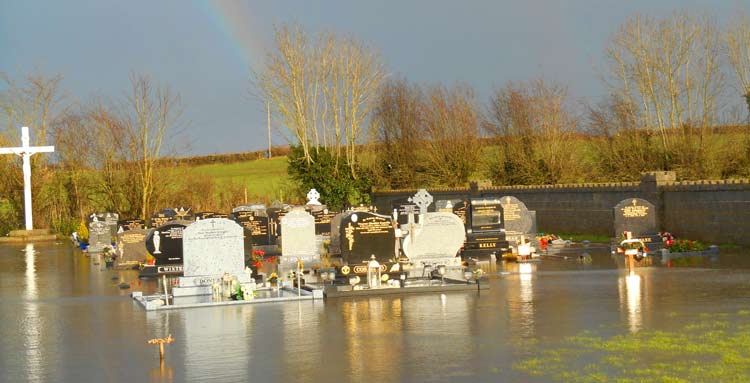 Littleton Graveyard, Thurles, Co Tipperary Today
(Picture courtesy Patricia Loughnane) Feelings of sadness and utter despair are being strongly expressed in the community of Littleton, Thurles Co Tipperary tonight as locals try to determine to find ways to resolve the issue of their flooded graveyard.
Numerous meetings have taken place with Tipperary County Councillors over the past number of days and Councillor Seamus Hanafin has been in contact with the Environmental Agency who are expected to meet with him and concerned residents tomorrow at 10.00am.
A long term as well as a short term solution is now being sought, with angry local people now wondering what will happen when this water eventually subsides.
As one angry resident surveying the scene stated; “This is going to end up yet another long drawn out saga with Tipperary Co Council. People outside the area are possibly not aware that this is a highly emotive issue here in Littleton; one that has been on going on here for years in relation to this cemetery and flooding issues. How will we ourselves be buried or indeed take it upon ourselves to bury anyone else in their family plot, while these conditions continue to exist?”
Heavy rain today is expected to raise further the levels of existing flood waters in this area.
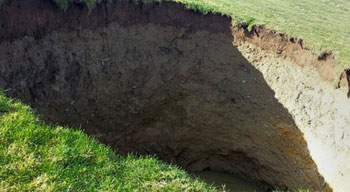 A major ‘sinkhole’ has appeared in the centre of a field near an underground mine at Galmoy, located in the Rathdowney Trend, Co Kilkenny, just seven miles from the Tipperary border. Galmoy Mine is a lead and zinc mine owned by Lundin Mining. A major ‘sinkhole’ has appeared in the centre of a field near an underground mine at Galmoy, located in the Rathdowney Trend, Co Kilkenny, just seven miles from the Tipperary border. Galmoy Mine is a lead and zinc mine owned by Lundin Mining.
The Rathdowney Trend, stretches 40 kilometres, between the towns of Abbeyleix in Laois and Thurles in Co Tipperary. The mining area is the largest producer of zinc concentrate in Europe and is made up of sedimentary rock, primarily limestones, which were concentrated some 320 million years ago.
This sinkhole was reported on Saturday morning last by the current landowner, who notified the mining company of the occurrence.
The sinkhole measures around 15m in circumference and approximately 9m in depth and the mining company in co-operation with the land owner has cordoned off the immediate area and a nearby minor road, while hydro-geological and geotechnical support engineering carry out assessments to determine the true cause. Assessments completed to date indicate there are no immediate risks to public safety and no need for any evacuations.
It is also understood that meetings are taking place between the Environmental Protection Agency, representatives of Lundin Mining and the Department of Natural Resources.
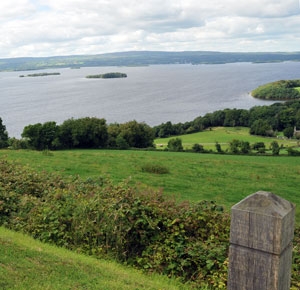 Tipperary’s Lough Derg shore line. Irish Water has begun to work on a €500m project which will remove water from the River Shannon to Dublin.
This Dublin Water Supply project is, aside from the installation of current water metering, the first major infrastructure project to be undertaken by this latest water utility.
It has now begun to seek tenders for a Survey Specialist who will examine the water quality at Lough Derg and the Parteen Basin, from which the water is expected to be sourced.
When eventually completed, Irish Water plan to remove around 350 million litres of water per day from the Shannon river to serve Dublin drinking water needs for the next 70 years.
The project previously stalled amid protests from communities and politicians representing the Shannon region.
A 2010 assessment of the plan, carried out for Dublin City Council by consultant engineers RPS, confirmed the Shannon scheme was the best option for supplying the ten counties along the route as well as the greater Dublin area.
It is now understood that Irish Water will submit a final planning application towards the end of 2015.
Roscrea native, Mr Anthony Glynn, together with business partner and Athlone native Mr James Sherlock, are amongst 3 business finalists shortlisted for the 2014 David Manley Emerging Entrepreneur Awards, sponsored by Dublin Chamber of Commerce and Ulster Bank.
Their product, “Dunk-E,” enables people to manufacture their own electricity and was originally conceived by Mr Glynn while researching Water Turbine Technology, as part of his studies here at the Tipperary/Limerick Institute of Technology (LIT), Thurles.
As part of his research, Anthony found that there were major issues with current technologies in providing rural communities with electricity, leading to his conclusion that off-grid micro generation remains the only feasible option. To this end he designed the original concept for his “Dunk-E,” latter a novel, patent-pending hydro turbine device that produces substantial electricity from the natural flow of water in small rivers, streams, weirs and sluice gates. This device will also provide users with exceptional long term value for money.
With over 9 years experience in the Renewable Energy Sector as well as having set up and run his own business, Mr Glynn has set up Ár-nuaTec, together with Mr Sherlock, to produce and market “Dunk-E,” using this product’s four main focused marketing factors:- Energy Savings; Upfront Costs; Payback Period and Warranty.
Anthony and James have now identified a minimum of 4 million potential micro hydro sites worldwide and hold advanced orders of over €150,000 during 2014 here at home, with orders worth over €250,000 for the Asian market in 2015.
The overall winner in the 2014 David Manley Emerging Entrepreneur Awards will be announced at a ceremony in the offices of Mason, Hayes and Curran on Thursday, January 30th 2014.
The winner will receive a prize package worth over €100,000, comprising of €10,000 in cash together with consultancy services and mentoring from a range of professional support companies.
|
Support Us Help keep Thurles.info online by donating below. Thank you.
Total Donated 2026: €300.00
Thank You!
Daily Thurles Mass Livestream
|



Recent Comments