“There are other forces at work here. They may not be political forces – I don’t know where they’re coming from, but they’re there and they’re active and they have influence.” – Remark made by Thurles born Fergus O’Dowd Fine Gael TD, – formerly the Minister of State at the Department of Communications, Energy & Natural Resources and Environment, Community & Local Govt, with responsibility for the NewEra Project.
Tipperary TD and Minister Alan Kelly is about to give away the exemption Ireland holds from directly charging for domestic water under EU Law. Unless he desists and renews Ireland’s water exemption by Jan 1st 2015, it will lapse. This ‘give away’ will make it more difficult for future governments to abolish direct charges for domestic water.
Mr Seamus Healy TD, in a recent Parliamentary Question, has called on Minister Kelly to immediately renew this exemption, so that the power to charge or not to charge for domestic water will remain with the Irish people and Dáil Éireann, into the future.
A copy of Seamus Healy’s request in a Parliamentary Question to Minister Kelly is carried here below.
Mr Healy stated; “Former MEP, Kathy Sinnott explained in a recent opinion piece in the Irish Times (Nov 21, 2014): “In 2000, the Irish government brokered this exemption and the inclusion of article 9.4 which formally and legally absolves Ireland and only Ireland from the requirement to charge for domestic water.” As an MEP I brought this to the public’s attention in 2008 when the last government was introducing water charges for schools. On April 17th of that year minister John Gormley stated in the Dáil that “The only exemption available to Ireland, and availed of, is contained in article 9.4 and relates to dwelling houses using water for ordinary household purposes.”
This government has no mandate to give away our exemption from domestic water charges. The Labour Party promised in the last election that it would prevent Fine Gael from introducing domestic water charges. Now a Labour Minister is not only introducing the charges, but is giving away the power of our parliament to abolish them in future. Irish democracy is being undermined by Minister Kelly and his government,” he stated.
“I call on all Oireachtas members from Co Tipperary including Senator Landy (Lab) and Minister Tom Hayes to stop this national betrayal now,” said Mr Healy!
Question for Written Answer by Seamus Healy TD
To ask the Minister for Environment and Local Government, Alan Kelly TD,
“If he will confirm that there is, at present in 2014, no requirement for charges to be imposed on domestic dwellings for the use of water from public mains for domestic purposes under the EU Water Framework Directive and that article 9.4 formally and legally absolves Ireland from the requirement to charge for domestic water.”
Also“If he will ensure on behalf of the Irish Government that this exemption is renewed before Jan 1,2015 so that Irish governments will retain the power to charge or not to charge for the use of water for domestic purposes into the future and if he will make a statement on the matter?”
Signed: Seamus Healy TD – 087-2802199.
For those of you who feel strongly about this issue; you should email (Copy & Paste) this “Parliamentary Question” directly to Mr Kelly (minister@environ.ie ), however, from my own experience dealing with his Tipperary office, do not expect to receive a reply, as Mr Kelly and his staff are shy and highly unlikely to respond.
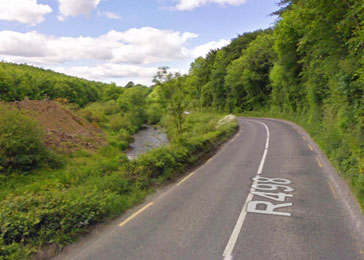
Following strong concerns over the condition of the R498 road, linking Thurles to Nenagh at Latteragh, Templederry, and the safety of those using it, notice has been given by Tipperary County Council to make an emergency road closure order, under the Roads Act 1993 – 2007 (Section 75 of the roads Act 1993,) Roads Regulations 1994.
The period of closure will come into effect from 8.30 a.m. to 4.00 p.m. from Monday December 8th to Friday December 12th 2014.
Motorists must now use the following alternative routes; with all R498 North Bound traffic diverted Currabaha Cross via the L2261, L2124, L2122, R497, R499 to re-join the R498 at Ballinamona Cross.
The R498 south bound traffic will divert at Ballinamona Cross via the R499, R497, L2122, L2124, L2261 to re-join R498 at Currabaha Cross. Heavy Goods Vehicles are well advised to use the R501 and N62 via Templemore and Roscrea as their chosen alternative diversion routes.
Note: Diversions will be fully in place and clearly sign-posted for all those travelling this route and Tipperary County Council sincerely regrets any inconvenience caused as a result of this unforeseen yet very necessary road closure, brought about as a result of serious recent flood damage.
I thought I would bring you a touch of pure nostalgia this lovely Sunday morning; a sentimentality glimpse, if you will, of the past, which will typify some period in your life, thus returning you to a place of hopefully happy personal associations, a time before Irish Water flooded your lives, if you’ll pardon the simile.
Having listened, I thought to myself, maybe it’s time to refresh this old ballad and bring it more into line with the more modern yet difficult economic climate of today’s Ireland. Let me know if you like it and if any of you have a verse or two to add, to ‘jig it up a bit,’ if you will, sure send me a comment.
“Five Feet High & Risin.” Lyrics Updated – (or “The F.G. / Labour Coalition’s Lament 2014.”)
How high’s the water, Enda?
He said “Two feet high and risin.”
How high’s the water, Joan?
She said, “Two feet high and risin.”
We won’t make it next election when the people vote.
Pee Hogan’s rigid policies just didn’t float.
Our reign is over, watch ‘Independents’ gloat.
Two feet high and risin.
How high’s the water, Enda? He said “Two feet high and risin.” How high’s the water, Joan? She said, “Two feet high and risin.”
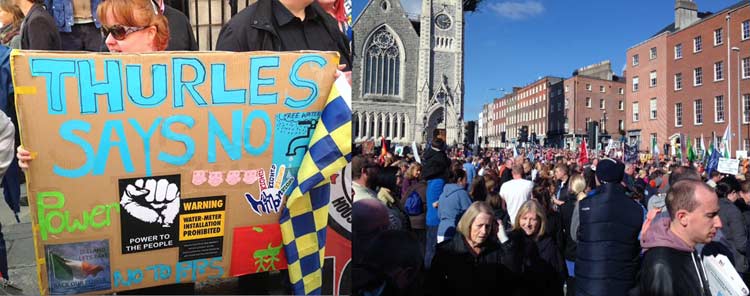
Hey, come look through the window pane Thurles right2water are protesting again.
Hope they catch pneumonia from the pissin rain,
Three feet high and risin.
How high’s the water, Enda?
He said “Three feet high and risin”
How high’s the water, Joan?
She said, “Three feet high and risin.
Well our jobs are gone, thanks to those protesting b‘s.
We’re stuck in Irish water up past our knees.
Best to grab our pensions and shoot the breeze.
Four feet high and risin.
How high’s the water, Enda?
He said “Four feet high and risin”
How high’s the water, Joan?
She said, “Four feet high and risin.
The R498 is gone, north of our Thurles town.
Vehicles can’t pass till the water goes down.
“Greenway” Kelly’s searchin for higher ground.
Five feet high and risin.
Well, it’s five feet high and risin.
Look at it this way, when you’re sitting on your behind all day, with no job prospects, writing poetry helps you to pass the time.
The public are being invited to have their say on the preparation of a new regional plan that will set out a framework for waste management in ten countries across the south of the country during the next six years.
The Southern Region Waste Management Plan, which encompasses 10 local authorities and is one of three being developed in Ireland, also sets out a range of policies and actions in order to meet the specified mandatory and performance targets.
The Southern Waste Region encompasses the local authorities in Tipperary, Carlow, Clare, Cork City, Cork County, Kerry, Kilkenny, Limerick City & County, Waterford City & County and Wexford.
This week’s launch of the three draft regional waste management plans took place in Galway City Council’s offices and was also attended by the Chief Executives of the three Regional Local Authorities, namely Tipperary County Council (Southern), Limerick City and County Council, Dublin City Council (Eastern and Midlands), and Mayo County Council (Connacht Ulster).
The launch coincided with the commencement of a period of public consultation which will continue until January 30th 2015, while the regional waste management plans are expected to be finalised by the end of March 2015.
“Most importantly the plan seeks to assist and support the community and local business to develop resource efficiency and waste prevention initiatives,” explained Ms Philippa King, Regional Waste Co-ordinator, Southern Waste Region.
She continued: “A key plan target is to achieve a 1% reduction per annum in the quantity of household waste generated per capita over the period of the plan. In tandem the plan identifies measures to develop a circular economy where waste management initiatives stop being confined to treating and disposing of waste, instead supporting initiatives that value waste as a resource or potential raw material.”
Ms. King added: “We want to hear your views on achievements to date and about what more needs to be done. Have your say in the future of waste management by telling us your views. The more feedback we receive the greater the potential for improving Ireland’s environment into the future. A feedback form and the full plan is available onwww.southernwasteregion.ie”
The preparation of new regional waste management plans for the regions have been under way since late 2013, following an evaluation of the previous plans which covered ten regions nationally.
Since the last plans were published between 2004 and 2006, a southern region network of 770 Bottle bank sites and 50 Civic Amenity Sites accepting more than 25 categories of waste have been maintained, while a household recovery/recycling rate of 63% and a commercial recovery / recycling rate of 61% have been achieved. Nationally, a packaging recovery rate of 87% was achieved while an average of 7.3 kg of WEEE was collected per person from private households.
A bomb threat was made against the offices of the Environment Minister, Mr Alan Kelly, here in Tipperary this morning.
Minister Kelly is tasked with overseeing ‘Irish Water,’ yet another mismanaged “banana skin to slip on” left behind by the exit of Fine Gael Minister Phil Hogan to Europe.
It is understood that the bomb threat was made to Mr Kelly’s constituency office, latter situated in Nenagh, Co Tipperary, earlier this morning.
Through a spokesperson for Mr Kelly, Labour’s Junior Minister Aodhan O’Riordain, has confirmed that a member of staff in Mr Kelly’s Nenagh office was extremely upset, having receiving this anonymous telephone communication. It is understood Gardaí have been notified with regard to this rather unsavoury communication.
Meanwhile, protesters have gathered in neighbouring Limerick at an event involving the Minister for Finance, Mr Michael Noonan. The crowd have been chanting anti-water charge slogans and Gardaí and plain clothes detectives have been drafted into the area to ensure that the protest remains peaceful.
In another incident, Gardaí in West Cork are forensically investigating the burning of two Irish Water vans over the weekend. The believed malicious incident happened in the early hours of yesterday morning. Gardaí in Bantry confirm that both Renault vans were the property of a contractor working for Irish Water.
This website uses cookies to improve your experience. We'll assume you're ok with this, but you can opt-out if you wish.AcceptRead More
Privacy & Cookies Policy
Privacy Overview
This website uses cookies to improve your experience while you navigate through the website. Out of these, the cookies that are categorized as necessary are stored on your browser as they are essential for the working of basic functionalities of the website. We also use third-party cookies that help us analyze and understand how you use this website. These cookies will be stored in your browser only with your consent. You also have the option to opt-out of these cookies. But opting out of some of these cookies may affect your browsing experience.
Necessary cookies are absolutely essential for the website to function properly. This category only includes cookies that ensures basic functionalities and security features of the website. These cookies do not store any personal information.
Any cookies that may not be particularly necessary for the website to function and is used specifically to collect user personal data via analytics, ads, other embedded contents are termed as non-necessary cookies. It is mandatory to procure user consent prior to running these cookies on your website.




Recent Comments