|
|
An overwhelming majority of adults recognise the value of the environment, while climate change is seen as the most pressing environmental issue in Ireland; so states The Environmental Protection Agency (EPA)
An overwhelming majority of Irish adults (86%) recognise the value of the environment, recent research conducted on behalf of the Environmental Protection Agency (EPA) has confirmed. The EPA have released their findings to coincide with the launch of its “The EPA Year in Review 2018” report. The Red C poll in November 2018 explored attitudes towards environmental issues.
 Commenting on the survey, Laura Burke, Director General of the EPA stated, Commenting on the survey, Laura Burke, Director General of the EPA stated,
“We are pleased to see that so many people recognise the importance of our environment as an asset to the country. Many of today’s environmental problems require a cross-sectoral, joined-up Government as well as a societal response. It is clear to us from our everyday interactions, that the public, business and broader society have a greater understanding of the link between reduced emissions and a clean environment, and our health, our wellbeing, our economy, our very culture”.
“In our survey, respondents ranked climate change, waste, water quality and pollution as the biggest environmental challenges they see facing the nation. The EPA has key roles in addressing each of these challenges and our 2018 review report highlights progress in several areas, such as enforcement, licensing and air quality monitoring.”
The EPA’s National Priority Sites for Enforcement system has become an important enforcement tool, driving environmental compliance at licensed industrial and waste facilities. The EPA published regular updates during the year, with the agri-food and waste sectors accounting for the majority of the 15 sites listed for further enforcement action. Of the 15 sites on the National Priority Sites for Enforcement list in 2018, two were convicted in 2018, five more have cases before the court and three others are under consideration. A total of 15 prosecution cases were concluded in 2018, with fines and costs totalling €229,483. Of these, eight sites had been on the National Priority Sites for Enforcement list in 2017 or 2018.
In terms of licensing, the number of decisions issued on industrial and waste licence applications increased in comparison to the previous year, with a total of 167 decisions taken. A new online licensing system also went live.
Speaking about air quality, Laura Burke stated,
“We continue to strengthen the capacity and capability of the air quality network and provide more comprehensive, localised, online information linked to public health advice. The number of EPA air monitoring stations more than doubled during the year, from 19 in 2017 to 45, under the 2017 – 2022 National Ambient Air Quality Monitoring Programme. Our reporting showed that home heating and transport choices directly influence the level of pollution in the air, affecting people’s health and life expectancy.”
The EPA’s Red C survey also shows that just over a third of adults (37%) recognise climate change as the most pressing environmental issue facing the country and 61 per cent cite it as being within the top three environmental concerns for us to tackle.
Ms Burke further stated,
“By any measure, we experienced an extraordinary year in 2018 where nature reminded us who is in charge; climate change is now with us and it is affecting us all. While Ireland’s greenhouse gas emissions decreased slightly in 2017, EPA projections show that, at best, Ireland will only achieve a one per cent reduction by 2020 compared to its 20 per cent EU reduction target.”
“We continue to work to engage people in debating how Ireland makes the necessary transition to a sustainable future. The newly established National Dialogue on Climate Action, a Government of Ireland initiative facilitated by the EPA, hosted its first two Regional Gatherings in 2018, held in Athlone and Tralee. The EPA also hosted two public lectures on the science of climate change.”
The EPA supports the implementation, monitoring and assessment of climate action through collating and communicating trends in Ireland’s past and future greenhouse emissions; influencing behavioural change to improve resource efficiency and to foster a circular economy in Ireland through the National Waste Prevention Programme; regulating emissions from industrial sectors and through climate science research.
Ms Burke concluded by stating,
“The EPA prides itself on being an independent public body, working in a complex environment. We have different roles with different stakeholders, as a regulator, knowledge provider and advocate for the environment. In 2019 we will continue to work with all stakeholders to place the environment at the heart of decision making so that the wonderful and unique asset can be protected and improved for all the people of Ireland.”
The “The EPA Year in Review 2018” report and the Red C Survey are both available on www.epa.ie.
Follow-up visit by TD Michael Lowry and Minister Heather Humphries to €30 Million Glanbia Biorefinery at Lisheen, Moyne, Thurles, Co. Tipperary.
On Wednesday last, Independent Deputy Mr Michael Lowry TD, together with Minister for Business, Enterprise & Innovation, Ms Heather Humphreys TD, visited Lisheen, Moyne, Thurles where an industrial scale biorefinery is now planned.
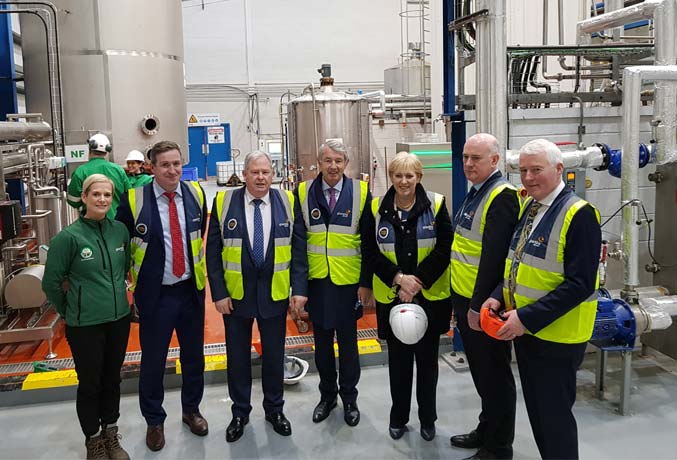
Deputy Lowry had welcomed a major announcement in December 2017 by Minister Humphreys, when Lisheen Mines, which had closed with 400 job losses, was chosen as the site for this national bio-economy centre. Mr Lowry also welcomed the Regional Enterprise Development’s allocation decision of €4.5 million to the project in December 2017.
Following on from this Deputy Lowry took part in discussions with EU Commissioner Mr Phil Hogan, in April 2018, upon the announcement of a substantial further €22 million of EU funding for this identified Biorefinery.
Deputy Lowry said, “State funding of €4.5 million for this Tipperary project will renew and reinvigorate the local and wider economy here as Lisheen; latter set to become a world-renowned innovation centre, offering enormous job opportunities into the future”.
Led by Glanbia Plc, the project involves the building of a processing plant which will transform over 25,000 tonnes of excess agricultural food waste per annum, converting same to bio-based fertilizers.
Deputy Lowry TD, who has been central to all stages of these discussions and plans from the outset, stated on Wednesday last “Environmental sustainability is a huge issue worldwide. This new project will now place Ireland and Co. Tipperary firmly on the world map as being at the centre for future technology research and the development of further sustainable agricultural processes.”
“Here employment potential as well as overall economic growth for Tipperary and the surrounding area will prove to be hugely significant”, concluded the Deputy.
Cost overrun on the National Children’s Hospital project will not delay the Templemore Flood Relief Scheme; same being currently undertaken by the Office of Public Works (OPW).
Tipperary Independent TD Deputy Michael Lowry has confirmed today that further to a number of meetings with Minister Boxer Moran, concerning the Templemore Flood Relief Scheme, he has received assurance that the main scheme in Templemore is progressing and will not be further delayed. This follows the Government decision, [on Tuesday February 12th 2019], in relation to capital reallocations, brought about by the cost overrun on the National Children’s Hospital project.
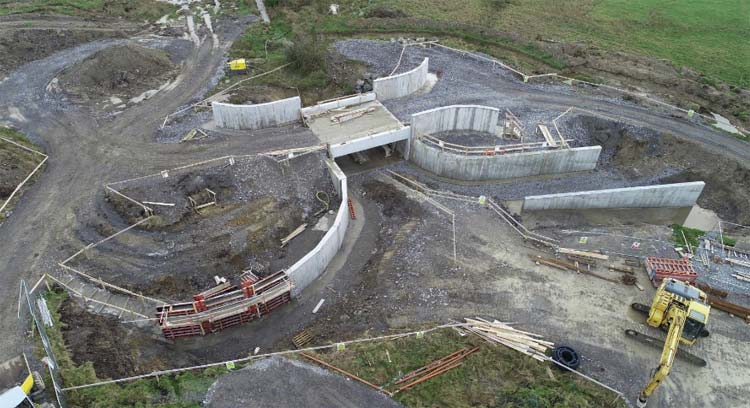 Bridge Construction, part of the Templemore Flood Relief Scheme, currently being undertaken by the OPW. As our readers will be aware; the town of Templemore, Co. Tipperary, part of the Templemore / Thurles Municipal district, lies on the River Mall, which drains a catchment area that includes parts of the Kilduff and Devilsbit Mountains, before flowing into the River Suir further downstream.
The town has had a long history of flooding; the most momentous of these having occurred back in December 1968 and even more recently in November 2000, December 2015 and January 2016, with flood waters submerging and overwhelming, in total, some 40 properties.
Deputy Lowry stated: “Following discussion with Minister Kevin Boxer Moran I have been informed by the Minister and the OPW that construction of the River Mall (Templemore) Flood Relief Scheme is currently ongoing. To date, approximately 35% of the works have been completed, which include 450m of new channel excavation, 4 field bridges completed at various locations with another bridge substantially complete, and demolition and site clearance of a commercial property on the Richmond Road. Liaison is ongoing with relevant stakeholders, including local landowners, Inland Fisheries Ireland, the ESB, and Tipperary County Council. It is hoped to have the scheme works substantially completed by the end of 2019”.
Concluding Deputy Lowry stated: “I am very grateful for the support of Minister Boxer Moran and the commitment of the OPW to this project. It is hoped that the scheme of works will be substantially completed by the end of 2019”.
Creating a Local Sustainable Future – Practical actions for your community
National and local networks have come together to host a solution-based approach to creating a sustainable future within both rural and urban communities.
Kilkenny is set to hold an interactive cross-county event, to explore how local communities can create a sustainable future against the backdrop of the growing impacts of climate change.
This free event, organised by the Public Participation Networks (PPN) of counties Tipperary, Kilkenny, Carlow, Wexford and Waterford and the Irish Environmental Network, will take place at the Ormonde Hotel on Saturday February 23rd. Senator O’Sullivan will deliver the keynote address at this event that comes in response to growing demand for local solutions to an impending threat of climate change.
The event will concentrate on actions that can be replicated in any local area, whether at home or in the community, and aims to deliver action-focused outcomes for all participants.
Each workshop is delivered by an expert in their field, with the overall event facilitated by Davie Phillip of Cultivate, a Tipperary-based environmental NGO based in the Cloughjordan eco-village.
The event will focus on four key themes, including how to work towards the Sustainable Development Goals (SDGs) and how to expand the conversation of climate action, through community initiatives.
The other key themes are how to develop local responses to climate action in water catchment areas, and developing actions for biodiversity protection across a range of habitats found across the five counties.
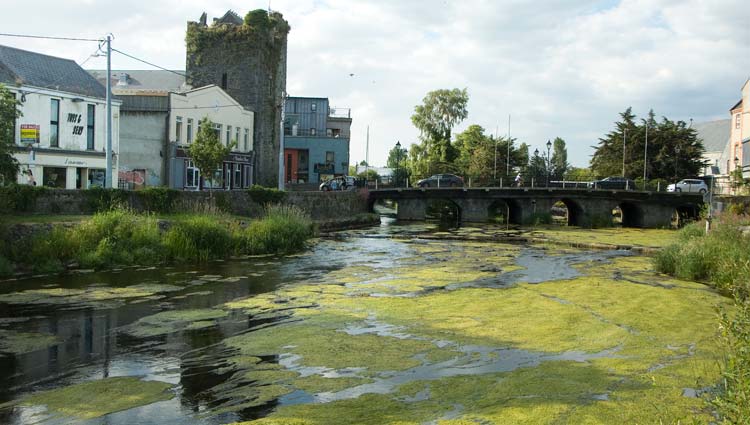
During the day there will be four breakout sessions, each focusing on an important issue that we face today, including biodiversity loss, with wildlife populations down 60% in the last 40 years.
Pádraic Fogarty, leading Irish ecologist and vocal spokesperson for reversing biodiversity loss, will lead a workshop to explore solutions to this crisis.
There will also be interactive workshop to explore the 17 Sustainable Development Goals, as well as the practical side of applying them to the work of community groups. Davie Phillip, who for the last 20 years has helped to create sustainable communities and locally led initiatives, will lead this community orientated workshop.
Individuals around Ireland are becoming more vocal about the need for climate action. Ray McGrath, who has been working within communities in Waterford to bring climate actions to a wider audience, will lead an action focused workshop set to expand the conversation to all community groups, and identify a range of environmental actions that they can take.
With floods and droughts increasingly impacting rural farming communities and set to become more severe over the next few years, it is important that we work now to protect our water sources.
For this reason, the final workshop will explore initiatives that are being taken to protect water quality and look at what can be done within communities to help nurture healthy rivers and lakes. Fran Igoe, the southern regional coordinator for the Local Authority Waters Programme, will lead this workshop. Mr Igoe has worked on large scale locally led conservation projects, which will be explored during the workshop.
The event will end with a Q&A panel including all facilitators and speakers, and time over lunch to browse the information stands from local and regional environmental groups.
Senator Grace O’Sullivan said: “The importance of ‘Think Global, Act Local’ has never been more evident than at the moment. The evidence for strong government and international action goes hand-in-hand with the need to include communities. We need to give citizens a feeling of agency and improve support for and awareness of environmental initiatives designed to tackle the ecological crisis we face.”
Pádraic Fogarty of the Irish Wildlife Trust said: “The extinction crisis is happening in parallel with the climate crisis and it is important that communities can appreciate how this is affecting the places in which they live and work. Addressing both crises in tandem can bring enormous opportunities for local people when the right initiatives are put in place.”
Annette Dupuy, Wexford PPN Support Officer said: “From this event we want to give attendees three things; evidence based actions that they can replicate in their own areas, an opportunity to make new connections, and most of all inspiration to continue their work in creating a local sustainable future. We are very excited to bring this event to the South East and to share the great work that is being done in the area.”
“Little trotty wagtail, he waddled in the mud,
And left his little footmarks, trample where he would.
He waddled in the water-pudge, and waggle went his tail,
And chirrupt up his wings to dry upon the garden rail.”
Extract from the poem “Little Trotty Wagtail”, by John Clare
London’s Trafalgar Square is famous for its daytime congregation of Pigeons. Dublin city’s Parnell Square, according to Dublin City Council, is famous for its congregation of daytime, marauding, chip snatching seagulls. Here in rural Liberty Square, Thurles, Co. Tipperary; practically unnoticed by the frequenters of our pubs, clubs, and other nightly entertainment venues, we remain secretly renowned for our congregation of nightly, urban roosting Pied Wagtails.
 Hundreds of roosting Pied Wagtails congregate nightly all year round, unnoticed in Liberty Square, Thurles, Co. Tipperary. To the night reveller, they go mostly unnoticed, perched on the very summit of three mature trees on the ‘money side’ of Liberty Square, close to the entrance into Westgate and Friar Street. Best not to stand too long directly under these trees at night; lest your unprotected bag of chips, or expensive hair-do, should inevitable fall foul to occasional falling defecation.
Bearing various allocated rural names; like ‘Penny wagtail’, ‘Willy Wagtail’ and ‘Water Wagtail’, in truth no one actually knows why Wagtails wag their tails, however, especially during the cold winter months, and indeed right through the year here in Thurles, large numbers of these inoffensive, 18cm long birds, join together and roost communally in our town.
In Ireland pairs of pied wagtails will nest favouring holes in walls, gaps under roof tiles and similar spaces, and particularly enjoy the use of farmyard areas, where they will nest two or three times during the summer season.
Haters of cold weather and not great dawn singers, these birds are exclusively insectivorous and choose towns possibly because same are always a couple of degrees warmer. Undeterred by noisy traffic, bright moving lights and loud night revellers; these birds enjoy the security of roosting in flocks, after all several hundred pairs of eyes are better than two in the case of any possible danger.
Not a protected species here in Ireland; one wonders what will become of this Thurles Wagtail colony, should work eventually begin on the constantly delayed revitalisation of Liberty Square. Will Tipperary Co. Council continue in the practice of eradicating mature trees, as seen previously in Fethard village and other Tipperary areas, thus leaving them homeless?
We trust that Tipperary Co. Council has learnt by now that the life of another creature is in no way less precious than their own.
|
Support Us Help keep Thurles.info online by donating below. Thank you.
Total Donated 2026: €300.00
Thank You!
Daily Thurles Mass Livestream
|



Recent Comments