Wastewater discharged from 59 per cent of Ireland’s existing treatment plants failed to consistently meet standards set in EPA licences to prevent pollution.
Nearly half of these failures are due to poor operational management at existing treatment plants.
Delays by Uisce Éireann in delivering improved infrastructure are prolonging risks to water quality.
EPA will continue to take enforcement action to bring existing wastewater treatment plants up to standard.
The Environmental Protection Agency’s (EPA) Urban Wastewater Treatment in 2024 report, released today, shows that investment at priority areas highlighted by the EPA is delivering improvements with the volume of raw sewage discharged daily halving since early 2024.
However, wastewater discharges continue to harm water quality in rivers, estuaries, lakes and coastal waters.
Effluent continues to flow into the River Suir in Thurles Town centre. Pic: G. Willoughby
EPA licences set out the treatment standards necessary to prevent pollution and protect the environment. EPA assessment of wastewater discharges in this report highlights that over half (59%) of licensed treatment plants fail to consistently meet these standards. Failures range from occasional, short-term breaches to persistent discharges of poorly treated sewage. The main causes are inadequate infrastructure and poor operation and maintenance of treatment plants.
Operation and maintenance issues can and must be resolved as a matter of urgency. Addressing infrastructural deficits is a longer-term challenge that requires substantial and sustained investment. As it will take many years to complete all infrastructural upgrades, Uisce Éireann must give priority to the areas where improvements are most needed and will bring the greatest benefits. The EPA has identified 78 priority areas for improvements. Uisce Éireann has not yet started the works needed at half of these.
Effluent continues to flow into the River Suir in Thurlrs Town centre. Pic: G. Willoughby
Launching the report, MrPat Byrne, Director of the EPA’s Office of Radiation Protection and Environmental Monitoring said: “Targeting improvements at priority areas identified by the EPA is delivering environmental benefits. The new treatment plants built to stop discharges of raw sewage from areas such as Arklow and Kilrush are clear examples of this progress. However, delays in designing and delivering infrastructural upgrades required at many more areas are prolonging negative impacts on water quality and the wider environment. Uisce Éireann must accelerate the pace of delivery of essential upgrades at priority areas to ensure cleaner rivers, estuaries, lakes and coastal waters and support a healthier environment for all.”
Treatment at fourteen large towns and cities failed to meet basic, European wide standards set in the Urban Wastewater Treatment Directive. Six of these met the standards in 2023, highlighting the need for Uisce Éireann to take action to prevent previously compliant treatment plants slipping into non-compliance.
Regarding the operation and maintenance of treatment plants, Mr Noel Byrne, EPA Programme Manager, said: “Too many wastewater treatment plants are failing to meet licence standards due to poor management and maintenance practices. This is simply not good enough. When treatment plants break down or are not managed properly, our environment pays the price. The EPA has prosecuted Uisce Éireann on 28 occasions for failing to treat wastewater properly. Poor operational performance will not be tolerated by the EPA. Uisce Éireann must take immediate action to improve the operation and management of treatment plants and implement effective maintenance programmes to prevent equipment breakdowns.”
The Urban Wastewater Treatment in 2024 report and the list of priority areas – including details of the environmental issues at each location and Uisce Éireann’s plans to address them – are available on the EPA website.
We are deeply saddened to share the news that Dr Jane Goodall, DBE (1934–2025), has passed away at the age of 91. Her groundbreaking research on chimpanzees forever changed science, while her voice for conservation, climate action, and youth empowerment has inspired millions worldwide. Her legacy endures through the Jane Goodall Institute and Roots & Shoots.
The Jane Goodall Institute, founded in 1977, in announcing her passing yesterday stated “Dr Goodall’s discoveries as an ethologist revolutionized science, became a tireless advocate for the protection and restoration of our natural world.”
Dr Goodall, an extraordinary scientist, conservationist, and humanitarian, sadly died yesterday, October 1st 2025, at the age of 91 years. Her death, due to natural causes, occurred while she was in California, U.S., participating in a speaking tour. Her passing now marks the close of a life that enriched science, inspired millions, and transformed how humanity understands and cares for the natural world.
A Legacy Beyond Measure.
Born on April 3rd 1934, in London, England, Dr Jane Goodall’s lifelong love of animals and wild places led her to Tanzania in 1960, where she established the world’s longest-running field study of chimpanzees at Gombe National Park. Over decades, her immersive and empathetic approach yielded startling discoveries: chimpanzees make and use tools, exhibit intricate social relationships, and display emotional complexity. Her work broke down the long-held wall between “human” and “animal” and reframed ethology itself.
In 1977 she founded the Jane Goodall Institute (JGI), an international organization that continues field research, supports conservation projects, and champions community-based sustainable practices across Africa and beyond. In 1991 she launched Roots & Shoots, a global youth-oriented environmental and humanitarian program, active now in many dozens of countries.
Throughout her life, Dr Goodall was a tireless advocate, not only for chimpanzees but for the entire planet. Appointed UN Messenger of Peace in 2002, she addressed issues ranging from habitat destruction and climate change to animal welfare and youth empowerment. Even in her later years, she traveled extensively, gave talks, and used new media (such as her “Hopecast” podcast) to share a message of hope and urgent action.
Her work was widely recognized: she was made a Dame Commander of the British Empire (DBE), received the Presidential Medal of Freedom (2025), the Templeton Prize (2021), and numerous other honours.
Her spirit lives on in the institutions she built, the young people she inspired, and the planet she fought to protect. JGI and Roots & Shoots will continue her work, safeguarding ecosystems, enabling local communities to lead, and cultivating hope in future generations.
In this time of mourning, we invite all who hold Jane’s ideals dear to renew our joint commitment: that curiosity, empathy, and action can yet transform the future of life on Earth.
Dr Goodall is survived by her son Hugo van Lawick and three grandchildren.
It should be noted that when batteries (including those in vapes, e-cigs & rechargeable devices) end up in household or business bins, they can ignite and cause fires in collection trucks, storage facilities and even in your own home. ⚠️ This puts lives at risk, damages equipment and disrupts waste services. ✅ Do the safe thing: ❌ Never put batteries, vapes or electricals in your bins. 🔋 Store batteries separately. 📍 Use drop-off points for safe disposal. Most Supermarkets have battery disposal units. ✅ So “Be a recycling hero 💚♻️”
Criminologists talk of the Broken Windows Theory: leave a single pane shattered, a wall sprayed with graffiti, and the message spreads – this place is abandoned, rules don’t matter. Soon the small disorder becomes a flood of crime.
Look now to our River Suir. The same theory holds true, only here the broken windows are plastic and glass bottles bobbing downstream, slurry running through drains, domestic bags dumped along the river banks. And just as in streets, once the first act of neglect is ignored, worse inevitably follows. A trickle of pollution becomes a torrent.
Latest piece of unwanted rubbish dumped on the bank of the river Suir in Thurles town centre – the rear wheel of a bicycle complete with gear cogs. Pic: G. Willoughby
Ireland’s Environmental Protection Agency (EPA) has warned again and again: almost half of our rivers are failing “good” ecological standards. Angling and environmental groups document salmon streams destroyed, trout waters suffocated, heritage fisheries reduced to open sewers. Yet still we tolerate the first offences the bags of rubbish, the secret pipes, the dead fish floating, until whole waterways are written off.
Supermarket trollies return to the riverbed again last Monday, following the last token cleanup by Thurles Municipal District Council. Pic: G. Willoughby
Tipperary County Councils are quick to boast of their fight against “illegal dumping,” yet their record speaks otherwise. The fines exist on paper, but enforcement is rare. Too often, councillors look the other way when it is slurry or effluent from within their own patch. The public see it, the farmers see it, the children fishing off the river bank see it, and the message spreads: “pollute with impunity“.
This is Ireland’s broken window. And it is not just glass we are leaving unfixed—it is the very arteries of our countryside. Polluted rivers strip local people of pride, crush community guardianship, and invite still more damage. They tell residents: this place doesn’t matter.
We cannot rebuild pride in our environment, while allowing rivers to become open rubbish tips. Every plastic bag, every barrel of waste, every illegal pipe is a window smashed in the face of the community. Ignore it, and the damage multiplies. Confront it, and the message changes: this river matters, Thurles community matters.
The question is simple: will Tipperary County Council, and indeed Ireland as a whole, repair that first broken window – or will we stand by as the whole house falls down?
Scientific facts published by Local Authority Waters Programme (LAWPRO). See HERE.
Water Quality in River Suir in Thurles only 33% satisfactory down from 61% in 2010-2012 which equals a relative drop of 46% in about 12 years.
Almost no aquatic life.Samples taken down stream of Thurles Bridge in town centre (Barry’s Bridge) on 11/09/24, result in no invertebrates typical of clean water such as Mayflies or Stoneflies – essential food for trout and salmon.
A few water shrimps (Gammarus), some biting Midge larvae (Simuliium) Extensive Cladophora algae.
Current data raises a harsh question: if our drinking water is so delicately balanced, how much “extra load” can rivers accept without tipping into crisis?
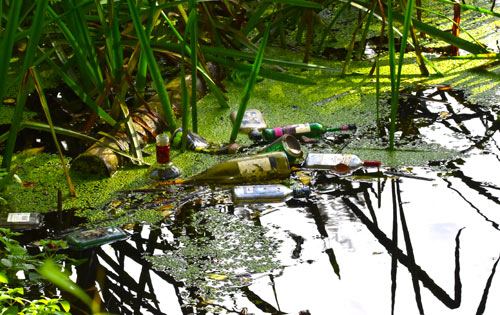
A small sample of floating bottles, River Suir, Thurles town centre. Pic: G. Willoughby. (Image taken Sept. 29th 2025)
Slurry Spreading: Tipperary’s Silent Pollution.
Hypocrisy is very much alive and well in Ireland, with the strict promotion of standards loudly proclaimed, yet quietly ignored when it comes to agriculture.
If an individual is caught illegally dumping a mattress or a bag of household rubbish, the law comes down hard. The penalties are steep: on-the-spot fines, €4,000 if convicted in the District Court, and up to €130,000 on indictment for more serious offences. Add to that the local authority’s investigation and legal costs, plus extra charges for continuing offences, and the message is crystal clear — thesepolluters will pay.
But here is the contradiction: when sewage or agricultural slurry is allowed to seep into our rivers, with the blessing of Tipperary Co. Council itself, the penalty is nothing, zero, zilch, no costs, no fines, no legal prosecution, and no accountability.
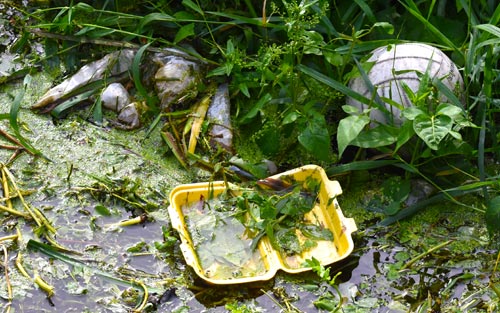
Just a small sample of the discarded litter at Barry’s Bridge, in River Suir, Thurles Town centre. Pic: G. Willoughby. (Image taken Sept. 29th 2025)
This double standard undermines public trust, punishes the ordinary citizen while shielding powerful interests, and leaves communities to live with the consequences — polluted drinking water, fish kills, and waterways turned into toxic drains. The rules are strict when it suits, yet curiously silent when the polluter is a farmer or an industry player with political influence.
Until agricultural slurry is treated as seriously as other forms of dumping, Tipperary and the rest of Ireland will continue to suffer the hidden, silent pollution that seeps into every stream and spring water well.
Tipperary was renowned for its rivers and lakes, the Suir winding through Thurles, the Shannon and its tributaries, and countless smaller streams supporting fish, wildlife, and local communities. Yet these waters are under increasing pressure, largely from the way slurry is managed on farms.
Slurry, a liquid mix of animal waste, provides a quick nitrogen boost to grass, making it popular among farmers. But its environmental costs are severe. Being liquid; slurry runs off easily during rainfall, carrying nutrients into rivers and lakes, triggering algal blooms, oxygen depletion and fish kills. Strong odours signal ammonia emissions, while heavy tankers compact soils, further increasing runoff.
By contrast, traditional dung releases nutrients slowly and enriches the soil with organic matter, improving structure, fertility, and biodiversity. Though slower to handle, it poses far less risk to water quality.
Evidence from EPA and Local Water Authorities The EPA’s 2023 report shows that many Irish rivers are failing to reach “good ecological status,” often due to nutrient pollution. In Tipperary, seven public water supplies, including Borrisokane, Nenagh, and Roscrea, are on the EPA’s Remedial Action List, meaning urgent improvements are needed. Dr. Fran Igoe from LAWPRO reports that water quality satisfaction in Tipperary has dropped from 61% to 33% over a 12 year period, with rivers around Thurles and Templemore particularly badly affected.
Voices from the Field Local anglers and fishing clubs have become strongly outspoken. Mr Joe O’Donoghue of Ormond Anglers says, “It’s doing untold damage to the river – the ecosystem is disappearing. Fly life we used to see in the evenings … it’s gone.” Inland Fisheries Ireland has prosecuted companies in Tipperary for slurry-related pollution. Ms Lynda Connor, regional director, states: “Ensuring clean and healthy water is not just a responsibility, but a necessity for the survival of fish and the ecosystems they thrive in.” Now the leading question “So why has Inland Fisheries Ireland not prosecuted Tipperary County Council for permitting sewage to flow into the River Suir?
Mixed effluent flowing from a pipe on the river walk close to the rear of Thurles shopping centre. Pic: G. Willoughby (Image taken Sept. 29th 2025)
Time for Action. Tipperary as a county can no longer rely on excuses. The County Council, Uisce Éireann, and the Department of Agriculture must now act together and this will require:
Enforcement of slurry regulations with inspections and severe penalties.
Support for farmers to adopt safer alternatives, including dung use and low-emission spreading technologies.
An investment in water infrastructure, buffer zones, and monitoring.
An engagement with stakeholders such as anglers, environmental groups, and local communities in oversight and planning.
Short-term gains from slurry can no longer be allowed to outweigh the long-term damage to rivers, drinking water, and local ecosystems. Tipperary’s waters deserve decisive action now, before more fish die, more rivers are polluted, and the county’s natural heritage is irreversibly harmed.
Now regarding my last communication, which further updated details of the 12 year old River Suir pollution problem in Thurles; seven emails in total were sent 10 days ago, on Friday September 19th 2025 to:-
(1)Ms Sinead Carr(CE Tipperary Co. Council), [sinead.carr@tipperarycoco.ie]; ) Result: No Reply or acknowledgementreceivedto date.
(2)Ms Sharon Scully, (Thurles Municipal District Admin)[sharon.scully@tipperarycoco.ie]; Result: No Reply or acknowledgementreceived to date.
(3)Mr Darragh O’Brien (darragh.obrien@oireachtas.ie) (Minister for Climate, Energy and the Environment & Minister for Transport). Result: Correspondence acknowledged. (Ref: HPLG-MBO-03271-2025). Reply “Your correspondence is currently receiving attention and a further reply will issue as soon as possible”.
(4)Mr Alan Dillon (alan.dillon@oireachtas.ie) (Minister of State with responsibility for Small Businesses and Retail and Minister of State with responsibility for Circular Economy). Result: No Reply or acknowledgementreceived to date.
(5) Mr Timmy Dooley (timmy.dooley@oireachtas.ie) (Minister of State with responsibility for Fisheries, Minister of State with responsibility for the Marine). Result: Correspondence acknowledged. (Ref: CCAE-MOSD-00280-2025). Reply:“I would like to acknowledge your recent correspondence regarding Pollution of the River Suir. The contents of your email have been noted and I will bring this to the Minister’s attention and we will respond accordingly”.
(6)Environmental Complaints section EPA[E.Complaints@epa.ie], Result: Reply received as shown hereunder.
(7)Mr Robert O’Brien(A/Executive Scientist, Environment & Climate Action, Tipperary County Council, Civic Offices, Clonmel, Co. Tipperary).[robert.obrien@tipperarycoco.ie]. Result: Reply received as shown hereunder.
Hello George, You are correct to highlight the seriousness of the pollution of our rivers and the priority that must be given to public health and safety. Any immediate actions that could have been taken are completed. To address the overall issue and root cause will require a longer-term approach. The consultative process is not intended to be a talking shop, but this pilot study ensures accountability, coordination and long-term protection of the river and community. I appreciate this can be frustrating but reversing water quality decline often takes years to be realised. Any information you request must be formally applied for under the Freedom of Information Act 2014. Regards……….
This website uses cookies to improve your experience. We'll assume you're ok with this, but you can opt-out if you wish.AcceptRead More
Privacy & Cookies Policy
Privacy Overview
This website uses cookies to improve your experience while you navigate through the website. Out of these, the cookies that are categorized as necessary are stored on your browser as they are essential for the working of basic functionalities of the website. We also use third-party cookies that help us analyze and understand how you use this website. These cookies will be stored in your browser only with your consent. You also have the option to opt-out of these cookies. But opting out of some of these cookies may affect your browsing experience.
Necessary cookies are absolutely essential for the website to function properly. This category only includes cookies that ensures basic functionalities and security features of the website. These cookies do not store any personal information.
Any cookies that may not be particularly necessary for the website to function and is used specifically to collect user personal data via analytics, ads, other embedded contents are termed as non-necessary cookies. It is mandatory to procure user consent prior to running these cookies on your website.







Recent Comments