Change to age requirements opens role to 35 to 50 year olds for first time.
The Minister for Justice, Helen McEntee TD, has welcomed the new recruitment campaign for An Garda Síochána, which opens for applications today and closes on Thursday 8 February.
Noting that recruitment into An Garda Síochána has accelerated following the forced closure of the Garda College to intakes, due to Covid-19, the Minister said: “I am very pleased to see Garda recruits once again regularly entering training at Templemore, and this competition will ensure there is a continuous pipeline of new trainees. As a government we allocated the highest ever budget of €2.3 billion to An Garda Síochána for 2024. That included funding for between 800 and 1,000 new Gardaí, and I hope, and indeed expect, that there will be a strong response to this campaign. I encourage anyone who believes they can make a positive contribution as a Garda to consider putting their name forward. Policing is a career in which no two days will be the same – it can be exciting, rewarding and undoubtedly challenging, but it offers a great opportunity to have a positive impact in the community and to be a part of a modern, inclusive police service that has the respect and trust of the Irish public.”
The last Garda recruitment campaign which closed in April 2023, received approximately 5,000 applications.
Both the Government and Garda Commissioner have said they are committed to reflecting the increasing diversity in Irish Society by ensuring that all communities see themselves reflected in An Garda Síochána. The Garda Commissioner has also put a strong focus on equality, diversity and inclusion and encourages applications from people of all backgrounds to join An Garda Síochána through this campaign.
Noting recent changes made to the eligibility requirements and increased training allowance, Minister McEntee added: “We have significantly increased the training allowance for trainee Gardaí, to €305 per week. Given that, and the decision to increase the maximum age of recruitment from 35 to 50, I believe we are opening up policing as a career option to a new cohort of people who will bring a range of different life and career experiences to the table. Across 2023 we have seen recruitment into An Garda Síochána gain real momentum. And with unprecedented funding recently allocated for equipment and wellbeing initiatives, and recent increases in frontline supervisors, I believe those who join will be supported as they take on what I know can be a challenging job. Our Gardaí do vital work every day investigating crime, supporting victims and maintaining the security of the state. Given that my top priority is building stronger, safer communities, I want to express my gratitude to them for their outstanding dedication and commitment and I hope this competition will lead to many more joining their ranks.”
Prospective candidates can visit publicjobs.ie for more information on how to apply.
Closing Date for the competition is Thursday 8th February 2024.
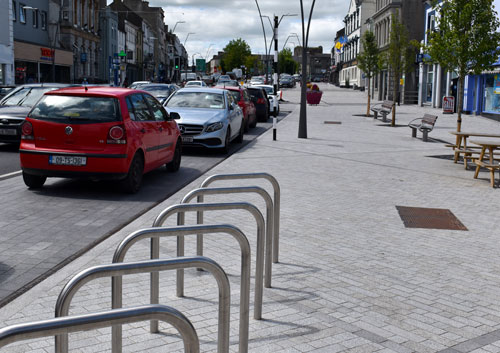
Redesignated parking on Cathedral Street, Thurles. Pic: G. Willoughby
In the early part of last month (December 2023) an elected Thurles town councillor, namely Mr Jim Ryan, correctly raised the clear possibility that the town could lose a vital car parking area, located on Cathedral Street.
The area sits adjacent to the now derelict, eyesore once known as the Munster Hotel.
Independent Councillor Mr Jim Ryan, who first raised the issue, stated that some existing 100 car parking spaces could be made unavailable, following a failure to agree on future rent sought by the owner of the Munster Hotel, Mr Martin Healy, and his current tenant, Tipperary County Council, with the facility set to be closed to the public on a date, confirmed by Mr Healy, possibly February 2024.
Cllr Ryan has correctly stated, that a lot of schools, shops, businesses and the religious facility nearby (Cathedral of the Assumption), all who benefit from the use of this car park on a daily basis will suffer huge inconvenience, when going about their normal business in Thurles.
Cllr Ryan has called on the relevant bodies (namely the declared owner of the car park and Tipp. Co. Council), to come together to find a compromise, thus ensuring that the car park in question remains open to the public.
In the meanwhile, Mr Healy, the named owner of the car park facility, has publicly stated that his dispute with Tipperary Co. Council is not about money, but instead, what he is looking for is a proper future lease that would involve better maintenance of the car park site; which of course confirms Cllr. Ryan’ statement that any such compromise will involve money.
In the days prior to Christmas week, 2023, Tipperary Co. Council officials appear to have taken the initiative to ensure that school buses will now move from the Munster Hotel car park area, unto Cathedral Street. This appears to be confirmed by the appearance of new road markings on both sides of the streetscape. (See Image shown left above).
If the car park is closed to the public, what will be the future possible consequences?
Keep in mind that presently, school buses arrive into Thurles and park between the hours 8:45am until 4:15pm each day, in this now disputed rented car parking area.
From February, the proposed car park closure will see these buses move unto both sides of Cathedral Street, leaving no spaces for would-be consumers, either in the car park itself or on the street outside.
Students of all ages attending secondary schools will now be places in decidedly greater danger, while attempting to board school buses in this area of heavy moving traffic.
This non availability to park vehicles, now presents existing tennants and their landlords; same running foodpremises, bookmaker establishments, hardware, dentistry, clothing, beauty, dry cleaning, charity and hair salon businesses, latter all currently trading in the immediate area; unable to attract and service regular consumers, in turn resulting in the nonpayment of rates, or at best found to be in serious arrears of same, thus leading to closures.
Attendances at the nearby Cathedral of the Assumption will be greatly reduced at daily Mass times, (which normally take place at 11:00am and 7:00pm on week days), with the elderly, in particular, now possibly forced to move to attend religious ceremonies in the nearby Church of St. Joseph and St. Brigid, in Bothar-na-Naomh, Thurles, where adequate free parking is readily available. Any such closure could cause greatest upset at funeral times, where people travelling great distances, particularly in winter time, will find no place to park in an already delibertly congested town, when wishing to attend such events in the Cathedral of the Assumption building.
Why does The Source Carparkremain closed. The recent fire in the carpark underneath the existing “The Source” library area has remained closed to the public for some time, even before two arson attacks; same having had its ceiling regularly attacked by “latch street kids” and others with “idle hands”. Latter travel around in small groups, while waiting for parents to return home from work. It was therefore no surprise that same area was set on fire, when strips of insulation was left unattended, dangling every-where in easy reach, from the ceiling area; within months of the building opening to a non attended political fanfare, back in 2006.
Where indeed will ticket paying consumers now park intent on attending Thurles Theatre and Thurles Library. Once again greed and poor planning; both have clearly “cut of their nose to spite their face”, a phrase which best expresses a needlessly, self-destructive, overreaction to a Thurles problem.
Time now for local councillors and their officials to inform their local electorate what exactly in going on at local government level. It is no longer acceptable for Councillors, TD’s and their officials, to treat their electorate like mushrooms – kept in the dark, and fed bullshit; while planned futures are being totally demolished.
The Food Safety Authority of Ireland (FSAI) today reported that ten Enforcement Orders, in total, were served on Irish food businesses during the month of November; all for breaches of food safety legislation, pursuant to the FSAI Act, 1998 and European Union (Official Controls in Relation to Food Legislation) Regulations, 2020. The Enforcement Orders were issued by both Environmental Health Officers in the Health Service Executive (HSE) and by veterinary inspectors in Louth County Council.
One Prohibition Order was served under the FSAI Act, 1998 on Mr David o’Brien, The Bakehouse (bakery), No. 7 Main Street, Cashel, Co Tipperary.
Reason for making of order:
Inadequate temperature control measures for high risk foods.
Uncertainty of conditions under which the food was produced and stored.
Other Closure Orders
A further six Closure Orders were served under the FSAI Act, 1998 on premises in counties Kerry, Cork, Louth, Dublin, Kilkenny and Sligo.
Three Closure Orders were also served under the European Union (Official Controls in Relation to Food Legislation) Regulations, 2020 on two premises in Co. Limerick and one in Co. Meath.
FullDetails of the food businesses served with Enforcement Orders are published on the FSAI’s website HERE.
Some of the reasons for the Enforcement Orders in November include: evidence that people were living and sleeping in the food preparation area; dead mice found in the ingredient storage area which is a part of the food production area, along with numerous mice droppings on shelving; ongoing cockroach infestation in the kitchen, storage areas and on the shop floor; large food storage containers found to be covered in food debris, dirt and cobwebs; evidence of mould and mildew on a chip storage container and on the chip scoops; inadequate temperature control measures in place for high-risk foods; no evidence to demonstrate that the food business operator was trained in food safety, with no evidence of a food safety management system; heavy deposits of mouse droppings behind the fridge, freezer, in the main food preparation area and in the dry goods store; evidence that food infested by rodent droppings was placed on the market; an establishment operating as a meat cutting plant, also producing meat preparations and meat products, without approval from the competent authority.
Commenting, Dr Pamela Byrne, (Chief Executive, FSAI), emphasised the need for all food businesses to take responsibility and commit to their legal obligation to comply with food law, ensuring that there is a strong food safety culture in their business.
“Food law requires all food businesses to be notified to the relevant competent authority prior to operating. This requirement ensures that food businesses will be registered and/or approved with the appropriate inspection agency to ensure food safety and protect consumer health. Every food business must have a food safety management system in place to protect consumers’ health and prevent instances, such as those seen in the Enforcement Orders in November. Each business must also have a positive food safety culture embedded within it. Failure to comply with basic food safety legal requirements is not only a potential risk to public health, but also a risk to the food business’s reputation if things go wrong. Several of the Enforcement Orders in November also detail problems with pest infestations. These must be prevented by always having robust pest control systems in place, but especially during these colder winter months.” said Dr Byrne.
AllClosure Orders and Improvement Orders will remain listed in the enforcement reports on the FSAI website for a period of three months from the date of when a premises is adjudged to have corrected its food safety issue, with Prohibition Orders being listed for a period of one month from the date the Order was lifted.
It has become perfectly obvious that urban city planning ideas are now being mandatory enforced on rural, agricultural towns like Thurles, Co. Tipperary with disastrous consequences, forcing trading retail businesses to either close or fold their tents to move elsewhere.
Anyone who visited Dublin City recently will know that only public transport, cyclists and pedestrians can now get into and around its increasingly menacing streets, with any degree of efficiently.
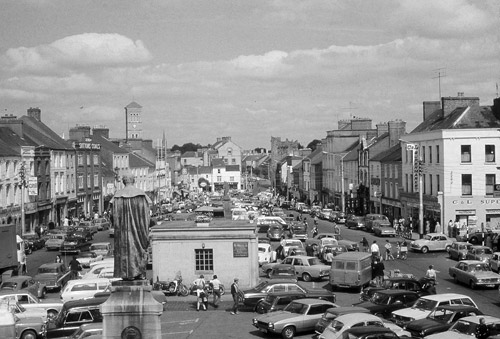
The busy prosperous Liberty Square of the 1960’s.
That is all well and good in Dublin with its network of buses, trams and taxis. Here in rural Thurles such public transport is very limited. There isn’t a Dart tram line to be found running from rural Upperchurch or indeed Two-mile-Borris or Littleton villages every 15 minutes. Indeed there is not one single bus shelter to be found in Thurles, to protect a prospective bus passenger from our inclement weather.
For those who wish to view what exactly will be forced on the residents and businesses of this once prosperous midland town, take a look here: N62-Slievenamon-Road-Phase-2.pdf
NOTE Page 6 of the above pdf: “Some of the key interventions that this strategy will deliver include significant investment in the provision of safe, segregated infrastructure to protect those walking and cycling on our roads, and initiatives to promote modal shift from motor vehicle travel to support environmental, safety and health objectives.”
The picturesque Liberty Square, midday in 2023, asks a Question: Where are the town centre consumers; where are the cyclists; the walker, and the vehicle parking spaces. Answer: Driven out with the businesses. Gone to support German international discount retailers on the outskirts of Thurles, who offer very little local employment, while selling a considerable amount of German processed produce.
See also what is planned in the Draft Discussion maps for Slievenamon Road, shown here: N62-Slievenamon-Road-Map.pdf.
Question: Where are the Cycle Paths either on a half upgraded Liberty Square, town centre or on this newly designed, still to be revamped, Slievenamon Road plan? Answer: Non existent.
This October 2022 plan will most certainly drive home that final nail in our town centre’s coffin. However, the local electorate, (now remaining surprisingly silent), can express their anger, during local elections, expected to be held possible next March.
A Recruitment Competition launched for CEO designate of New Policing & Community Safety Authority (An tÚdarás Póilíneachta agus Sábháilteachta Pobail) has been launched today.
A competition has been launched to recruit a Chief Executive Officer designate for the forthcoming new agency – An tÚdarás Póilíneachta agus Sábháilteachta Pobail, the Policing and Community Safety Authority (PCSA), latter which will be established following the enactment of the Policing, Security and Community Safety Bill, which is currently before the Seanad.
The competition has been launched by the Public Appointments Service, with the deadline for applications to close at 3:00pm, on Thursday, November 16th, 2023.
Once established, the PCSA will consolidate and enhance the broad-ranging oversight functions of the existing Policing Authority and the expert inspection functions of the Garda Síochána Inspectorate into a new body. This is a key step toward a more cohesive and effective framework for the independent oversight of An Garda Síochána and to help in building stronger, safe communities.
The establishment of the PCSA is one important element of the broad overall suite of changes being delivered under the Policing, Security and Community Bill 2023.
A comprehensive implementation programme is running in parallel with the passage of the Bill, to ensure that the new structures and provisions can be established as soon as possible, following enactment.
The key role of the PCSA will be to review and assess the performance of An Garda Síochána and to promote the continuous improvement of An Garda Síochána in delivering on their mission of ‘Keeping People Safe’. The independent body will benefit from an expert, in-house inspection function, which will have robust inspection powers, including the power to conduct unannounced visits of Garda premises.
The PCSA will also promote inter-agency collaboration and community engagement to improve community safety, including through oversight of Garda cooperation and collaboration with other relevant agencies. This is in line with the policy underpinning the Bill that improving and maintaining community safety is not only the responsibility of An Garda Síochána, but requires a whole-of-Government and cross-society approach.
The PCSA will also continue to fulfil the important public awareness and engagement role of the current Policing Authority, including through regular public meetings with the Garda Commissioner and his senior leadership team.
This website uses cookies to improve your experience. We'll assume you're ok with this, but you can opt-out if you wish.AcceptRead More
Privacy & Cookies Policy
Privacy Overview
This website uses cookies to improve your experience while you navigate through the website. Out of these, the cookies that are categorized as necessary are stored on your browser as they are essential for the working of basic functionalities of the website. We also use third-party cookies that help us analyze and understand how you use this website. These cookies will be stored in your browser only with your consent. You also have the option to opt-out of these cookies. But opting out of some of these cookies may affect your browsing experience.
Necessary cookies are absolutely essential for the website to function properly. This category only includes cookies that ensures basic functionalities and security features of the website. These cookies do not store any personal information.
Any cookies that may not be particularly necessary for the website to function and is used specifically to collect user personal data via analytics, ads, other embedded contents are termed as non-necessary cookies. It is mandatory to procure user consent prior to running these cookies on your website.







Recent Comments