From yesterday May 9th to May 15th is Coeliac Awareness Week. Every day this week the Coeliac Society of Ireland will host a number of free online events. This year the events focus on the psychological impact of living with coeliac disease and gluten intolerance. Webinars will explore gluten-free cooking, wellbeing, mental and physical health challenges, as well as advice on nutrition and sleep. To register for free and to view more details about the schedule of events click HERE.
What is Coeliac Disease?
Coeliac disease is a condition where a person is intolerant to the gluten protein found in wheat, barley, rye and oats. Gluten is therefore found in foods made from these ingredients, including breads, pasta, cakes and many processed foods.
Coeliac disease is an auto-immune disease which means that your immune system mistakenly attacks your own body. When a person with coeliac disease eats gluten, the lining of the small intestine is damaged which in turn stops the body’s ability to absorb nutrients.
There is no cure for coeliac disease but a gluten free diet keeps the condition under control. If left undiagnosed however, the condition can result in osteoporosis, anaemia, infertility and some types of cancer.
Symptoms of coeliac disease can range from mild to severe and may include diarrhoea, bloating, abdominal pain, weight loss and malnutrition. It is not certain what causes coeliac disease but it is thought to be some combination of genetic and environmental factors.
It is believed that the condition effects 1 in every 100 people, with an estimated 50,000 people living with coeliac disease in Ireland and a further 400,000 living with gluten intolerance.
If you have any concerns about your health and coeliac disease or gluten intolerance, please contact your GP.
Thurles as a midland town has everything one could wish for; Theatres, Nightclubs, a Swimming pool, Gyms, a Museum, a County Library, excellent Shops, Restaurants, Hotels, Top Primary & Secondary Schools, Two Excellent Third Level Institutions and a very low crime rate. Indeed, as a place to live you could not find better, with caring neighbours and for the moment at least, affordable housing.
The Covid-19 pandemic in Co. Tipperary has seen an upsurge in the purchase of dogs as household pets. In turn, prices for dogs have soared in value and lockdown has even led to a higher business turnover for vets, because of this wish to increase canine ownership.
During lockdown people have turned to ‘man’s best friend’ for comfort and support and dogs have been a positive addition, great company and even protection for those living alone in many homes.
This sudden increase in dog ownership has regrettably demonstrated a negative side also. One major downside for people residing in Thurles, (whether they own a dog or not), has been an increase in dog fouling around our streets and public park areas. This has suddenly given an annual voice to some local councillors and to community activists, latter with an eye to becoming possible future councillors.
An bhfuil cead agam dul go dtí an leithreas?Irish: Can I go to the toilet?
With more people out exercising their new dogs, instances of dog defecation on footpaths have risen somewhat and many local residents have become mildly annoyed by the problem, especially those whose homes directly open unto footpaths and road frontage.
Dog Fouling – One Solution.
If dog fouling is a problem on our streets, what can we do to solve it and who can we turn to for help?
Local authorities are responsible for the control of dogs under the Control of Dogs Act 1986. They can appoint dog wardens, impose fines and take court action against dog owners. Tipperary County Council currently employ two dog wardens.
Although one might be quick to criticise Tipperary County Council officials and their appointed dog wardens, for failing to deal with the situation, dog fouling is a nationwide problem that all Municipal District Councils are finding extremely difficult to manage. Why? Because Dog fouling is almost impossible to police under current legislation. To impose a fine on a dog owner who lets their dog defecate on a footpath without appropriate remedy; you need to catch them in the act and they have to refuse to clean it up. Most people when directly shamed or threatened with a fine by the dog warden, will pick up their dog’s faeces.
Under these conditions, it’s not realistic to expect a dog warden alone, to deal with such issues, especially when one also considers the fact that the majority of people walk their dogs early in the morning and late in the evening, when the dog warden is off duty. With few onlookers and the public in general reluctant to shame such individuals into compliance, and with the dog warden’s back turned, it is a temptation during quieter times of the day to leave dog faeces on the footpath.
Thankfully, this issue has already been recognized at government level. The existing laws to deal with dog fouling are now recognised as being inadequate. A more logical and practical approach to policing irresponsible dog owners has been proposed through a Bill (Deputy Seán Crowe TD, Dublin South West), to amend the Litter Pollution Act of 1997. Mr Crowe seeks to amend existing legislation to, “make it an offence for a person, in charge of a dog in a public area, to fail to produce evidence of having a suitable bag or other instrument with which to dispose properly of dog faeces, when requested to do so by a dog warden, a litter warden or a member of An Garda Síochána”. This proposal Bill therefore if adopted, (and there is every probability that it will be unobstructed) will make recent local radio and press reports almost antiquated.
More However Is Still Needed
More effective policing is certainly one solution, but much more is also needed. Once a dog owner picks up their dog faeces, it is vital that they have a suitable place to dispose of it. This is one small area where Tipperary County Council can do more; by simply installing an adequate network of bins on our streets and in our park lands. At least then, dog owners won’t be deterred from cleaning up, in the knowledge they are no longer forced to carry dog faeces on their person, over long distances.
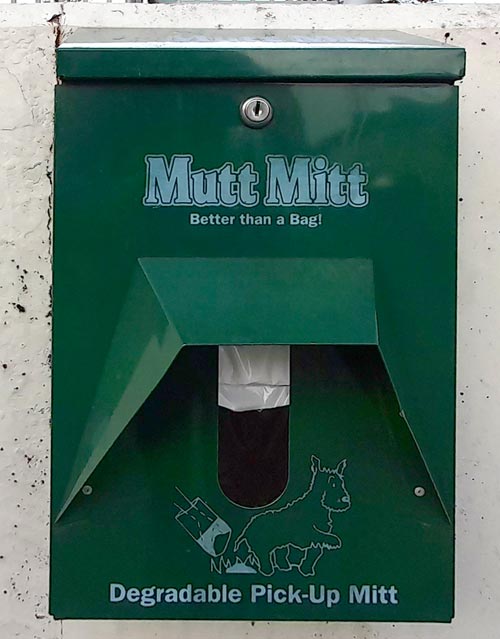
To be fair to Tipperary County Council, same have provided dispensers and free bags (Mutt Mitt a degradable pick-Up Mitt), and raised awareness of the issue.
Dog fouling is not only an unsightly and filthy nuisance, but it is also a dangerous health risk. Dog faeces can expose us to illnesses, with children and pregnant women most at risk. Toxocariasis, an albeit rare condition, can be contracted from infected dog faeces and can cause organ damage and eye disease.
“Every problem has a solution and if a problem doesn’t have a solution, then it’s a fact of life, legislate or live with it.”
There’s a wise old saying, “Every problem has a solution and if a problem doesn’t have a solution, then it’s a fact of life, legislate or live with it.” Dog fouling doesn’t have to be a fact of of life, but the solution to the problem of dog faeces isn’t simple either. It will involve a combination of better legislation, policing, deterrents, facilities, education and greater public awareness. Tipperary County Council will have a lot more work to do, to change dog owners mindsets, but in the end local pedestrians, prampushers and cyclists will be extremely grateful and supportive.
Minister for Further and Higher Education, Research, Innovation and Science Mr Simon Harris TD has designated AIT and LIT Ireland’s next technological university, (TU).
Announcing the designation of the new TU, Minister Harris TD stated, “This is another hugely important day for higher education in Ireland and in particular for the Midlands and Mid-West regions.
The higher education landscape is rapidly evolving and the people of the Midlands and Mid-West will henceforth be at the heart both geographically and practically of that evolution. This new technological university designate will increase higher education access, provide enhanced research-led teaching and learning, drive enhanced regional development and increase opportunities for students, staff, business and enterprise, local communities and regional stakeholders, thereby facilitating and promoting deepened socio-economic progression.
This new TU – our third since 2019 – will now take its rightful place in the higher education landscape in the country’s heartlands. I would like to warmly congratulate and sincerely thank the very many people from the two Institutions including their management, governing bodies, staff, students and the wider regional and community stakeholders who have enabled today’s announcement and who can now look forward to an exciting future for this new university and the regions it will serve.”
Minister of State with responsibility for Skills and Further Education Mr Niall Collins TD added, “This is a transformational event for the people of the Midlands and the Mid-West. We know the many faceted benefits of TUs and we are seeing how they can transform regions elsewhere. This will allow people across the Midlands and Mid-West and beyond through digital connectivity to obtain a university degree in their home places. As a former LIT lecturer and a proud Limerick man, I am delighted to see this milestone being reached, and I want to congratulate all involved.”
Welcoming the announcement, the presidents of both institutes of technology, LIT’s Professor Vincent Cunnane and AIT’s Professor Ciarán Ó Catháin, described the designation of the new TU as the conclusion of a strong and dedicated collaboration process between two institutions with a shared vision and ethos.
LIT President Professor Vincent Cunnane stated, “Today is a Red-Letter Day for the Midlands and Mid West, and a significant day in the educational history of the regions and indeed Ireland. Receiving TU designation is a huge achievement – an achievement based on a strong, comparable strategic direction in both organisations over a number of years, and a real concerted effort for the last 18 months. The new TU promises to be a university with a strengthened regional focus and a national and international outlook, that will benefit our staff, our students and the communities we serve. It will take its place as an economic driver for the regions in a post pandemic Ireland, rebuilding our economy and our society, researching new ideas, providing solutions, supporting business and industry, while ensuring a first-class education for all its students.”
Chair of Governing Body LIT Mr Tony Brazil stated, “The new university points to a strong future serving a region that stretches along the River Shannon, making this area even more attractive to Indigenous SMEs and foreign direct investment, by linking knowledge, research, education and innovation. The new TU will require significant public investment and support to reach its full potential, as it opens up educational opportunities to areas previously underserved. This new university will carry with it the student-centred ethos of its predecessors ensuring access to education for the communities it serves.”
AIT President Professor Ciarán Ó Catháin stated, “This is a historic day for the Midlands and Mid West of Ireland, as we see our ambition of achieving technological university status realised. Today’s designation will see AIT and LIT come together to form a new educational powerhouse, linked by the River Shannon. Unique in its geography, the new university will border almost half of Ireland’s 26 counties, providing unprecedented levels of access to higher education. This will be a transformative change in accessibility and one that we are proud to lead. As a new university, we will be bold and ambitious. We will drive future development and technological innovation across Ireland and on an international stage through cross-cutting, high-TRL research and knowledge transfer to stakeholders in industry. Today marks the start of an exciting future for all.”
Chair of the Governing Body AIT Mr Liam Rattigan added, “As chair of the AIT Governing Body, I am delighted to see the progress that has been made over the last 18 months, which has now culminated in the creation of Ireland’s third technological university. The new TU will be a powerful educational entity that will serve with dedication and distinction, futureproofing higher education across the Midlands and Mid West through practical learning, applied research and strong industry engagement. The future is indeed bright, and we can now look forward to opening our doors and starting a new chapter in our story.”
Professor Tom Collins, Project Facilitator of the AIT-LIT Consortium stated, “It has been a great privilege to have been able to play a small part in the formation of this newest Irish university. The region to be served by this technological university, a region which is unified and defined by the Shannon, will be enabled by this new university to face and shape the future with confidence, resilience and expertise.”
New SU President-Elect Áine Daly and LIT SU President Dylan Ryan both added, “We were delighted to be part of the process that brought us to TU designation today, and proud of our students who ensured they had their say in the formation of Ireland’s next technological university.”
Today, May 5th, is World Maths Day, one of the largest annual educational events in the world. In honour of World Maths Day here are ten Maths riddles that are sure to challenge your mathematical acumen.
(1) What number goes up but never goes down. (2) How did the soccer fan know before the game that the score would be 0-0? (3) If you multiply this number by any other number, the answer will always be the same. What number is this? (4) I am a three-digit number. My second digit is 4 times bigger than the third digit. My first digit is 3 less than my second digit. What number am I? (5) I add five to nine and get two. The answer is correct, but how? (6) How can you take 2 from 5 and leave 4? (7) Using only addition, how can you add eight 8’s to get the number 1,000? (8) Where can you add 2 to 11 and get 1? (9) Once I’m 24. Twice I’m 20. Three times I’m inappropriate. What am I? (10) What can you put between a 7 and an 8 so that the result is greater than a seven, but less than an eight?
(1) Your age. (2) The score is always 0-0 before the game. (3) Zero. (4) 141. (5) When it is 9 p.m., add 5 hours to it and you will get 2 p.m. (6) Remove the 2 letters F and E from the word FIVE and you have IV. (7) 888 +88 +8 +8 +8 =1,000. (8) On a clock. (9) The letter “X”. (10) A decimal because 7.8 is greater than 7, but less than 8.
The Department of Health this evening has confirmed that there has been 1 further death caused by the Covid-19 pandemic; leaving the overall death toll, here in the Republic of Ireland, remaining at 4,906.
In the 6 counties of Northern Ireland, their Department of Health have confirmed 69 new Covid-19 cases, and 1 further death also.
There have been 402 new additional virus cases reported here within the Irish Republic. This leaves the current total number of confirmed cases, since conception, at 249,838.
Of the cases confirmed today, 79% were under the age of 45 years.
There have been 5,860 virus cases confirmed here in Co. Tipperary, since the pandemic began, same figure relevant up to and including April 30th, 2021.
There are 127 people with Covid-19 remaining in hospital today, and of that number, 41 are in ICU’s, according to Ireland’s COVID-19 Data Hub.
Some 1,130,958 first doses of Covid-19 vaccines have now been administered here in Ireland up to April 30th, with 441,821 persons having received their second dose.
Meanwhile, Fianna Fáil TD and Minister for Education Ms Norma Foley is appealing to Leaving Cert students not to party so that their exams can go ahead as planned this year.
Ms Foley issued the warning as the final countdown to the State exams gets under way and as Leaving Cert students were given their last chance to decide whether they will sit the exam or opt to accept predictive grades based on work submitted during the past academic year.
The total worldwide number of virus cases identified up to 5:00pm this evening, now stands at well over 151.51 million confirmed, with global deaths at well over 3.18 million.
This Holiday Weekend, Please Do Continue To Behave Responsibly.
This website uses cookies to improve your experience. We'll assume you're ok with this, but you can opt-out if you wish.AcceptRead More
Privacy & Cookies Policy
Privacy Overview
This website uses cookies to improve your experience while you navigate through the website. Out of these, the cookies that are categorized as necessary are stored on your browser as they are essential for the working of basic functionalities of the website. We also use third-party cookies that help us analyze and understand how you use this website. These cookies will be stored in your browser only with your consent. You also have the option to opt-out of these cookies. But opting out of some of these cookies may affect your browsing experience.
Necessary cookies are absolutely essential for the website to function properly. This category only includes cookies that ensures basic functionalities and security features of the website. These cookies do not store any personal information.
Any cookies that may not be particularly necessary for the website to function and is used specifically to collect user personal data via analytics, ads, other embedded contents are termed as non-necessary cookies. It is mandatory to procure user consent prior to running these cookies on your website.







Recent Comments