With our Harvest moon waning and Autumn wind, low temperatures and rain prevailing outside today, let us take a virtual walk on the Great Famine “Double Ditch”, starting from the Mill Road side of Thurles, in Co Tipperary.
Warning, during our simulated walk of this existing location, do watch out for the barbed wire. Same was placed on either side by the Thurles Municipal District’s work force, reducing progress along this right-of-way, to single file only.
Yes, since Thurles Municipal District own the land on either side it is highly unlikely that anyone else came in to fence using barbed wire; ergo, they are aware that the public legal right, established by usage over the last 175 years; to pass along this specific route and Mass path, does truly exist. This of course remains contrary to the recent nonsensical statement made by Thurles Acting District Manager Ms Janice Gardiner and former Thurles Acting District Manager Mr. Eamon Lonergan.
Let us chat as we walk: (Ignore the “flytipping’, and burnt-out crab apple trees. Most of the fridges, 3 seater couches, washing machines, vacuum cleaners, beer cans, children’s toys and broken sinks etc. remain covered this Autumn courtesy of Mother Nature, in her effort to hide our shame.)
As we begin our walk, remember this Double Ditch was built by a group of men and boys who understood what it was like to watch their families starve and who had, themselves experienced extreme hunger; something no man, woman or child, thankfully, has to endure or experience, unless wilfully, in our Ireland of the 21st century.
For the Thurles paupers of 175 years ago, the only existing social welfare system that existed, was an overcrowded ‘Workhouse’ from which very few would leave in their own lifetime.
What Is A Double Ditch?
A single ditch is a narrow channel dug at the side of a road or in a field. Its purpose is to either hold, drain or carry away flood water. In Anglo-Saxon, the word ‘dïc’ was pronounced ‘deek’ or ‘deetch’. In digging such a water trench the upcast soil will form into a bank alongside it. This banked soil thus means that the word itself included not just the excavation alone, but also the bank of soil derived from such efforts. Latter word would later evolve into the English words we more commonly use today, e.g.‘dyke’ or ‘ditch’.
Now, if we dig two ditches side by side and you will create a double ditch which in turn creates a high platform in the centre, enabling people to cross extremely wet land without wearing waterproof overshoes (Galoshes) or the then worn leather Wellingtons (Latter first invented around in 1817 and the then privilege only of landed gentry and aristocracy.)
In the case of the Thurles Double Ditch, both sides of the raised platform were faced with limestone; which came free from a stone quarry the property of Rev. Dr. Henry Cotton.
On the day that this Thurles Great Famine work project began, we learn from further hand written communication sent to the Trustees appointed for the distribution of Indian Meal, quote: – “In the town of Thurles alone there are at this moment 768 families containing 3364 inhabitants in actual want; of these 739 are old men, women and children, unable to work and who have no one to labour for them; and the remaining 2625 are depending on the daily hire of the sons and heads of the families to the number of 790 able to work and now out of employment”.
The idea of this Thurles “Double Ditch” was to provide work for paupers unemployed and starving.
The following rules for labourers employed to work on this ‘Double Ditch’ were adopted: –
(1) Hours of labour to be from 7.00am to 7.00pm with 2 hours for meals. (2) Any labourer found to shirk from reasonable and fair work or refusing to follow the directions of his overseer shall forthwith be discharged and not admitted to the works again. (3) That the persons employed shall be paid every evening. (4) That in case of a greater number of labourers shall offer themselves, than the funds will enable the committee to pay. A preference shall be given to those who have the largest and most necessitous families”.
It was further agreed that, quote: –
“Henceforth there be two rates of payment; 8 pence and 5 pence, and that no boy under 12 years old be employed. That tickets of the form now agreed on, should be printed to admit labourers to work – those for men in black ink and those for boys in red ink; Ordered that 500 red and 500 black tickets be printed. Families containing 7 members and over and having 2 men over 17 shall, at the discretion of Committee, be entitled to 2 black tickets; Families having a less number shall, if the Committee wish, get 2 tickets, one red and one black”.
On December 4th 1846, we learn that “In workhouse this day 740 (Persons) – House built to contain 700. Five families were refused admission on Thursday last by the Guardians; in three cases the husband applied with the wife and children stating that he was employed in the public works but that the hire scarcely keeps them alive; in the other 2 cases the wives and children applied without the husbands and stated the hire would not support them. The men offering to support as many of their families as the wages would enable them.”
The Thurles Workhouse
The Thurles Workhouse was built during the period 1841- 1842 to accommodate 700 inmates, on a 6.5 acre site at Castlemeadows, Gortataggart, Racecourse Road, Thurles, Co. Tipperary, (back then known as East New Street). The finished workhouse building was declared fully fit for the reception of the destitute poor on the 25th April 1842 four years before the Great Famine. First admissions however were not received until November 7th of that same year. The workhouse was demolished completely except for a low wall, 16 years ago, in 2004.
Later, with the loss of the potato crop, beginning in the Autumn of 1845; in 1846 sheds to the rear of the main building, originally designed to house straw (latter to make mattresses for beds) and turf (for the provision of heat), would be converted into a 70 bed Epidemic Typhus, Fever Hospital; latter killer disease spread by body lice.
In a report sent from Thurles to the “British Association for the Relief of Extreme Distress in Ireland and Scotland” and forwarded to Lieutenant Col. Douglas on February 11th 1847 we learn; – “Of the population of the united parishes of Thurles, 8,000 are on the relief list. The majority obtains very inadequate relief by employment on Public Works. There are about 300 destitute families having no person to work, to whom gratuitous relief must be given; there are other families varying from 10 to 12 having only one member able to work, whose wages 10p a day would not be adequate to the support of two persons at the present famine prices of food. The poor house built to accommodate 700 has now stowed within 940 and there cannot be any more admissions, and groups who cannot be admitted are to be seen shivering in the cold and wet anxiously expecting the fragments of cold stirabout that remains after the inmate pauper meal. We have lived to see the poor sitting at the pauper’s gate among the crumbs that fall from the pauper’s table. We have not had any deaths from actual starvation but numerous deaths have occurred from severe and long continual privation. The weekly average of deaths has increased fivefold.”
Thurles Municipal District Council in conjunction with Tipperary Co. Co. we believe, now wish to eradicate this important history from our midst, instead of using same to attract much needed and currently non-existent tourism.
History is NOT there for you to like or dislike. It is there for you to learn from and if it offends you, even better. Because then you are less likely to repeat it. It’s not yours to ERASE. It belongs to all of us.
According to Tipperary County Council’s online policy statement on heritage, the role of their Heritage Office is, “To promote awareness and appreciation of our rich heritage and to protect and enhance it for future generations”. View HERE.
According to the same Tipperary County Council’s online policy statement on planning the purpose of the Planning Section is “To ensure the protection of the natural built heritage and amenity of the county”. View HERE.
One would believe that same policies should allow for Tipperary dwellers to feel safe, same policies having been signed off on by Tipperary Chief Executive Mr Joe MacGrath. Alas, eight weeks on and no direct written communication from the same Mr MacGrath or his nominee Mr Marcus O’Connor.
We also await communication from the recently re-assigned Ethics Registrar, Mr. David Coleman, Administrative Officer, Corporate Services, (Tel: 0761 065000) with regards to the failure by the above named local councillors to follow their required Code of Conduct.
We gather from the reply by Ms Janice Gardiner or Mr. Eamon Lonergan, (we are unsure of the actual author – View HERE), that it is the full intention of Tipperary Co. Council to destroy the historic 1846 Thurles “Double Ditch”.
Both have stated that the Double Ditch does not exist, but of course it does and its stone clad sides can be viewed with the naked eye. So can be viewed the one step, stone, stile at one end, latter destroyed by Tipperary Co. Co. and the swinging rotary gate at the other end, erected by Tipperary Co. Co.. Do watch the video above again.
Our video shown above indicates clearly; as you enter from the College Lane side of the Double Ditch, in Kickham Street, the abject failure by local politicians to attract any industry into Thurles over the past 30 years. The failure to generate even one long term job, can be observed simply by viewing the abundance of graffiti on the walls of an area; same having such a strong bearing and mutual relationship with our past local history.
Tipperary Co. Council has over the years eradicated much of the town’s history. Just two examples are the Moat and Moat Lane and in more recent years Hickey’s pub (Griffins Shop). In both cases using rate payer’s money back then to build the Parnell Street car park and more recently, (yet to open), the new car park. In turn both these tax payer funded projects are being used to generate further taxes, laughably at the expense of the very same tax payers who funded them in the first place; result the destruction of the town centre, through parking charges.
We are now aware, sadly, that some of our local elected representatives and county council officials are faithless; treacherous and deceitful, showing a willingness to act dishonestly, by failing to communicate directly with those who elected them and who pay their wages.
This deceit is further borne out by a communication from Ms Josepha Madigan TD, former caretaker Minister for Heritage, who stated, and I quote, “So far as we understand, there is no direct impact on the “Double Ditch” from any current development. The Department is a statutory consultee in the planning and development process, but our role in this regard is to respond to particular development proposals as referred to us by the planning authority.” Of course we now know that the ‘statutory consultee’ appears to have been misinformed by the “planning authority” as were the staff who provided the Environmental Impact Assessment Screening Report and those involved in the conjuring up of the Archaeological Impact Statement.
Perhaps the time has come for a locally-led task force for Thurles, akin to that same recently appointed force in Tipperary Town.
Six new confirmed cases of the killer Covid 19 virus recorded over the last 24 hours in Co. Tipperary, bringing our overall case numbers to 755.
This evening, figures from the Department of Health confirm that there has been zero new deaths caused by the Covid-19 pandemic; leaving the overall death toll here in the Republic of Ireland remaining at 1,792.
However, there are 274 new additional cases reported today, leaving the current total number of confirmed cases, since conception in the Irish Republic, at 32,538.
Of the cases confirmed in the republic; 166 are in Dublin; 21 in Cork; 19 in Donegal; 7 in Kildare; 7 in Offaly; 6 each in Waterford and Wicklow, 5 each in Louth, Limerick and Meath; with the remaining 27 cases located across 12 counties.
There are more than 200 new confirmed cases of Covid-19 in the last 24 hours in Northern Ireland, one of the biggest daily increases in the region since the start of the pandemic.
Please do make a special effort to stay safe by reducing social contacts; avoiding crowds; physically distancing; while wearing face coverings and washing your hands regularly.
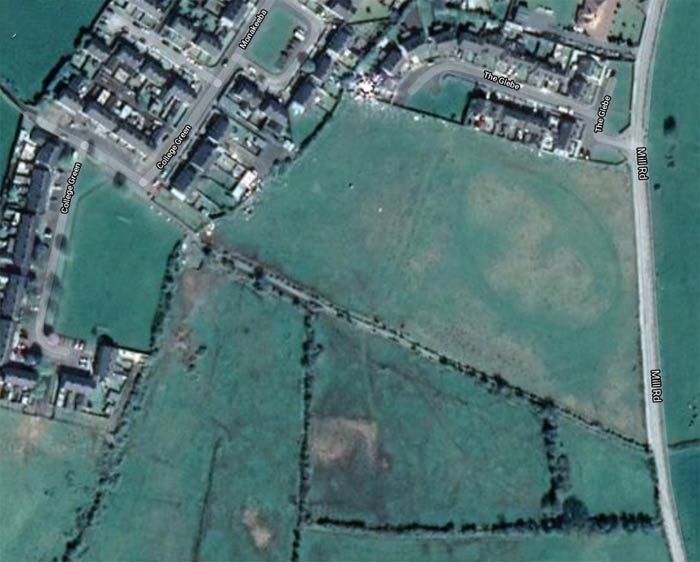
The Thurles Double Ditch, running from College Green, Thurles to the Mill Road in Thurles, viewed onGoogleSatellite Maps which ‘Roads Capital Section’ says “DOES NOT EXIST”. You can view this map HERE
Yesterday, after almost 8 weeks, the Thurles Municipal District Council has eventually replied to my 3 questions. We remain unsure who actually replied since the email, hereunder, suggests two authors. Not that authors matter since the reply is fallacious, imprecise and dare I say possibly felonious.
Questions asked; as if anyone needed reminding, were:- (1). Will the planned Thurles inner relief road impinge, in a negative way, on the 1846 Thurles “Double Ditch”, which has been a Right of Way and a Mass Path for almost 175 years and which is the property of the people of Thurles and a national monument? (2). What are the future plans for the 1798 memorial statue [The Stone Man], first erected in Liberty Square, Thurles in 1900, and still standing there, awaiting possible removal prior to the new upgrade? Note: [We recently published replies on this matter HERE.] (3). Which Municipal District Councillor is responsible for delaying the Thurles Recycling Civic Amenity, which this town so badly needs?
I refer to your email communication sent to Mr. Joe MacGrath, Chief Executive and the Thurles Municipal District Councillors in relation to a number of queries concerning the Thurles Municipal District and advise that the matters were forwarded to myself as District Manager, consideration and direct reply.
Response to queries as follows: Q.1.Response received from the Roads Capital Section.
Tipperary County Council has reviewed all documentation relating to the planning aspects of the Thurles Inner Relief Road Project and can find no reference to the existence of the feature/path/monument you describe. The relevant reference documents/databases in this instance are:
TCC Planning GIS
Department of Arts Heritage and the Gaeltacht – Historic Environment Map Viewer
National Monuments Service – Record of Monuments and Places (RMP)
National Monuments Service Archive Unit – Sites & Monuments Record Archive (SMR)
An Bord Pleanala Report PL79.JP0024
2013 EIA Screening Report
2013 Archaeological Impact Statement
These documents/databases contain no reference to a “Double Ditch”.
Q.2. 1798 Memorial Statue – there are no plans for this monument and it will stay in place during upcoming construction works.
Q.3.Thurles Recycling Civic Amenity – No Municipal District Councillor is responsible for delaying the provision of a Civic Amenity site in Thurles. The provision of a Civic Amenity site in any town is subject to availability of funding from the Department.
Yours faithfully, Mr. Eamon Lonergan, Acting District Manager, Thurles Municipal District.
Email Message Ends
My same-day-reply to Ms Janice Gardiner, bore the following message:- George Willoughbygeorge.willo@gmail.com 00:06 to Janice
To: Ms Janice Gardiner, Madam, Thank you for your communication via Mr Eamon Lonergan. For the moment please view this link http://www.thurles.info/2020/09/16/more-news-on-efforts-to-destroy-thurles-heritage/ Keep in mind that in November of last year (2019) I asked Ms Róisin O Grady(Heritage Officer and Creative Ireland Coordinator) walking on the ‘Double Ditch’to have the area declared a National monument. I now believe it is perfectly fair for me to believe that she has been prevented from achieving this goal by Tipp. Co. Council officialdom. So we must continue to ask questions and seek the truth.
Yours sincerely George Willoughby
Email Message Ends
We have constantly discussed the waste of Tax and Rate payers money by Tipperary Co. Council and we now ask Ms Gardiner, as Thurles Municipal District Manager, to request that any fees paid to or generated by: (1) An Bord Pleanala Report PL79.JP00242013. (2) Environmental Impact Assessment (EIA) Screening Report2013. (3) Archaeological Impact Statement; be immediately refunded to Thurles Municipal District, since all three reports forwarded by them were complete works of fiction or deliberately influenced by officialdom to deceive the people of Thurles town.
I now request copies of all 3 reports to be sent directly to me, in the knowledge that there is a charge for such copies, which I will pay for immediately on receipt.
Please inform the Roads Capital Section; Mr Eamon Lonergan; Mr Marcus O’Connor and Mr Joe MacGrath, that if so much as one blade of grass is touched on the Thurles Double Ditch; costs incurred courtesy of the National Monuments Service will be greater than the compensation cases being defended currently by Tipp. Co. Council; which I understand are estimated at €22 million Euros, if same cases are upheld by the courts.
‘Fly-Tipping’ on Templetuohy to Johnstown Road, Thurles, Co. Tipperary. Photo: G. Willoughby
Ireland generated 14 million tonnes of waste in 2018 across all sectors.
Municipal waste, from household and commercial sources, amounted to 2.9 million tonnes in 2018, up 3.5% on 2017.
Ireland’s waste management practices have changed significantly in the past two decades:
Landfill disposal has fallen sharply to 14% in 2018,
Recycling rates increased steadily in the early 2000s, before stagnating at 40% and declined to 38% in 2018,
Waste sent for energy recovery has risen significantly from 7% in 2011 to 43% in 2018,
Over one third (35%) of Ireland’s municipal waste was exported for recycling or recovery in 2018 highlighting a reliance on export.
We need to decouple waste generation from economic growth and achieve higher levels of recycling and reuse if we are to realise a circular economy in Ireland.
Levels of municipal waste generation in Ireland continue to be closely linked to high consumption levels, as well as a single-use and throwaway culture, according to the Environmental Protection Agency’s (EPA) National Waste Statistics Summary Report 2018 , which includes the most recent official data on waste generation and management in Ireland.
Ireland continues to generate significant amounts of waste, amounting to 14 million tonnes in 2018. In particular, municipal waste, from household and commercial sources, amounted to 2.9 million tonnes, up 3.5% on 2017. While Ireland achieved high recycling rates in some material streams, such as glass and paper/cardboard packaging, the figures reveal some worrying trends.
Ireland’s recycling rate for municipal waste has decreased to 38% in 2018, having remained stagnant at 40% since 2014. Recycling of packaging waste has declined from 70% in 2013 to 64% in 2018. Ireland also continues to have some significant waste infrastructure deficits and relies on export for a number of key waste streams, including packaging and hazardous waste.
Dr Eimear Cotter. Director of the EPA’s Office of Environmental Sustainability, said, “A circular economy is one that is based on less waste and more reuse and recycling of materials that otherwise would be thrown away. These figures indicate that we are going in the wrong direction across a number of indicators, such as falling recycling levels. To get the most from our resources, we need to prevent waste and break the link between economic growth and waste generation. We also need to significantly increase our recycling rates to ensure that Ireland meets ambitious new EU targets in the coming years. Measures that promote better segregation of waste and also expand the range of materials that can be recycled in Ireland will be key to this.”
Over the past decade in Ireland, there has been a welcome decline in landfilling of municipal waste in Ireland, from 62 % in 2008 to just 14 % in 2018. Over the same period, the share of waste sent for incineration with energy recovery has increased substantially from 3% in 2008 to 43% in 2018, reflecting Ireland’s increased incineration capacity since 2011. While these trends indicate some progress has been made in moving waste management further up the waste hierarchy, Ireland’s stagnating recycling rates and continuing high levels of waste generation are a significant cause for concern.
Commenting on the figures, Dr. Tara Higgins, EPA Senior Scientist said, “We welcome that the Government’s new Waste and Circular Economy Action Plan sets out concrete measures to address Ireland’s stagnating recycling rates and continuing high levels of waste generation. We look forward to engaging with and participating in the implementation of the Plan to put Ireland on a path to a circular economy and bring about environmental and climate benefits.”
This website uses cookies to improve your experience. We'll assume you're ok with this, but you can opt-out if you wish.AcceptRead More
Privacy & Cookies Policy
Privacy Overview
This website uses cookies to improve your experience while you navigate through the website. Out of these, the cookies that are categorized as necessary are stored on your browser as they are essential for the working of basic functionalities of the website. We also use third-party cookies that help us analyze and understand how you use this website. These cookies will be stored in your browser only with your consent. You also have the option to opt-out of these cookies. But opting out of some of these cookies may affect your browsing experience.
Necessary cookies are absolutely essential for the website to function properly. This category only includes cookies that ensures basic functionalities and security features of the website. These cookies do not store any personal information.
Any cookies that may not be particularly necessary for the website to function and is used specifically to collect user personal data via analytics, ads, other embedded contents are termed as non-necessary cookies. It is mandatory to procure user consent prior to running these cookies on your website.







Recent Comments