A nationwide awareness campaign to warn against serious risks posed by illegal fireworks, at this time of year, has been launched by the Irish government. Fines of up to €10,000 and 5 years’ imprisonment is applied to those having fireworks in their possession with intent to sell or supply, or if convicted of throwing an ignited firework at any person or property.
This Campaign has been launched in collaboration with An Garda Síochána, the Irish Society for Prevention of Cruelty to Animals (ISPCA), Irish Guide Dogs, and Dublin Fire Brigade. Representatives from the National Office for Community Safety were also in attendance.
While Halloween can be an enjoyable time for local communities, everyone knows the distress the use of such fireworks can cause around this time of year, be they be illegal or not.
Those who use fireworks don’t always fully consider the harmful effect they can have in their local areas and on their neighbours. Fireworks pose a real risk to the health and safety of young people, the elderly and the vulnerable. They also terrify family pets, service dogs, roosting bird life and other animals.
The penalties people face for misusing fireworks show how seriously this kind of behaviour is taken. People are urged to think hard before they use fireworks this year and to consider those who are indirectly impacted by their actions over the Halloween period.
Fire Brigade officials warn of the devastating physical injuries fireworks can cause and urge people to only attend officially organised fireworks displays this Halloween.
Injuries caused by fireworks can going off in some young person’s pocket, can severely burn their leg, or explode in their hands, causing disfigurement to their fingers, or even as projectiles from bonfires, striking them in the face, and causing serious facial and eye injuries. These types of injuries are all potentially life-changing, or even worse.
Irish Guide Dog officials, have highlighted the dangers Halloween poses for Guide and Assistance Dogs and their owners, and while their dogs are highly trained to cope with stress, the anxiety caused by fireworks is beyond what any dog can reasonably endure. In some cases, despite every effort, the trauma is too great, and the dog has to be withdrawn. The owner then faces a profound loss of independence and mobility, while waiting through a lengthy process to be matched with another suitable dog. Also, the senses of smell and hearing by dogs are far more sensitive in most animals than in humans as they can hear at different frequencies than humans. The strange sight, sound and smell of fireworks can be extremely distressing for them. Frightened pregnant female horses (Mares) can also take fright, resulting often in the loss of their off-spring.
Operation Tombola combats the importation, sale and distribution of illegal fireworks, through intelligence led operations, visits to local car boot sales, searches and seizures of fireworks, as well as focusing on preventing associated public disorder and anti-social behaviour through the incremental deployment of resources.
Fireworks are illegal, and young people especially need to be fully aware that it is a criminal offence to throw or direct any ignited firework at a person or property. To this end Community Policing Gardaí in the coming days will be visiting schools to speak with children about the dangers and criminal offences associated with fireworks.
If people have information relating to the sale or supply illegal or unlicensed fireworks, Gardaí are inviting them to please contact their local Garda Station (Thurles – Tel: 0504 25100) or the Garda Confidential Line (Tel: 1800 666 111).
‘We need to do more to protect clean air in towns, villages and cities across Ireland’ says EPA
Air quality in Ireland is generally good and was compliant with 2024 air quality standards, meeting all EU legal requirements.
It will be more challenging for Ireland to meet new and more stringent air quality limits that will come into force from 2030.
Clean air is essential for our health. Around 1,700 premature deaths occur in Ireland each year because of poor air quality.
The Environmental Protection Agency (EPA) has published its report, Air Quality in Ireland 2024, which is based on data from Ireland’s extensive air monitoring network of 115 stations. It reveals that while Ireland currently meets EU air quality standards, we are projected to fall short of the stricter air quality standards set for 2030 under the new Ambient Air Quality Directive.
The new EU Directive, part of the Zero Pollution Action Plan, aims to reduce premature deaths from air pollution by 55 per cent by 2030. Ireland faces significant challenges in meeting these targets, with projected compliance levels of only 93 per cent for fine particulates (PM2.5) and 78 per cent for nitrogen dioxide (NO₂). Ireland also continues to fall well short of achieving the more stringent World Health Organization (WHO) health-based 2040 guidelines for several key pollutants.
The primary sources of air pollution in Ireland are solid fuel burning and traffic emissions. The European Environment Agency estimates that in Ireland, more than 1,700 premature deaths annually are attributable to air pollution, with links to cardiovascular and respiratory diseases, dementia, type 2 diabetes and neonatal mortality. Vulnerable groups, including children and older adults, are particularly at risk.
Mr Pat Byrne, Director of the EPA’s Office of Radiation Protection and Environmental Monitoring, stated: “Many of us have grown up with the comfort of an open fire and limited alternatives to travelling by car—but these familiar habits contribute to poor air quality. Supporting people to shift towards cleaner heating and more sustainable travel isn’t about giving something up—it’s about gaining healthier air and healthier lives.”
Air pollution in Ireland is not confined to cities — towns and villages are also affected. The EPA website www.airquality.ie provides hourly-updated information on air quality and a 3-day air quality forecast. Having these online tools can help us make choices to protect our health during periods of poor air quality. Ms Roni Hawe, EPA Programme Manager for Environmental Monitoring and Surveillance, added: “Ireland is facing considerable challenges in its efforts to meet the more stringent air quality standards set for 2030, as well as the World Health Organization targets for 2040. Achieving these goals will require a decisive shift away from solid fuel burning, alongside the adoption of electric vehicles, efforts to reduce traffic and encouraging the use of public transport.” To find out more about how we can improve air quality read the EPA’s “How we can improve the air we breathe“infographic or check out the “Government of Ireland Clean Air“, which highlights some simple steps we can all make and help reduce pollution from solid fuels. The Air Quality in Ireland 2024 report is available on the EPA website HERE.
Ireland is predicted to miss targets for recycling municipal and packaging waste for 2025.
An additional 400,000 tonnes of recycling is needed to reach our targets.
Packaging waste generation has increased almost four times faster than recycling since 2016.
Plastic packaging recycling rate is just 30 per cent, significantly below the required target for 2025 of 50 per cent.
Construction waste is Ireland’s largest waste stream, reaching nine million tonnes in 2023.
The Environmental Protection Agency (EPA) has published its latest data on municipal, packaging and construction and demolition waste for the 2023 reporting year. EPA data shows that in 2023:
Ireland’s municipal recycling rate is 42 per cent, significantly below the 55 per cent target.
Ireland’s packaging waste recycling rate is 59 per cent and the 65 per cent target is at risk.
Ireland’s plastic packaging recycling rate is 30 per cent, significantly off the 50 per cent target.
While 1.3 million tonnes of municipal waste were recycled, this represents no improvement in recycling rates over the past decade. Investment in waste infrastructure is needed to reduce our reliance on overseas facilities with 1.2 million tonnes of municipal waste exported in 2023.
Opportunities to reduce, reuse and recycle valuable materials and resources are also being missed. Packaging waste generation is excessive, and our rate of waste generation is increasing more than we are increasing recycling capacity.
It is now almost certain that mandatory recycling targets that apply from 2025 will be missed.
Commenting, Mr David Flynn, Director of the EPA’s Office of Environmental Sustainability, EPA said: “Ireland’s waste generation is too high. Our report highlights that Ireland needs to make measurable progress on stalled recycling rates and reduce overall consumption. Ireland needs to recycle 400,000 more tonnes of waste each year than we currently do. To address this we need investment in recycling infrastructure and to stop exporting a significant amount of our municipal waste to other countries.”
Construction is the most wasteful sector with nine million tonnes of construction waste generated in 2023. As the industry grows, companies need to urgently prevent waste and maximise the use of recycled and recyclable products.
Commenting, Mr Warren Phelan, Programme Manager of the EPA’s Circular Economy Programme said: “Ireland’s economy uses significant raw materials producing valuable products and materials – but also lots of waste. If we are serious about moving to an economy which values resources and materials, we need to support innovation for low waste businesses as well as lean production, remanufacturing and circular supply chains. Materials and wastes are a cost to businesses, we need to value and retain materials, and our policies must incentivise circular businesses.”
The EPA’s national waste statistics are published on the EPA website HERE where more information on all of the waste streams is now available.
A book, entitled “The Oldest Of Old Kriegies”, has now been published by Moycarkey-Borris, Littleton Men’s Shed History Group, under the guidence of Dr Pat McMahon.
The word “Kriegie”[pronounced kree-gee] is the German military slang for an Allied prisoner of war held in a German internment camp during World War II.
Local history researcher and member of Moycarkey-Borris Littleton History Group, Mr Michael Dempsey, now reports.
The new publication “The Oldest Of Old Kriegies”, is a well sourced publication which has researched, for the very first time and in greatest detail, the life of former Littleton, Thurles, Co. Tipperary resident Mr Lawerence (Larry) Slattery. Before coming to Littleton, Mr Slattery was born on February 28th 1913, some 35km away in Rossacrow, Donohill, Co. Tipperary, of parents Mary Ann (nee Moran) and Michael Slattery, both primary school teachers.
On September 4th 1939, Mr Slattery’s aircraft was shot down over the sea at Wilhemshaven, west of Hamburg, latter a coastal town in Lower Saxony, Germany, while attempting to bomb 4 warships.
Picked up from the sea Mr Slattery would go on to become the longest detained British P.O.W of the entire War; not being finally freed until Allied troops reached his prisoner-of-war camp (stalag) in April of 1945.
Moycarkey-Borris History Group Littleton (MBL) would like to thank the National Archives of Ireland, Military Archives of Ireland, University College Dublin (UCD) Archives, Rockwell College Archives, Lincoln University Digital Archives, British National Archives, Tipperary Studies (at Thurles Library), and family descendants, from whence this extensive research now featured in this publication was gleaned.
This new publication can be purchased from Book Worm Bookshop & Cafe,Thurles, The Horse & Jokey Hotel, from all retail shops in Littleton and directly from members of the Moycarkey-Borris, Littleton Men’s Shed, History Group. Mobile Phone:086-3648664.
Carved into buildings, Churches, bridges and old stone walls across Ireland are these small but remarkable relics of scientific history, known as Ordnance Survey Benchmarks.
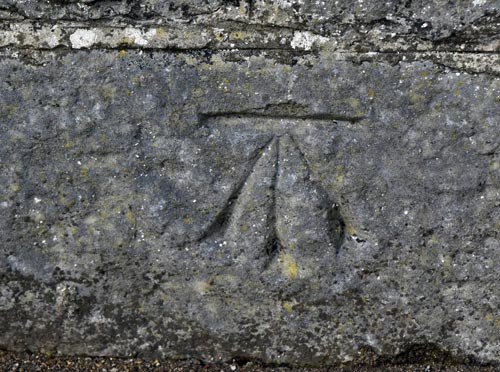
One Ordnance Survey Benchmark (Devil’s Mark) in Thurles, Co. Tipperary. Pic: G. Willoughby.
Though created for science and statecraft, they soon became part of Irish folklore. Particularly in the west of Ireland, where oral tradition recalls that some communities called them the “Devil’s marks,” believing the mysterious cuts were left by dark forces. Same were sometimes smashed in the belief that with these marks, once removed, would ensure that the Devil could not return.
These chiselled symbols, usually a simple crow’s foot cut beneath a horizontal line (view image above), once formed part of a vast system for measuring height above sea level. Known colloquially as “sappers’ marks,” the upward-pointing arrow same contain, was borrowed from the British Government’s ‘broad arrow’ emblem of ownership, repurposed by surveyors as a practical, durable and instantly recognisable tool. At one point the British government issued prison clothing which were stamped with this ‘broad arrow’ emblem, so that people in the towns and villages would know that these individuals were convicts.
The story of benchmarks begins with the Ordnance Survey of Ireland (OSI), established in 1824 under Lt.-Col. Thomas F. Colby. His team carried out the world’s first large-scale mapping of an entire country, culminating in the survey of 1834 and the levelling of Ireland between 1839 and 1843. By 1846, Colby’s monumental effort was complete, leaving behind not only the celebrated six-inch-to-the-mile maps but also a physical legacy inscribed into the landscape.
Each benchmark recorded a precise elevation point, forming a network that allowed engineers, builders, and cartographers to work from a common reference.
Today, a lot of benchmarks still survive as tangible links to Ireland’s first great scientific survey and the progress it represented. Yet they lack any protection status. Modern demolition, redevelopment, road surface levels rising and weathering have already erased from sight, and permanently eradicated many.
Sadly, without awareness and preservation, these modest but historic cuts in stone may in time vanish altogether, along with the stories and the knowledge that they carry.
This website uses cookies to improve your experience. We'll assume you're ok with this, but you can opt-out if you wish.AcceptRead More
Privacy & Cookies Policy
Privacy Overview
This website uses cookies to improve your experience while you navigate through the website. Out of these, the cookies that are categorized as necessary are stored on your browser as they are essential for the working of basic functionalities of the website. We also use third-party cookies that help us analyze and understand how you use this website. These cookies will be stored in your browser only with your consent. You also have the option to opt-out of these cookies. But opting out of some of these cookies may affect your browsing experience.
Necessary cookies are absolutely essential for the website to function properly. This category only includes cookies that ensures basic functionalities and security features of the website. These cookies do not store any personal information.
Any cookies that may not be particularly necessary for the website to function and is used specifically to collect user personal data via analytics, ads, other embedded contents are termed as non-necessary cookies. It is mandatory to procure user consent prior to running these cookies on your website.





Recent Comments