The Ursuline Secondary School community here in Thurles, Co. Tipperary, is celebrating with great pride, following the news that former student Ms Jessie Buckley has won the 2026 Academy Award for Best Actress for her powerful performance in the film “Hamnet”.
The Academy’s official results confirm Buckley’s win, while multiple reports noted that she became the first Irish performer to win the Oscar for Best Actress.
Jessie Buckley’s success has been warmly welcomed in Thurles, where she is remembered as a talented and creative former Ursuline secondary student whose journey from the classroom to the world stage continues to inspire immense local pride. Recent local reporting has also identified Buckley as a past pupil of Ursuline Secondary School, Thurles.
Her Oscar-winning role in “Hamnet” has been widely praised by critics and audiences alike, with Buckley earning acclaim throughout the 2026 awards season before securing Hollywood’s highest acting honour. Her performance as Agnes, the wife of William Shakespeare, has been described as emotionally powerful and deeply memorable, helping to cement her place among the most respected actors of her generation.
For the Ursuline school community, Jessie’s achievement is a moment of enormous joy and celebration. It is a reminder to current and future students that talent, dedication and belief in oneself can lead to extraordinary opportunities. Her story reflects the strength of ambition nurtured at local level and realised on the international stage.
Everyone at Ursuline Secondary School, Thurles, extends heartfelt congratulations to Jessie on this remarkable achievement and wishes her continued success in all future projects.
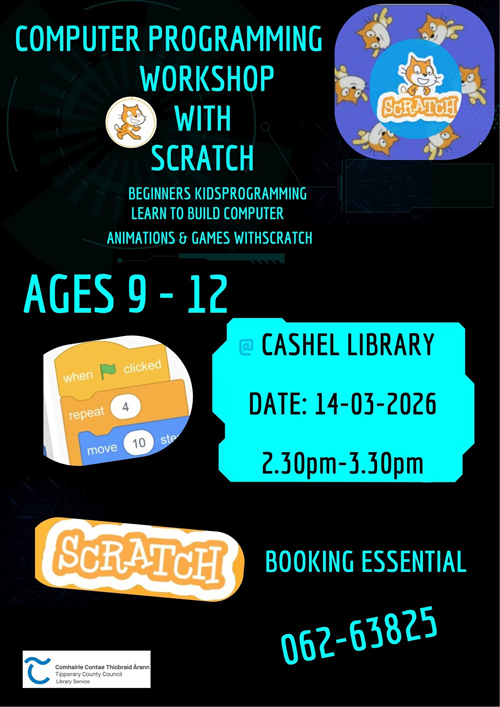
The next Scratch Coding Workshop will take place in Cashel Library on Saturday next March 14th from 2:30pm-3:30pm.
This workshop is suitable for children ages 9+, and as is always, booking required, please, to Tel: 062-63825.
The Benefits of Scratch Coding for Children.
Scratch coding gives children an inviting first step into programming because its block-based design lets them focus on ideas rather than syntax. Instead of getting stuck on punctuation errors, they can build stories, games, and animations while learning core concepts like sequencing, loops, conditionals, and variables. The Scratch Foundation describes Scratch as a creative learning platform used by millions of young people worldwide, and research reviews on computational thinking and coding in primary education link these kinds of activities with stronger problem-solving, persistence, and computational thinking skills.
Just as importantly, Scratch helps children see themselves as creators, not just consumers, of technology. When kids design their own interactive projects, they practice imagination, communication, and iterative thinking: they test ideas, fix mistakes, and improve their work. UNICEF also emphasizes that digital literacy is now a core skill for school, work, and life, which makes early, playful experiences with tools like Scratch especially valuable. In that sense, Scratch does more than teach coding; it builds confidence, creativity, and a sense of agency in a digital world.
The grave of George Plant still attracts annual republican commemorations, while his story remains one of the most striking and contested in Tipperary’s revolutionary past.
Early March each year holds a particularly haunting place in Tipperary history because it marks the anniversary of the execution of Mr George Plant, one of the most controversial republican figures of the early 20th century. On Thursday March 5th 1942, George Plant was executed by military firing squad in Portlaoise jail, bringing a dramatic and deeply disputed chapter of Irish history to a close.
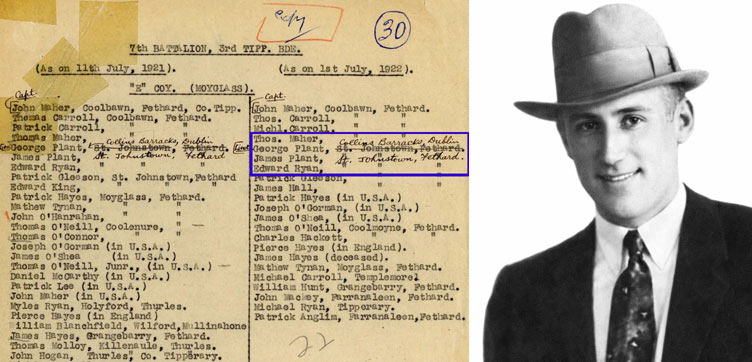
Pictured Left → E Company (Moyglass), 7 Battalion, 3 Tipperary Brigade, IRA, membership list. Pictured Right → George Plant executed by military firing squad in Portlaoise jail, March 1942. The above shows George Plant’s membership during the War of Independence and Civil War, and his change of address to “Collins’ Barracks, Dublin”,where he was tried, convicted and sentenced to death. The James (Jimmy ) Plant also on this list above was George’s brother.
Born on January 5th 1904, at St Johnstown, Fethard, Co. Tipperary, George Plant grew up in a Protestant farming family. The Plant family were known locally as hardworking, strict, and largely removed from politics. Yet George’s life took a decisive turn in 1916, when he and his older brother James were harshly interrogated by the local constabulary about their associations with local republicans including Seán Hayes and Dan Breen. That experience appears to have had a lasting effect on both boys.
By 1918, George and James had joined Na Fianna Éireann, and during the War of Independence and Civil War George served in the Moyglass unit of the 7th Battalion, 3rd Tipperary Brigade, IRA. He earned a reputation for bravery and reliability. Captured near the end of the Civil War, he escaped from Templemore jail and made his way home across country.
After the 1923 ceasefire, George and James emigrated, living and working in Scotland and later across North America. But Plant’s involvement with republican activity did not end. In 1929 the brothers were sentenced to seven years for their part in an IRA bank robbery in Tipperary town. After serving time in Limerick and Portlaoise, George eventually returned to the United States. In 1938, as Seán Russell steered the IRA in a more militant direction, Plant came back to Ireland and by 1940 was on full-time IRA service.
The event that sealed his fate was the killing of Michael Devereux, quartermaster of the IRA’s Wexford battalion. Devereux, wrongly suspected of informing to the gardaí, disappeared in September 1940. His body was not discovered until a year later, after the sensational escape of IRA chief-of-staff Stephen Hayes from IRA custody triggered fresh revelations and investigations.
Plant and IRA Southern Division commander Joseph O’Connor were first charged with Devereux’s murder in the Special Criminal Court. That case collapsed when key witnesses withdrew their statements, claiming they had been beaten and intimidated into making them. However, the government then took extraordinary steps under emergency legislation to retry the matter before a special military court. In a highly controversial move, normal rules of evidence were effectively suspended, allowing previous witness statements to be read into evidence even when those witnesses refused to testify.
On February 27th 1942, George Plant, along with Patrick Davern and Michael Walsh, was convicted and sentenced to death. O’Connor was acquitted on a technicality. Amid widespread public appeals for mercy, the sentences of Davern and Walsh were commuted to life imprisonment, but Plant’s was not. He was executed just days later, on March 5th 1942.
Even decades later, the Plant/Devereux affair remains clouded in controversy. The legal process used to convict Plant has long been criticised as one of the most troubling episodes in Irish judicial history. Later research suggests that Michael Devereux was likely innocent of informing and that Plant was probably involved in his murder. Yet debate continues, shaped by the turbulent politics, secrecy, and emergency powers of that period in wartime Ireland.
In September of 1948, Plant’s remains were returned to his family and reburied at St Johnstown, where his grave still attracts annual republican commemorations.
Bain triail as do chúpla focal sa leabharlann Chaiseal Mumhan. Tá fáilte roimh gach duine. [Try your hand at a few words in the Cashel Munster library. Everyone is welcome.]
Visitors attending this informative event can locate the Cashel Library building; situated on Friar Street, Lady’s Well, Cashel, Co. Tipperary, HERE. (Eircode E25 K798).
Cashel Branch Librarian Ms Maura Barrett Reports:–
As we celebrate International Women’s Day we invite you to our free Pilates Session with Sasha, followed by refreshments.
Pilates is a form of exercise developed by Joseph Pilates that focuses on core strength, flexibility, and overall body conditioning through controlled movements. It can be performed on a mat and is suitable for people of all fitness levels.
Please Do remember: Spaces are limited, bring your own mat and note booking is essential to Tel: 062-63825
International Women’s Day falls on March 8th and it honours the achievements of women and promotes women’s rights. Sasha is committed to seeing her clients grow in confidence and ability as they develop a shared understanding of the benefits of precise and mindful movement.
Visitors attending this event can locate the Cashel Library building; situated on Friar Street, Lady’s Well, Cashel, Co. Tipperary, HERE. (Eircode E25 K798).
This website uses cookies to improve your experience. We'll assume you're ok with this, but you can opt-out if you wish.AcceptRead More
Privacy & Cookies Policy
Privacy Overview
This website uses cookies to improve your experience while you navigate through the website. Out of these, the cookies that are categorized as necessary are stored on your browser as they are essential for the working of basic functionalities of the website. We also use third-party cookies that help us analyze and understand how you use this website. These cookies will be stored in your browser only with your consent. You also have the option to opt-out of these cookies. But opting out of some of these cookies may affect your browsing experience.
Necessary cookies are absolutely essential for the website to function properly. This category only includes cookies that ensures basic functionalities and security features of the website. These cookies do not store any personal information.
Any cookies that may not be particularly necessary for the website to function and is used specifically to collect user personal data via analytics, ads, other embedded contents are termed as non-necessary cookies. It is mandatory to procure user consent prior to running these cookies on your website.






Recent Comments