|
|
 It is not often you get a chance to have your say nowadays living in a ‘Nanny Republic’ as we do. However Europe Direct Ireland are inviting you to enter a national soapbox competition and by doing so, win some fantastic prizes! It is not often you get a chance to have your say nowadays living in a ‘Nanny Republic’ as we do. However Europe Direct Ireland are inviting you to enter a national soapbox competition and by doing so, win some fantastic prizes!
To highlight the importance the European Union places on ‘Climate Change’ they are holding a soapbox competition on “Wind energy – the future or a blot on the landscape?”
You will have a chance to share your views and to win some fantastic prizes. Regional finalists will win an iPad, a trip to Brussels and will be entered for the National Final with a prize of €1,000. Soapbox events will be held in 7 regional locations followed by a national final in Farmleigh, Dublin on 19th November 2010.
Your 3 minute speech will be less impromptu – you will get to research it and prepare it in advance. The topic is wind energy, so like it or loathe it, agree or disagree, wind farms generate a lot of controversy, as well as potential energy.
They want to hear your views! You will deliver your speech at your local Europe Direct Centre, at an event in November in front of a local audience and a panel of judges who will include someone with an expertise on the subject – so do your research!
Your local Europe Direct Information Centre is at the Source Library, Cathedral St., Thurles, Co. Tipperary. They are holding their regional final on Friday 12th November at 7 p.m. and this event will be chaired by Alan Kelly M.E.P.
There will be also be runner-up 2nd and 3rd prizes of €150 and €100 respectively to be won.
To help get your thinking cap on, they will be holding information sessions with the Tipperary Energy Agency in Nenagh Library (19th October, 12.30 p.m.), Thurles Library (19th October, 6.30 p.m.) and Clonmel Library (28th October, 6.30 p.m.).
They will also be paying a visit to a working wind farm, at Ballinveny near Templemore, on Friday 22nd October at 2.30 p.m.. This free trip is open to all but booking is necessary. Why not call Thurles Library on 0504 29720 to book your place now.
You can pick up an entry form in any of the public libraries in Tipperary or enter online at www.europedirect.ie.
 A free business seminar, entitled ‘Building a Business on Your Ideas‘, will be held in the Horse and Jockey, Hotel, Thurles, on Thursday next the 21st of October. A free business seminar, entitled ‘Building a Business on Your Ideas‘, will be held in the Horse and Jockey, Hotel, Thurles, on Thursday next the 21st of October.
This event is the second in a series of eight seminars for small business owners, entrepreneurs, inventors and startup companies in the Mid-West region.
Speakers will include: Dermot Doyle, Fergal Brady, Yvonne Cassidy (Patents Office), Colin Pope (Enterprise Ireland), Dan Richardson (Technology from Ideas) Denis Hayes (Technical Director C & C Supply) Rowena Elliott (Enterprise Ireland) Gerard O’Regan (Enterprise Europe Network)
Interested participants are invited to register for this event by logging onto www.tnceb.ie, or by emailing info@tnceb.ie or phoning 067-33086.
 Ursuline Secondary School Crest The popular ‘All Island School Choir’ competition returns to our screens Sunday week and will run for five weeks on RTÉ One.
The event will culminate with the live final which will be held in Belfast’s Waterfront Hall on Sunday, November 14.
Twenty schools have qualified for this year’s regional finals, which take place in the School of Music in Cork, the Royal Theatre in Castlebar, the Solstice Theatre in Navan and the Market Place Theatre in Armagh.
This years chosen competitors will include the Ursuline Secondary School Chamber Choir, from Thurles who will compete in heat number 1 of the event in Cork city.
The competition is organised by Co-Operation Ireland in association with RTÉ. Anne Cassin presents the series which was devised by RTÉ’s Northern Editor, Tommie Gorman, latter who is also the executive producer.
The adjudicators for the competition are Seamus Crimmins, Executive Director of RTÉ Performance Groups, Dr Angela Feeney, well known Belfast Opera singer and teacher, Brendan O’Connor, Musical Director, Cois Cladaigh Chamber Choir in Galway and Dr Geoffrey Spratt, Director of the Cork School of Music and Conductor of the Fleischmann Choir.
On September 29th last St. Patrick’s College, Thurles welcomed a newly appointed Governing Board.
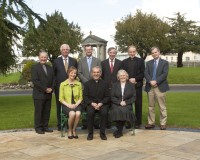 Board St.Patricks College, Thurles. The Governing Board, which consists of National figures from academia, business and social justice, is tasked with building on the already impressive strategic development of the College.
St. Patrick’s College first opened its doors to students in 1837, serving as a seminary to the Archdiocese of Cashel and Emly until, 2002. The college has since developed as a College of Education, specialising in educating post-primary teachers in the fields of Business, Accounting, Religion and Irish.
The new Board includes Rev. Tom Fogarty (College President), Ms. Paula Hourigan (College Registrar and Staff Representative), Dr. Richard Thorn (Director of Flexible Learning & Research, IOTI), Dr. Bernadette Flanagan (Director of Research, All Hallows), Mr. John Lonergan (Former Governor, Mountjoy Prison), Robbie Kelleher (Head of Global Investment Strategy, Davy Stockbrokers), Dr. Finbarr Bradley (Former Professor, DCU, UCD and NUI Maynooth), Rev. Christy O’Dwyer (Former President, St. Patrick’s College and Board of Trustees member) and Rev. Celsus Tierney (Board of Trustees member).
On the appointment of the Board, Rev. Tom Fogarty, the College President commented that he has the “utmost confidence in the new Board and is both delighted and proud that the College is positioned to benefit from such a wide and extensive array of expertise as continuously demonstrated by the Board members throughout their professional lives. The appointment of the Board heralds a new and exciting era of development for the college.”
It is with the deepest regret, we have learned of the death (peacefully) yesterday, September 28th, 2010, of Sr Enda Moran (An tSuir Éanna Ní Mhóráin) Ursuline Convent, Thurles, Co. Tipperary and late of Ballyferriter, Co. Kerry.
Her death is also deeply regretted by her nieces, nephews, grand-nieces, grand-nephews, great grand-nieces, great grand- nephews, relations, her sisters in Community, the Ursuline Congregation, past pupils, Ursuline staff and her many friends.
Sr Enda will be remembered as a fluent speaker and lover of the Irish language, an inspirational teacher and a loving and loyal friend to all who had the privilege of making her acquaintance.
Her body will repose in the Ursuline Convent Chapel, Cathedral Street this (Wednesday) evening from 5.00pm with evening prayer at 6.30pm.
Her funeral Mass will take place in the Ursuline Convent Chapel, Cathedral Street, tomorrow (Thursday) morning at 11.30pm, followed by burial in the adjoining Convent Cemetery.
Go ndéana Dia trócaire ar a anam dílis.
|
Support Us Help keep Thurles.info online by donating below. Thank you.
Total Donated 2026: €300.00
Thank You!
Daily Thurles Mass Livestream
|



Recent Comments