|
|
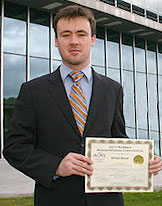 Winning Tipperary PhD researcher William Ronan William Ronan, a Cloneen, Co Tipperary native and PhD student in Mechanical and Biomedical Engineering at NUI Galway, has won first prize in the PhD Student Paper Competition at the American Society of Mechanical Engineering Biomedical Engineering Conference, a leading US conference in the field of Biomedical Engineering and Bio-mechanics.
Currently in his third year of PhD research at NUI Galway while under the supervision of Dr Patrick McGarry, Mr Ronan has developed advanced computational models, that predict the active response of biological cells to different mechanical environments.
Mr Ronan’s prize winning paper entitled ‘Simulation of Stress Fiber Remodeling and Mixed-mode Focal Adhesion Assembly During Cell Spreading on Elastic Substrates,’ is indeed a testament to the exceptional talent being nurtured in Irish Universities presently.
Mr Ronan is funded by an Irish Research Council for Science, Engineering and Technology (IRCSET) scholarship and his research is also supported by Science Foundation Ireland Research Frontiers Programme (SFI-RFP) and the Irish Centre for High End Computing (ICHEC).
We wish Mr Ronan every success for the future.
It should be noted that this is the second major International Award won by a member of Dr Patrick McGarry’s research group in 2011, with his PhD student Emer Feerick also winning first prize at the Annual Symposium on Computational Orthopaedic Bio-mechanics in the US last January.
Of almost 58,000 Leaving Certificate students who sat their examinations in Ireland this year, close to 2,000 will have got their Leaving Certificate results here in County Tipperary today.
This mornings results will bring mixed emotions to students, with some students pleased and others possibly disappointed. Regardless of your results take the time to listen to this excellent piece of advice for your future.
The narrative you have just heard is based on an essay by Mary Schmich’s in her column in the Chicago Tribune which headlined “Advice, like youth, probably just wasted on the young.”
This popular and well-known essay became the successful music single “Everybody’s Free (To Wear Sunscreen)“, released in 1998, (Something for Everybody album) by Australian film director, screenwriter and producer, Mark Anthony “Baz” Luhrmann.
Heed it, this advice is still not outdated.
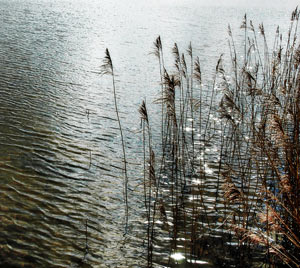 Wetland Writers Have you ever had the idea you would love to write a book, a short story perhaps, or maybe write about and leave behind details of your early life, your experiences, the highs and lows of your life and times. Maybe shyness or a lack of self confidence has held you back.
Well, no more excuses are now acceptable, because on Thursday, the 8th of September next, 8.00pm sharp, the inaugural meeting of “Wetland Writers” will take place at Cabragh Wetlands, Thurles, Co Tipperary.
This group will welcome, with open arms, all comers and hope to see current authors, aspiring writers, reciters or just listeners joining their group.
Whatever your favourite genre, be it poetry, verse, essay, short story, comedy, novel, theatre, factual writing, compilation of thoughts, ideas or memories, it will be an exciting experience to find a platform for your expression, and you never know, perhaps a ‘cupan tae,’ will be thrown in, to assist, evoke and inspire the Muses.
Perhaps there may be a J. K. Rowling, a Jeff Doyle or a Robert Hass waiting, screaming to be realised down through the nib of your pen, and all that is needed is just a little help and encouragement.
Interested – Then why not contact: Joan Pollard Carew, Tel: 086 8718819 or Una Crowe, Tel: 087 7930319.
 With September 1st drawing nearer, Tipperary teachers are preparing to go back to school. Amidst a multitude of new changes and challenges, 2011/2012 will mark the first academic year in which ‘Literacy and Numeracy for Learning and Life,’ (The National Strategy to Improve Literacy and Numeracy among Children and Young People 2011-2020.) will be implemented. With September 1st drawing nearer, Tipperary teachers are preparing to go back to school. Amidst a multitude of new changes and challenges, 2011/2012 will mark the first academic year in which ‘Literacy and Numeracy for Learning and Life,’ (The National Strategy to Improve Literacy and Numeracy among Children and Young People 2011-2020.) will be implemented.
Speaking recently at the official launch of the Strategy, on July 8th, 2011, Minister Ruairí Quinn stated “It is the government’s belief that no child should leave school unable to read and write and use mathematics to solve problems. We know that there is currently much room for improvement and this strategy sets out the road map with concrete targets and reforms that will ensure our children, from early childhood to the end of second level, master these key skills.”
The estimated cost of implementing the Strategy will be €6 million in 2012 rising to approximately €19 million per annum by 2017. Given that funding for education is extremely limited at present, at the official launch of the Strategy Minister Quinn also stated that “We will have to find the necessary resources for literacy and numeracy by re-prioritising existing spending, by cutting activities that may be desirable but less important, and by ensuring that we get the very best outcomes from whatever financial and human resources we have.”
Speaking on behalf of Reading Association Ireland, Thurles native, Dr. Karen Willoughby, delivered a presentation on the new Strategy and some of its key targets for literacy at the 17th European Conference on Reading in Mons, Belgium. Speaking in Mons, Dr. Willoughby outlined that in the area of literacy (and indeed numeracy) the Strategy sets out ambitious targets across six key educational areas, namely: involving parents, school leadership, curriculum development and revision, supporting pupils with additional learning needs, using assessment and supporting teachers’ pre-service and continuous professional development.
Continue reading Tipperary Schools Face Changes To Teaching
 Ardscoil na mBraithre the CBS High School, in Clonmel has successfully appealed against an earlier Equality Tribunal finding, which ruled that the school indirectly discriminated against members of the Travelling Community and others when it refused a Traveller child admission. Ardscoil na mBraithre the CBS High School, in Clonmel has successfully appealed against an earlier Equality Tribunal finding, which ruled that the school indirectly discriminated against members of the Travelling Community and others when it refused a Traveller child admission.
The school had argued that their actions did not constitute discrimination, because 83 other children from the locality had also been refused admission, due to their parents having not attended this same establishment.
Judge Thomas Teehan allowed the appeal against the decision of the Equality Tribunal, that it should offer John Stokes a place and also their direction for the school to review its current admission policy, thus ensuring that in future it did not indirectly discriminate against any child of the state.
Thirteen year old John Stokes, through his mother Mary Stokes, latter instructed by the Irish Traveller Movement Independent Law Centre, first lodged a complaint against the Clonmel school based on the grounds that the school had breached the Equal Status Act 2000.
John Stokes had applied in November 2009 to attend the CBS School, having attended a local primary school in Clonmel town. However there were 174 student applications applying for just 140 places available, at this educational facility, at that time.
The school selected pupils on the basis of an agreed admission policy and based on three criteria:-
(1) The students father or another older sibling had previously attended the school.
(2) He was Roman Catholic.
(3) He had attended a primary school in the locality.
While John Stokes met the last two criteria of the school boards criteria, John Stokes was the eldest boy in his family, and his father had never attended the school in question.
The student, through his family, had unsuccessfully appealed this initial refusal by the school, to the Department of Education, and failing here, had appealed to the Equality Tribunal, on the grounds that requiring a parent to have previously attended the school, disproportionately affected the rights of the Irish Travelling Community and others.
Judge Teehan said that he was satisfied that the parental rule was discriminatory against Travellers and indeed others, whose parents were unlikely to have had the opportunity of attending this school previously. However, it fell to the school to demonstrate that its admissions policy could be fairly justified, and he found that supporting family ethos within education had amounted to a legitimate aim by the school.
Judge Teehan also found that the policy was appropriate in a case where numbers of students applying, exceeded available existing places. This parental rule, by the school, assisted in striking a fair balance between academic results and admissions, based on these exceptional circumstances.
He further noted that the CBS School had highlighted the importance of ties between their school and their past pupils in terms of meeting funding shortfalls and therefore this parental rule was necessary in creating a balanced and a proportionate admissions policy.
The school was therefore within its legal rights to reject a student because his father was not a past pupil.
|
Support Us Help keep Thurles.info online by donating below. Thank you.
Total Donated 2026: €300.00
Thank You!
Daily Thurles Mass Livestream
|



Recent Comments