|
|
A Leader Of Irish Girl Guides Recalls Her Five Years In India
Reporter Tom Ryan
 This year’s World “Thinking Day” (22nd February last) – a day when Girl Guides celebrated their international friendships; had special significance for a Thurles Irish Girl Guide Leader.
It was the first time in five years that Catherine O’Connor, formerly of Cathedral Street, Thurles, Co. Tipperary, had celebrated that event in Ireland. For the past five years she has celebrated with Girl Guides from around the world at Sangam World Guiding Centre in Pune, that sprawling city in the western Indian state of Maharashtra, India; in her role as Deputy World Centre Manager.
World “Thinking Day” is a day when Guides across the globe give thanks for the international friendships they enjoy through the Guiding movement and raise money to deliver life-changing opportunities for girls in developing countries. This year’s World “Thinking Day” theme was ‘Impact’ and the Irish 12,000 Girl Guide membership joined with 10 million Girl Guides and Girl Scouts across the globe, to celebrate the
impact that Guiding has on them and that they, in turn, have on their local communities and the wider world.
Catherine, who is a Leader with Thurles Senior Branch (Senior Branch Irish Girl Guides are those aged from 14-30 years) and a Community Youth Worker with Youth Work Ireland Tipperary, says, “Everything we do in Girl Guiding has an impact on our lives and the lives of people around us. My own life has been hugely impacted by Girl Guiding since joining at age seven. By taking part in relevant, exciting and fun activities our members experience positive change within themselves. As they develop different skills such as communication, collaboration, creativity, commitment and citizenship, they get motivated to make a positive change in the community and wider world. Hence, Girl Guiding impacts individually and collectively.”
Catherine’s time in India was life-changing. “What an amazing country! From the colours, the noise, the festivals, the vibrancy, the hustle and bustle and the warmth of the people, it was a real honour calling this country my home,” she says.
“A big honour for me was getting to represent the Irish Girl Guides and when I got to see the Irish flag flying high at the opening ceremony of the 107 events that happened during my time at Sangam. There was lots of fun and laughter when I attempted to teach Irish dancing at international nights and special memories of enjoying Tayto sandwiches, while watching and explaining Moone Boy with the Sangam family.”
“During my time at Sangam I got to meet over 5,000 Girl Guides and Girl Scouts from all around the world! I also got to work closely with 13 other international staff, 36 Indian staff and volunteers in training from the local community. (Some 71 volunteers and 125 interns were community programme participants). So on a daily basis I got to experience the true friendship and sisterhood of global Guiding and have such interesting conversations, learning so much about other cultures. I am so privileged to have friends I can now visit around the world; from Australia, Chile, Costa Rica, Canada, Japan, Kenya, Nepal, Rwanda, Slovenia and Sweden, to name but a few places.”
Cate considered herself very lucky to have been part of Sangam’s 50th birthday celebrations, from the early planning stages in March 2013 right through to the big day on 16th October 2016, when 1000 plus friends from around the global and local community joined in with the Sangam camp-site for a massive celebration. She was delighted to discover that “amazing, wonderful, exciting things can can happen when you’re brave enough to try and take the chance on new and sometimes scary opportunities”.
She continues, “By getting on the plane on 19th July 2012, just days after Irish Girl Guides’ international camp CAMP 101, despite being so nervous, anxious, doubting myself and so tired; I got to experience so
much from the kindness of strangers who are now lifelong friends; to being able to call the amazing country of India my other home; to having dared myself to do all of the following, from driving a
rickshaw and scooter, trying Bollywood dancing, hanging upside down in an ariel yoga hammock, abseiling off the Sangam water tower, to travelling solo in India, including taking an overnight sleeper bus and finding my way around Delhi train station at midnight.
This all happened because I took that first step to apply! So I would encourage you to BE BRAVE when new opportunities come your way, just GO FOR IT!”
Local Littleton / Two-Mile-Borris Correspondent Mr Gerry Bowe Report:
With so much inclement weather having being experienced in recent months; waiting for buses in the village of Two-Mile-Borris has become somewhat of a major ordeal for computers of all ages.
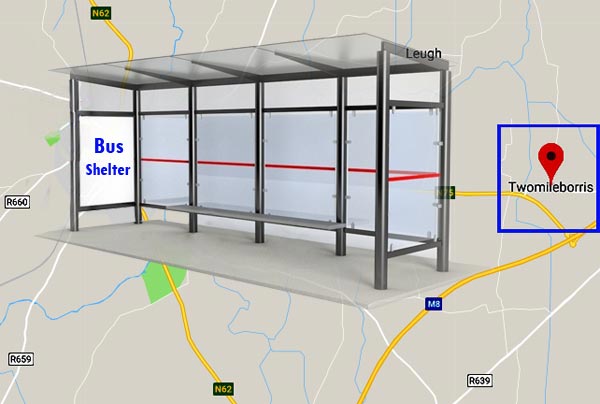
Some twenty-five schoolchildren are presently forced to congregate in the open twice daily to use school transport. On Friday’s some fifteen adults, including many old age pensioners must wait for rural transport in similar circumstances, with a minimum of six people on other week days.
The rural transport service is provided by Kavanagh’s of Urlingford, whose facility is greatly appreciated, especially by those with no other available means of transport. The Kavanagh service include stops in Urlingford, following a route to Clonmel, operating a twice daily service.
School transport, also greatly appreciated, conveying students in particular to schools in Thurles is presently being provided by Jerry Ryan Coaches in Thurles. Under the present scenario pupils find themselves often sitting through the day, in wet clothing, due to a lack of basic shelter.
Sites available and indeed suitable for the erection of a bus shelter, have now been identified in Two-Mile-Borris village.
It is now hoped that with the support of local Councillors and Transport Infrastructure Ireland (T.I.I), swift action will be taken to advance an obvious solution with regard to this ongoing issue.
M/s Ursula Paine, CAMEO Care, Thurles, Co. Tipperary, reports:-
Thurles Businesses Urged to Sign Up Staff for Dementia Awareness Workshops to Better Support Customers.
Do you work with the public in the Retail Sector or in Financial Services?
 The Source Building here in Cathedral Street, Thurles, Co. Tipperary will be the venue for a number of free dementia awareness workshops for staff working in the retail and financial services sectors, and being organised during the months of February and March, 2018.
These workshops, which will be presented by M/s Ursula Paine (CAMEO Care, Thurles), and M/s Jennifer Doyle, (Community Hospital of the Assumption, Thurles), as part of an ongoing initiative, “Dementia: Understand Together”, which is anxious to create a better understanding and awareness about this growing condition.
Approximately 4,000 people, or an average of 11 people every day, develop dementia in Ireland each year. Indeed, there are over half a million people who have had a family member with dementia, yet research shows that many of us do not fully understand this condition.
Dementia Awareness Workshops.
The dementia awareness workshops are completely free with the workshops for the retail sector taking place in February on three consecutive Fridays – February 9th, 16th and 23rd, from 2.00 pm to 5.00 pm. Workshops for financial services staff are taking place on three consecutive Fridays in March – March 2nd, 9th and 16th from 2.00 pm to 5.00 pm also.
[For more information, contact M/s Ursula Paine on Mobile: 086 8381818.]
For M/s Ursula Paine, (Nurse Manager, CAMEO Care in Thurles), these workshops will hopefully support people with dementia to continue to live safe and well within the community:-
“We know that there are about 55,000 people living with dementia in Ireland right now – a number that is set to more than double by 2040 – and that approximately two-thirds of these people remain living within the community. These workshops are all about providing staff who work with the public day in and day out, with a better understanding of dementia, perhaps recognising someone with dementia who comes into their shop, supermarket, café or financial institution; and how best to support that person”, stated M/s Paine.
“For example, signs of dementia could include persons having trouble remembering names or details; like their address; is finding it difficult to communicate what they need or want, or is having difficulty navigating their way around. We want to try to lift some of the misunderstanding that sometimes confronts people with dementia, so that they feel more included in their communities through making life that little bit better for them”, continued M/s Paine.
For M/s Jennifer Doyle, (Clinical Nurse Manager, Community Hospital of the Assumption, Thurles), these workshops will offer really practical ideas for shops and banks to better support day to day customers:-
“We are aware that shopping is one of the big activities that people with dementia living in the community continue to undertake, and we also know that being able to manage our finances is ultimately key to our independence. With these two workshops, we explore some of the situations in which customers might find themselves in a shop or bank, and offer some ideas to workshop participants, as to how to make their environments more dementia-inclusive”, stated M/s Doyle
“For example, in a shop it could be about ensuring that signage is clear and visible, or having seating, good lighting and being aware of noise levels. In a financial institution, it might be around identifying signs of financial abuse and how to engage supportive communication skills and best work with relatives. It could include changes to the customer environment, combined with staff trained in dementia awareness, e.g. who smiles warmly; speaks clearly and listens carefully to what a person is saying, and to give them that bit of extra time if needed. Such practises truly help dementia sufferers to continue to live independently”, continued M/s Doyle.
Dementia: Understand Together
The “Dementia: Understand Together” campaign is led by the Health Service Executive (HSE) in partnership with the Alzheimer Society of Ireland and Genio. The campaign website offers a comprehensive information resource on dementia, including a service-finder detailing county-by-county the dementia supports and services available.
It also offers a range of training resources for carers, and for businesses and organisations in the retail, transport, public and financial sectors. Support packs, including posters, leaflets and badges, can be ordered also. Simply visit HERE or Freephone 1800 341 341.
On Monday morning last (February 5th), we first broke the exciting news that the former ‘Black Castle’, west of Liberty Square, overlooking the Parnell car-park, here in Thurles, Co. Tipperary; once home of Lord Viscount Thomas Butler & his wife, Lady Viscountess Elizabeth Butler (alias Poyntz), has been sold.
The vendor of this hugely historical building; namely the Kenny family; latter relatives of the late Mr Billy Maher; was sold through the professional offices of Mr Sean Spain Auctioneers & Valuers, No. 21 Fianna Rd, Thurles, Co. Tipperary.
The purchasers; Sir Timothy Maher (Knight of Innisfallen & Chairman & Chief Financial Officer (CFO), of Timothy Maher Finance) & his lady wife American born Dr. Phyllis Maher (Chief Executive Officer (CEO), of Timothy Maher Finance), have since employed the successful firm of DHRyan Architects, No.1 Liberty Square, Thurles, to undertake a feasibility study of the site and its associated buildings, and to prepare a development brief for the new purchasers. Solicitor Mr James J. Meagher (Thomas F. Griffin Parnell St, Thurles), has been retained to deal with all aspects of the site transfer.
However, this welcome news has now raised a massive inquisitiveness from those living both at home and overseas who have emailed us here at Thurles. Info, seeking further information on Lady Elizabeth and her interaction with Oliver Cromwell, who even in our modern Ireland, still evokes extremely strong emotions, some 360 years after his death in 1658.
In Ireland, though he only spent nine months of his reign here (August 1649 to May 1650), Cromwell stands accused of war crimes, religious persecution and the ethnic cleansing of Irish people on an unparalleled scale. The phrase ‘the curse of Cromwell on you and your house’, just 50 years ago, to elderly people, still evoke fear.
The Cromwellian administration was to find that Lady Viscountess Elizabeth Butler (Lady Thurles), was an extremely tough and feisty lady to deal with, and unlike many, she was never known to kowtow to Cromwell or his “Adventurers”, latter those who had financed his cause here in Ireland and Co. Tipperary, for their personal financial gain.
On 15th August 1649 Oliver Cromwell had landed at Ringsend, Dublin, and with him had come his Parliamentarian cavalry; an army of some 3,000 battle-hardened “Ironsides”, (Title “Old Ironsides”, was one of Cromwell’s nicknames). The civil war in England had ended, and King Charles I had been executed some seven months earlier.
 Lady Viscountess Elizabeth Butler (Lady Thurles) and later Lady Elizabeth Mathew, (following her second marriage). Here in Ireland, however, Roman Catholics had been in revolt since 1641 and were in possession and control of much of the country. Many had seen in England’s recent turmoil, an opportunity to restore Irish independence.
Cromwell a fanatical Protestant, would offer no quarter to papist rebels who had massacred English and Scottish settlers. Now in Ireland, he could also use confiscated rebel land to pay off the debts his loyal troops and the “Adventurers” who had financed his cause.
According to a Cromwellian edict, no Catholic who lived in the “Irish Quarters” before 1649, could be exempted from confiscation of property and transplantation; hence
“To hell or Connaught” was the quote and the choice, that Cromwell now offered the Irish. They would either be killed or go to Connaught, which meant their eventual death, because they all could not possibly have survived in a small ruggedly inhospitable province, not fully conducive to agriculture.
An Inquisition found that Lady Thurles held a life interest, in the right of her jointure, (an estate settled on a wife for the period during which she survives her husband), in lien (the right to keep possession of property) of a dower in the Castle, town and lands of :- Thurles, Leugh, Killinan, Athlummon, Clobanna, Lahardan, Derryfadda, Longfordpass, and Garranroe, in the Barony of Eliogarty; and Kilshane, Cleghile, and Lagganstown in the Barony of Clanwilliam.
Lady Thurles also owned 80 head of cattle, and 800 sheep and lambs; all of which ought to have been forfeited to Oliver Cromwell the then declared ‘Lord Protector of the Commonwealth of England’.
The Cromwellian financiers of his cause known as the “Adventurers” (as distinct from his soldiers) had, among the lands allotted to them, the Baronies of Eliogarty and Clanwilliam, and therefore now clamoured for the eviction of Lady Elizabeth, out of Thurles Castle and lands. Two thousand acres, calculated to return her an income of £200 a year, were set out for her in Connaught, but by various stratagems the astute Lady Thurles managed to delay her immediate removal.
She succeeded in winning over to her side to plead her cause, among others, such deep-dyed Puritans as the regicides or “King killers”, Sir Hardress Waller (latter condemned to death for his part in the regicide of Charles I. However his life was spared owing to the efforts of his friends and instead he was condemned to life imprisonment) and Colonel Robert Phaire (Governor of Cork, who avoided a similar fate through having married the daughter of Sir Thomas Herbert); also Colonel Hierome Sankey, (latter who sat in the House of Commons at various times between 1654 and 1659. He also served in the Parliamentary army during the English Civil War and later served in Ireland as Governor of the Tipperary Precinct of Clonmel), a man whose reputation for savagery in dealing with the Irish was scarcely less than that of Cromwell himself.
Petitions By Lady Thurles Sympathisers
In July 1656 the Cromwellian Council transmitted the petitions of these men on behalf of Lady Thurles to the Commissioners adjudicating on the Irish, in Co. Cork, for their report on it. Their report, on 13th August, shows that they were also under the spell of Lady Thurles.
- It stated that the good lady had several times in 1641 harboured, entertained, and preserved from murder and famine, divers English families whom the Irish had plundered, robbed, and attempted to murder. In total, 60 persons, and in particular Mr. Bullock and family, Joane Harris and family and Mr. Price, a protestant minister and his family.
- The report also stated, that after the fall of Archerstown Castle, Lady Thurles received the wounded Major Peisley, and others of his company, into her home, entertained them for several weeks until they were recovered, and then gave them money and other necessaries, before they betook themselves to the English garrison at Doneraile, Co. Cork.
- When Sir Charles Vavasour, who had raised a regiment of 500 men for service in Ireland from Cheshire, England, lay wounded and a prisoner of the Irish rebels at Clonmel, she had on several occassions sent him money, and later when he was very ill and weak, she had procured with great difficulty his liberty to come to her house where he was nursed to health, and was furnished with money on his departure.
- That in the years 1643-46, she gave considerable sums of money for the relief of the English, £500, £300, and divers other sums.
- That Lord Inchiquin, when he marched into Co. Tipperary, regarded Lady Thurles as English and of English interest and affection, and ordered that she and her tenants were not to be molested.
- That the Irish looked on her as an enemy, and several times pillaged and plundered her — in all, of 1500 sheep, 60 cows, and a great number of horses and colts; they broke down her weirs, and threatened to burn down her house if she did not hand over the poor English to their fury, but she refused to do so.
- That Owen Roe O’Neill, marching by her house, looked on her as an enemy and commanded her to furnish him with 200 beeves. She refused to pass them over, and notified Lord Inchiquin, who came to her relief and repulsed O’Neill.
- She was also instrumental in the rendition of Cahir Castle to Cromwell by her son, George Mathew.
- She also refused admission to Thurles Lieut. Colonel Brian O’Neill, and sent a messenger to Cromwell at Fethard, Co Tipperary to request him to send a garrison to Thurles, which he immediately did, under the command of Major Bolton, and for which, Cromwell promised her gratification, and this was seconded by the certificates of Colonel Sankey, Major Greene [later who settled at Killoghy, Mullinahone] and Colonel William Moore.
The Commission found her to be a very deserving person, but owing to legal and other difficulties, they now decided to submit her case for the decision of the Lord Deputy.
Continue reading Lady Thurles & Oliver Cromwell – “To Hell Or Connaught”
 White-tailed Eagle The Department of Agriculture, Food and the Marine today confirmed that a virus identified as avian influenza (subtype H5N6) has been found in a white-tailed sea eagle, found dead in Co. Tipperary, on January 31st last.
The HSE Health Protection Surveillance Centre (HSE-HPSC) and the European Centre for Disease Control (ECDC) have both advised that the risk to public health from this avian influenza strain is very low and that the disease poses no food safety risk for consumers.
However, this finding could warrant an increased risk to poultry and therefore strict bio-security measures, irrespective of actual bird-flock size, are now necessary to further prevent the disease. Poultry owners are advised to feed and water their birds inside and under cover where wild birds are less likely to access.
This find in Co. Tipperary comes as no great surprise; since this virus has already been detected in wild birds in several locations across Great Britain from the start of 2018, and indeed in other more eastern European countries prior to the end of 2017.
Warning: In particular inform your children. If you do find dead or sickly wild birds, e.g. wild ducks, wild geese, swans, gulls or birds of prey, do not handle, but immediately report the findings.
A list of Department of Agriculture, Food and the Marine offices and their contact details are available HERE.
The results of further comparative tests on this virus are expected to become available in the coming days.
|
Support Us Help keep Thurles.info online by donating below. Thank you.
Total Donated 2026: €300.00
Thank You!
Daily Thurles Mass Livestream
|



Recent Comments