The Director General of the Environmental Protection Agency (EPA), Laura Burke; and the Chief Justice, the Hon Mr Justice Frank Clarke, will provide the opening addresses at this year’s virtual conference on Environmental Law Enforcement: Emerging Challenges 2020 which will take place on Wednesday on November 11th 2020, with the event timed for 9.00am until 1.15pm.
Note: Advance registration for this event is essential. To view the full conference programme, please use the link shown HERE. To register for this event, please use the link shown HERE.
The conference, which is co-hosted by the EPA and the Irish Centre for European Law (ICEL), will explore some of the challenges and potential opportunities that are emerging through experience with environmental enforcement; recent developments in the case law; as well as new policy initiatives.
Commenting on the conference, Ms Laura Burke(EPA Director General), stated: “This conference is an important opportunity for practicing legal professionals, leading academics and researchers, policy makers, concerned stakeholders as well as professional regulators to come together to explore emerging challenges in Ireland with regard to enforcement of environmental law. It also has an important role in supporting the development of competency and capacity in environmental law and its enforcement.”
The conference will explore experience, challenges and recent case law in relation to the Environmental Impact Assessment Directive; the Environmental Liability Directive and the Habitats Directive; as well as the implications of the recent judgment of the Supreme Court in ‘Climate Case Ireland’ for climate and wider environmental protection.
There will also be contributions providing different perspectives and experience in the context of establishing a specialist court for planning and the environment.
Dr Áine Ryall, (ICEL and Centre for Law and the Environment UCC) stated: “The conference is very timely. The Programme for Government includes a commitment to establish a Planning and Environmental Law Court managed by specialist judges. There is also a commitment to reform the judicial review process. These proposals raise important issues concerning the right of access to justice and merit close attention. Furthermore, the pandemic has created challenges for the exercise of rights guaranteed under the Aarhus Convention, in particular the right to participate in environmental decision-making. The conference provides a forum for informed debate. It will explore how to use the law to protect the environment and improve environmental quality.”
300 lung cancer cases in Ireland each year are linked to exposure to radon.
The risk of developing radon related lung cancer is particularly high for smokers. In fact, smokers are at about twenty-five times greater risk than non-smokers.
It is easy to test your home for this indoor air pollutant and to reduce high levels.
The highest level home tested in Ireland this year had over 22 times the acceptable level. This level could give a radiation dose equivalent to receiving 15 chest X-rays a day.
On European Radon Day, 7th November, the Environmental Protection Agency(EPA) are calling on all householders to test their homes for this cancer-causing radioactive gas. Radon is the second biggest cause of lung cancer after smoking. In Ireland, it is estimated that about 300 lung cancer cases each year are linked to radon exposure.
What is Radon?
Radon is a radioactive gas formed in the ground from the radioactive decay of uranium which is present in all rocks and soils. It has no smell, colour or taste and can only be detected using radon detectors. Outdoors, radon quickly dilutes to harmless levels but when it enters an enclosed space, such as a house or other building, it can accumulate to unacceptably high levels. Radon is a lung carcinogen and is linked to some 300 lung cancer cases each year in Ireland making it a serious public health hazard.
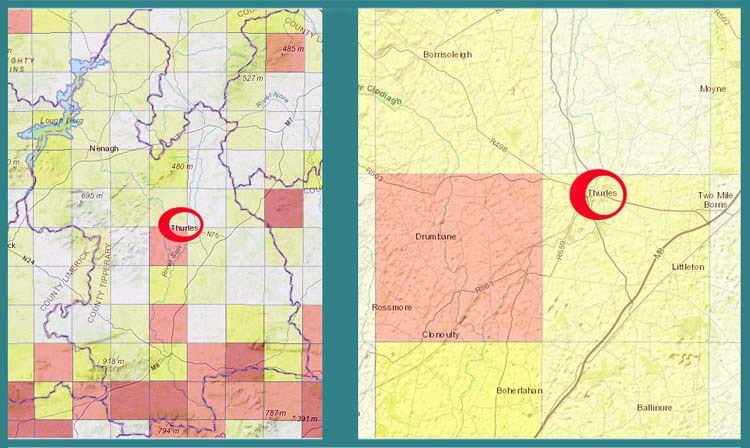
About a third of Ireland is classified as a high radon area by the EPA. However, the EPA recommends that homeowners in all areas of Ireland test their homes for radon. You can check if you are living in a high radon area on the EPA’s interactive radon risk map on www.radon.ie. Ireland has relatively high indoor radon levels, with an average indoor level of 77 Bq/m3, compared to the worldwide average of 39 Bq/m3.
Radon gas can seep into your home through small cracks and gaps in the foundations of the building or openings around service pipes. It comes from the rocks and soil in the ground under your home. Radon has no colour, taste or smell, so the only way to know how much of this pollutant is in your home is to carry out a radon test.
The test costs about €50 and is all done by post using one of the services registered with the EPA. The test kit includes two radon detectors – one should be placed in the bedroom and one in the living room. After three months, the detectors are posted back to the provider and analysed to see how much radon they have been exposed to in your home. The results are posted back to you, with advice on how to deal with any high radon readings.
Stephanie Long, (Manager of the EPA’s Radon programme) has stated: “Exposure to high levels of radon can cause lung cancer and many families are unknowingly living with this indoor air pollutant. Earlier this year, one home was found to have over 22 times the acceptable level. Living with this level of radon gives a radiation dose equivalent to getting 15 chest x-rays a day.”
You can visit www.radon.ie to find out how to test your home and keep you and your family safe. Reducing radon levels is simple and inexpensive and will immediately reduce the risk of developing lung cancer.
For moderate levels of radon, improving indoor ventilation may reduce the level by up to half, the cost of which is low. For higher levels, a fan assisted ‘sump’ can be installed which can reduce radon levels by over 90 per cent. The sump can be installed in a day by a contractor with little disruption to the home.
Alison Dowdall(EPA) has stated, “Radon is everywhere but is only a problem if it is ignored. Testing for radon – where high levels are found – and fixing the problem are both relatively straightforward and easy to do. Now more than ever, as people spend more time at home, we would urge everyone to take action on radon, improve your indoor air quality and keep your home safe from this cancer-causing gas.”
Green and blue spaces should be protected, maintained and integrated in health, planning and other social and economic development policy.
The Environmental Protection Agency (EPA) and the Health Service Executive (HSE) will launch the key findings from jointly-funded research projects on the benefits of green and blue spaces to health and wellbeing in a joint Webinar today.
View of part of ‘The Galtees’ mountain range, Co. Tipperary
Ireland’s green and blue spaces are essential components of Ireland’s health infrastructure and include urban parks, coasts, lakes and rivers, forests and bogs. The research launched today has found that using green and blue spaces benefits people’s physical and mental health. Such benefits include increasing physical activity, enhancing mental wellbeing and providing spaces for social interaction.
Findings highlight that green and blue spaces should be protected, maintained and integrated in health, planning and other social and economic development policy.
Laura Burke(Director-General, Environmental Protection Agency) stated, “Research has an important role to play in establishing how human health can be enhanced by a healthy environment. The research launched today is particularly relevant and timely during the on-going Covid-19 crisis as people focus on making the most of the natural environment in their local areas. It shows that access to green and blue spaces benefit people’s health and wellbeing. Establishing a knowledge base on the link between our health and our environment, can support the development of policies to protect our essential blue and green spaces.”
Dr. Stephanie O’Keefe(Health Service Executive) stated: “Our health and our environment are hugely interconnected. COVID-19 has brought this reality into stark relief. These excellent research projects increase our understanding of the importance of green and blue space for our health and wellbeing. The research also highlights that access to good quality green and blue space is not equal for all. The HSE’s ongoing collaboration with the EPA is important as we strive to protect and improve human health and wellbeing, and therefore the spaces and places in which we live. Developing a strong evidence base to target improvements is part of this.”
Joint funding to a value of around €0.6 million was awarded to three research studies in 2016 to support the implementation of Healthy Ireland, the national framework for action to improve the health and wellbeing of the people of Ireland.
The following research reports were launched today:
GBI-Health: Green and Blue Spaces and Health: A Health-led Approach – Led by Dr Ronan Foley in Maynooth University – focusing on health-date aspects.
Eco-Health: Ecosystem Benefits of Greenspace for Health – Led by Professor Mark Foley in University College Dublin – focusing on Design/Planning aspects.
NEAR-Health: Nature and Environment to Attain and Restore Health – Led by Dr Caitriona Carlin in National University of Ireland, Galway – focusing on the relations between green & blue spaces, nature and communities
An additional project, also co-funded by the EPA and HSE, looking at evaluating health benefits derived from green and blue spaces, was carried out by the ESRI and its findings will be presented by Dr Gianluca Grilli during the Webinar.
Speaking at the Webinar today Dr Jonathan Derham, Environmental Protection Agency stated: “Research is needed at a national and local level to provide evidence for decisions and investment by government and others to protect and develop green and blues spaces, so they can deliver for the health and wellbeing of the population. There is a high value in ongoing research and in providing insights and information that can better inform policy and planning. We need to monitor usage to improve data and understanding of the contribution to health and wellbeing. A well-managed network of green and blue spaces contributes to our quality of life and health, but also helps Ireland meet its European and international obligations and future-proof the country.”
Further EPA-HSE co-funded research (to a value of around €1.2 million) is currently on-going on the topics of linkages between Health and Air Quality and Noise, as well as on Antimicrobial Resistance. These projects are due for completion in 2021-2022.
With our Harvest moon waning and Autumn wind, low temperatures and rain prevailing outside today, let us take a virtual walk on the Great Famine “Double Ditch”, starting from the Mill Road side of Thurles, in Co Tipperary.
Warning, during our simulated walk of this existing location, do watch out for the barbed wire. Same was placed on either side by the Thurles Municipal District’s work force, reducing progress along this right-of-way, to single file only.
Yes, since Thurles Municipal District own the land on either side it is highly unlikely that anyone else came in to fence using barbed wire; ergo, they are aware that the public legal right, established by usage over the last 175 years; to pass along this specific route and Mass path, does truly exist. This of course remains contrary to the recent nonsensical statement made by Thurles Acting District Manager Ms Janice Gardiner and former Thurles Acting District Manager Mr. Eamon Lonergan.
Let us chat as we walk: (Ignore the “flytipping’, and burnt-out crab apple trees. Most of the fridges, 3 seater couches, washing machines, vacuum cleaners, beer cans, children’s toys and broken sinks etc. remain covered this Autumn courtesy of Mother Nature, in her effort to hide our shame.)
As we begin our walk, remember this Double Ditch was built by a group of men and boys who understood what it was like to watch their families starve and who had, themselves experienced extreme hunger; something no man, woman or child, thankfully, has to endure or experience, unless wilfully, in our Ireland of the 21st century.
For the Thurles paupers of 175 years ago, the only existing social welfare system that existed, was an overcrowded ‘Workhouse’ from which very few would leave in their own lifetime.
What Is A Double Ditch?
A single ditch is a narrow channel dug at the side of a road or in a field. Its purpose is to either hold, drain or carry away flood water. In Anglo-Saxon, the word ‘dïc’ was pronounced ‘deek’ or ‘deetch’. In digging such a water trench the upcast soil will form into a bank alongside it. This banked soil thus means that the word itself included not just the excavation alone, but also the bank of soil derived from such efforts. Latter word would later evolve into the English words we more commonly use today, e.g.‘dyke’ or ‘ditch’.
Now, if we dig two ditches side by side and you will create a double ditch which in turn creates a high platform in the centre, enabling people to cross extremely wet land without wearing waterproof overshoes (Galoshes) or the then worn leather Wellingtons (Latter first invented around in 1817 and the then privilege only of landed gentry and aristocracy.)
In the case of the Thurles Double Ditch, both sides of the raised platform were faced with limestone; which came free from a stone quarry the property of Rev. Dr. Henry Cotton.
On the day that this Thurles Great Famine work project began, we learn from further hand written communication sent to the Trustees appointed for the distribution of Indian Meal, quote: – “In the town of Thurles alone there are at this moment 768 families containing 3364 inhabitants in actual want; of these 739 are old men, women and children, unable to work and who have no one to labour for them; and the remaining 2625 are depending on the daily hire of the sons and heads of the families to the number of 790 able to work and now out of employment”.
The idea of this Thurles “Double Ditch” was to provide work for paupers unemployed and starving.
The following rules for labourers employed to work on this ‘Double Ditch’ were adopted: –
(1) Hours of labour to be from 7.00am to 7.00pm with 2 hours for meals. (2) Any labourer found to shirk from reasonable and fair work or refusing to follow the directions of his overseer shall forthwith be discharged and not admitted to the works again. (3) That the persons employed shall be paid every evening. (4) That in case of a greater number of labourers shall offer themselves, than the funds will enable the committee to pay. A preference shall be given to those who have the largest and most necessitous families”.
It was further agreed that, quote: –
“Henceforth there be two rates of payment; 8 pence and 5 pence, and that no boy under 12 years old be employed. That tickets of the form now agreed on, should be printed to admit labourers to work – those for men in black ink and those for boys in red ink; Ordered that 500 red and 500 black tickets be printed. Families containing 7 members and over and having 2 men over 17 shall, at the discretion of Committee, be entitled to 2 black tickets; Families having a less number shall, if the Committee wish, get 2 tickets, one red and one black”.
On December 4th 1846, we learn that “In workhouse this day 740 (Persons) – House built to contain 700. Five families were refused admission on Thursday last by the Guardians; in three cases the husband applied with the wife and children stating that he was employed in the public works but that the hire scarcely keeps them alive; in the other 2 cases the wives and children applied without the husbands and stated the hire would not support them. The men offering to support as many of their families as the wages would enable them.”
The Thurles Workhouse
The Thurles Workhouse was built during the period 1841- 1842 to accommodate 700 inmates, on a 6.5 acre site at Castlemeadows, Gortataggart, Racecourse Road, Thurles, Co. Tipperary, (back then known as East New Street). The finished workhouse building was declared fully fit for the reception of the destitute poor on the 25th April 1842 four years before the Great Famine. First admissions however were not received until November 7th of that same year. The workhouse was demolished completely except for a low wall, 16 years ago, in 2004.
Later, with the loss of the potato crop, beginning in the Autumn of 1845; in 1846 sheds to the rear of the main building, originally designed to house straw (latter to make mattresses for beds) and turf (for the provision of heat), would be converted into a 70 bed Epidemic Typhus, Fever Hospital; latter killer disease spread by body lice.
In a report sent from Thurles to the “British Association for the Relief of Extreme Distress in Ireland and Scotland” and forwarded to Lieutenant Col. Douglas on February 11th 1847 we learn; – “Of the population of the united parishes of Thurles, 8,000 are on the relief list. The majority obtains very inadequate relief by employment on Public Works. There are about 300 destitute families having no person to work, to whom gratuitous relief must be given; there are other families varying from 10 to 12 having only one member able to work, whose wages 10p a day would not be adequate to the support of two persons at the present famine prices of food. The poor house built to accommodate 700 has now stowed within 940 and there cannot be any more admissions, and groups who cannot be admitted are to be seen shivering in the cold and wet anxiously expecting the fragments of cold stirabout that remains after the inmate pauper meal. We have lived to see the poor sitting at the pauper’s gate among the crumbs that fall from the pauper’s table. We have not had any deaths from actual starvation but numerous deaths have occurred from severe and long continual privation. The weekly average of deaths has increased fivefold.”
Thurles Municipal District Council in conjunction with Tipperary Co. Co. we believe, now wish to eradicate this important history from our midst, instead of using same to attract much needed and currently non-existent tourism.
History is NOT there for you to like or dislike. It is there for you to learn from and if it offends you, even better. Because then you are less likely to repeat it. It’s not yours to ERASE. It belongs to all of us.
According to Tipperary County Council’s online policy statement on heritage, the role of their Heritage Office is, “To promote awareness and appreciation of our rich heritage and to protect and enhance it for future generations”. View HERE.
According to the same Tipperary County Council’s online policy statement on planning the purpose of the Planning Section is “To ensure the protection of the natural built heritage and amenity of the county”. View HERE.
One would believe that same policies should allow for Tipperary dwellers to feel safe, same policies having been signed off on by Tipperary Chief Executive Mr Joe MacGrath. Alas, eight weeks on and no direct written communication from the same Mr MacGrath or his nominee Mr Marcus O’Connor.
We also await communication from the recently re-assigned Ethics Registrar, Mr. David Coleman, Administrative Officer, Corporate Services, (Tel: 0761 065000) with regards to the failure by the above named local councillors to follow their required Code of Conduct.
We gather from the reply by Ms Janice Gardiner or Mr. Eamon Lonergan, (we are unsure of the actual author – View HERE), that it is the full intention of Tipperary Co. Council to destroy the historic 1846 Thurles “Double Ditch”.
Both have stated that the Double Ditch does not exist, but of course it does and its stone clad sides can be viewed with the naked eye. So can be viewed the one step, stone, stile at one end, latter destroyed by Tipperary Co. Co. and the swinging rotary gate at the other end, erected by Tipperary Co. Co.. Do watch the video above again.
Our video shown above indicates clearly; as you enter from the College Lane side of the Double Ditch, in Kickham Street, the abject failure by local politicians to attract any industry into Thurles over the past 30 years. The failure to generate even one long term job, can be observed simply by viewing the abundance of graffiti on the walls of an area; same having such a strong bearing and mutual relationship with our past local history.
Tipperary Co. Council has over the years eradicated much of the town’s history. Just two examples are the Moat and Moat Lane and in more recent years Hickey’s pub (Griffins Shop). In both cases using rate payer’s money back then to build the Parnell Street car park and more recently, (yet to open), the new car park. In turn both these tax payer funded projects are being used to generate further taxes, laughably at the expense of the very same tax payers who funded them in the first place; result the destruction of the town centre, through parking charges.
We are now aware, sadly, that some of our local elected representatives and county council officials are faithless; treacherous and deceitful, showing a willingness to act dishonestly, by failing to communicate directly with those who elected them and who pay their wages.
This deceit is further borne out by a communication from Ms Josepha Madigan TD, former caretaker Minister for Heritage, who stated, and I quote, “So far as we understand, there is no direct impact on the “Double Ditch” from any current development. The Department is a statutory consultee in the planning and development process, but our role in this regard is to respond to particular development proposals as referred to us by the planning authority.” Of course we now know that the ‘statutory consultee’ appears to have been misinformed by the “planning authority” as were the staff who provided the Environmental Impact Assessment Screening Report and those involved in the conjuring up of the Archaeological Impact Statement.
Perhaps the time has come for a locally-led task force for Thurles, akin to that same recently appointed force in Tipperary Town.
This website uses cookies to improve your experience. We'll assume you're ok with this, but you can opt-out if you wish.AcceptRead More
Privacy & Cookies Policy
Privacy Overview
This website uses cookies to improve your experience while you navigate through the website. Out of these, the cookies that are categorized as necessary are stored on your browser as they are essential for the working of basic functionalities of the website. We also use third-party cookies that help us analyze and understand how you use this website. These cookies will be stored in your browser only with your consent. You also have the option to opt-out of these cookies. But opting out of some of these cookies may affect your browsing experience.
Necessary cookies are absolutely essential for the website to function properly. This category only includes cookies that ensures basic functionalities and security features of the website. These cookies do not store any personal information.
Any cookies that may not be particularly necessary for the website to function and is used specifically to collect user personal data via analytics, ads, other embedded contents are termed as non-necessary cookies. It is mandatory to procure user consent prior to running these cookies on your website.





Recent Comments