|
|
Driver arrested after attempting to evade Mandatory Intoxicant Checkpoint in North Tipperary.
A pregnant female motorist was arrested yesterday in North Tipperary, following an incident at a Mandatory Intoxicant Checkpoint.
Gardaí observed a vehicle attempting to avoid the checkpoint. Members attached to Killaloe Garda Station stopped the car and spoke with the driver.
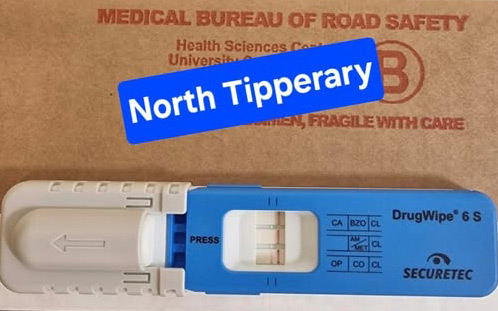
A roadside drug test returned a positive indication for cocaine. Checks also indicated the vehicle was uninsured.
The pregnant driver was arrested in connection with the alleged road traffic offences and was brought to Nenagh Garda Station. The vehicle was seized and enquiries are ongoing. The results of the blood sample are currently being awaited.
The Cabinet has approved the publication of the Garda Síochána (Powers) Bill 2025, a major piece of legislation designed to modernise and consolidate the statutory basis for key Garda powers, placing them on a clearer and more accessible legislative footing.
Key measures in the Bill:
- Reform of search warrants (including electronic devices)
- Updates and reforms the law on search warrants in light of Supreme Court judgments.
- Provides for tailored search warrants specifically authorising the seizure and search of electronic devices, and procedures to assess claims of privilege.
- Strengthens rights for individuals to be informed about authorised access to data on seized electronic devices (Section 23), reflecting the Landeck judgment of the Court of Justice of the European Union.
- Creates a statutory mechanism enabling the examination of devices seized without prior judicial approval, with appropriate authorisation arrangements.
Judicially supervised handling of privileged material.
- Establishes clear statutory procedures to ensure privileged material is handled through a judicially supervised process.
- Confirms legal professional privilege as absolute, and provides a structured process for other forms of privilege, including (where required) determination by the High Court under Section 24.
Stop-and-search provisions.
- Introduces provisions to support greater consistency in the use and understanding of Garda stop-and-search powers.
- Requires Gardaí to make a formal record of all searches, and provides for stop-and-search of a person or vehicle in a public place where Gardaí reasonably suspect possession of a relevant article (as defined in the legislation).
Custody and interview safeguards.
- Places on a statutory footing the existing right of a person in custody to consult a solicitor before and during interview.
- Provides for electronic recording of Garda interviews and modernises the custody framework.
The Bill is intended to clarify the law in an area that has become complex, strengthen safeguards, and provide clear procedures for dealing with privileged material, grounded in the principle that human rights are the foundation and purpose of policing.
A stamped draft of the Garda Síochána (Powers) Bill 2025 has been made available, with formal publication by the Oireachtas to follow in due course.
The Bill builds on the objective of codifying and modernising police powers of search, arrest and detention and strengthening procedural rights, as set out in the earlier general scheme (published June 2021).
Cocaine price claims: what can be confirmed from Gardaí, Revenue and published monitoring?
Garda leadership has publicly stated that wholesale kilo prices rose and attributed the increase to enforcement pressure and major seizures.
Revenue/Garda releases document continued significant seizures nationally, including recent high-value cocaine detections.
Public comments from senior Garda sources in recent years have pointed to a rise in the wholesale (per-kilo) price of cocaine and have linked that rise to the disruption caused by large-scale seizures. The available public record is stronger on wholesale impacts than on retail (“street”) price trends, and international monitoring cautions that retail prices can remain stable even when purity and supply conditions shift.
A blow to the smuggling operations of the Dublin crime group known as “The Family” is most certainly leading to a lower-purity drug currently on Irish streets.
(1) What Gardaí have said – Wholesale per kilo price increase:
In August of 2024, Det Chief Supt Séamus Boland (Garda National Drugs and Organised Crime Bureau) said Gardaí had seen a “significant increase” in the wholesale price, with kilos moving from around €25,000 to some €40,000, and he linked that change to the impact of major seizures and enforcement activity.
(2) What can be confirmed about large seizures in recent years following joint Garda/Revenue operations:
Revenue and Garda press releases confirm continued high-value cocaine seizures under joint, intelligence-led operations, including:
- 5.46kg of cocaine seized at Dublin Airport (estimated value €382,200) in December 2025.
- A joint Operation Tara-related seizure of suspected cocaine valued at around €4.06 million in December 2025.
- The MV Matthew operation remains a reference point in discussions of large-scale disruption: the vessel was seized in connection with Ireland’s largest drugs haul in 2023, with official costs and handling continuing to be reported in 2025.
(3) What cannot be firmly confirmed from public sources:
While Garda commentary has focused on wholesale kilo prices, publicly available, Europe-wide monitoring reports that retail cocaine prices have remained relatively stable over the past decade, alongside changes in purity. This does not rule out local or short-term volatility, but it means a sustained retail price rise in Ireland is not confirmed on the same evidential footing as the reported wholesale change.
(4) From a local Tipperary context:
Garda press releases confirm cocaine seizures and related enforcement activity in Tipperary, including a December 2024 operation in which Gardaí in the Tipperary Division said they seized approximately €100,000 worth of cocaine and cannabis, with a man arrested and charged.
Separately, Revenue has reported joint operations resulting in arrests/detentions within the Clare–Tipperary Division (e.g., Shannon Airport seizures), reflecting the regional footprint of national enforcement activity.
A sustained rise in retail prices is not established by the main public monitoring sources; EU monitoring notes retail prices have remained relatively stable over the past decade.
Tipperary: Garda releases confirm cocaine seizures and arrests in the county/Division in recent years.
Recent Garda commentary has pointed to a sharp rise in the wholesale price of cocaine in Ireland and has linked that rise to major drug seizures. Publicly available monitoring and data sources, however, are stronger on wholesale impacts than on retail (“street”) price changes, and the relationship between seizures and lasting price rises is not straightforward.
What Gardaí have said:
Wholesale prices: In August 2024, the head of the Garda National Drugs and Organised Crime Bureau (GNDOCB), Det Chief Supt Séamus Boland, said the wholesale price per kilogram of cocaine had risen sharply (reported as moving from about €25,000 to around €40,000), and that the increase was probably due to large seizures by Gardaí and Revenue.
It has been reported that a senior Garda drug investigator linked the ‘MV Matthew’ seizure (2023) to an increase in the wholesale price in Ireland, describing disruption and internal “investigation” by those controlling the shipment.
What can be confirmed about seizures.
Large-scale cocaine seizures by Gardaí and Revenue are well documented in official releases, including joint operations under ‘Operation Tara’ and regular intercepts at ports and airports.
Examples from December 2025 include:
- A joint Garda/Revenue operation reporting suspected cocaine valued at €4.06m, with arrests.
- Revenue reporting a 53.5kg seizure at Rosslare Europort valued at €3.75m.
- Revenue reporting a 5.46kg seizure at Dublin Airport valued at €382k.
What cannot be firmly confirmed from public data:
Public reporting and official statements cited above, focus mainly on wholesale kilo prices. They do not conclusively establish a sustained rise in retail price per gram across Ireland.
EU-wide monitoring context.
The EU Drugs Agency (EUDA) reports that, at retail level, cocaine prices have remained relatively stable over the past decade across Europe, while purity has trended upward. This does not rule out short-term Ireland-specific volatility, but it cautions against presenting retail price rises as settled fact.
A key operational nuance highlighted in reporting:
Where wholesale prices rise, impacts may appear as greater adulteration / lower purity rather than higher street prices. Recent reporting cites Garda detections of heavily diluted cocaine in some instances.
23 new speed camera zones for Tipperary, as national expansion goes live on January 1st 2026.
A total of 390 new safety camera zones will become operational nationwide from January 1st 2026, bringing the overall number of safety camera zones to 1,901, An Garda Síochána has confirmed.
Gardaí say the primary purpose of the safety camera programme is to reduce speed-related collisions, lessen injuries and save lives, against the backdrop of 187 road deaths recorded so far in 2025 – the highest level on Irish roads in more than a decade.
Tipperary and North Tipperary.
Tipperary is set to receive 23 new safety camera zones as part of the rollout.
Updated GoSafe listings for the county include new zones on the M7 and multiple zones on the R498 latter the Nenagh to Thurles road.
In North Tipperary, motorists travelling through Latteragh are also being reminded to observe temporary measures associated with ongoing works on the R498, with Tipperary County Council publishing traffic management updates and roadworks speed-limit orders for the route.
In a Garda message, Assistant Commissioner Ms Catharina Gunne said the vast majority of drivers obey speed limits, but a “small persistent cohort” continue to drive in excess of posted limits, putting others at risk. The aim of targeting high-risk areas, Gardaí say, is to reduce fatal and serious-injury collisions.
A full list of all safety camera zones is published on the Garda website, including downloads for navigation providers HERE
Irish Revenue seizures exceed €1.2m ahead of Christmas – Midlands operations and major cannabis interception at Shannon
Revenue has confirmed seizures with a combined estimated value of more than €1.2 million in the lead-in to Christmas, including detections in the Midlands with a significant seizure at Shannon Airport in the Mid-West region (latter region which covers counties Tipperary, Clare, and Limerick.)
Contraband seized in Midlands-linked operations.
Over the week commencing December 15th, 2025, Revenue officers seized contraband with an estimated value of over €455,500 during operations in Dublin, the Midlands and Rosslare Europort.
According to Revenue the seizures included:
- 11.6kg herbal cannabis (estimated value €232,458).
- 2.4kg butane honey oil (estimated value €48,000).
- 5kg cannabis resin (estimated value over €30,010).
- Other illicit drugs (estimated value over €3,630).
- Tobacco products (estimated value over €21,005).
- 344.68 litres of alcohol (estimated value almost €3,875).
- 282 counterfeit items (estimated value over €99,375).
- €17,122.93 in cash and six weapons.
Revenue said the herbal cannabis and other drug detections were made following risk profiling, assisted by detector dogs Ciara and Sam, with parcels originating from the USA, UK, Thailand, India, Spain and France.
A record total of 2,050 people have appeared before Irish district courts for drug-driving offences in the first 10 months of 2025(January to October). This marks the highest level on record for drug-driving prosecutions in Ireland’s district court system.
Here in Co. Tipperary, Nenagh District Court in the north of the county, saw a 155% increase in drug-driving cases in the same first 10 months of 2025, compared to the same period in the previous year.
Cannabis worth €760,000 seized at Shannon Airport.
Separately, a further seizure was reported at Shannon Airport, where Revenue Customs officers seized 38kg of herbal cannabis with an estimated value of €760,000, assisted by detector dogs Brody and Gus.
The drugs were found in shipments originating from the USA and were destined for addresses in the South and Mid-West area. (Note: Reports do not specify individual county destinations)
Ongoing investigations and public appeal:
Revenue have stated that further investigations into the seizures are ongoing and reiterate that the operations form part of its ongoing work targeting smuggling, illegal drugs and shadow economy activity.
Anyone with information regarding smuggling can contact Revenue in strictest confidence TEL: 1800 295 295.
|
Support Us Help keep Thurles.info online by donating below. Thank you.
Total Donated 2026: €290.00
Thank You!
Daily Thurles Mass Livestream
|








Recent Comments