Department of Justice is Finalising Regulations to Enable In-Service Drug and Alcohol Testing for Garda Members.
The Department of Justice has confirmed it is finalising regulations required to enable the testing of serving members of An Garda Síochána for drugs and alcohol. Once the regulatory framework is completed, it will be open to An Garda Síochána to implement an in-service testing regime.
The move follows continued focus on strengthening anti-corruption safeguards within the organisation, including recommendations set out in the Garda Síochána Inspectorate’s 2020 report on countering internal corruption.
The Policing and Community Safety Authority (PCSA) has this week published a review of progress on the 2020 report’s recommendations, finding that 56% of the 34 recommendations have been implemented or partially implemented to date.
PCSA review highlights. The PCSA noted progress in several key areas, including:
The formation and resourcing of the Garda Anti-Corruption Unit (GACU), and new policies addressing abuse of power for sexual gain and professional boundaries.
A prohibition on acceptance of gifts or hospitality from covert human intelligence sources (CHIS).
Strong support among members for reform measures, including in-service vetting (supported by 83% in a survey referenced by the PCSA).
The PCSA also highlighted areas where further action is needed, including the absence of a policy and supporting technology to detect and prevent misuse of Garda IT systems, and ongoing concerns regarding compliance with rules on gifts, hospitality and sponsorship.
Regulation drafting “complex” and at an advanced stage: The Department of Justice has previously indicated that regulations underpinning an in-service drugs testing scheme are complex and require detailed consideration, and that drafting work is now at an advanced stage and expected to be finalised.
Engagement with Garda leadership: The PCSA has said the review will be discussed at a public meeting between the Authority and the Garda Commissioner on today, (Thursday, 26th February 2026).
Tipperary – Multi-Agency Operations in Clonmel and Emly (Wednesday, 25 February 2026).
Gardaí have completed planned multi-agency operations at a site in Clonmel, Co. Tipperary and a property in Emly, Co. Tipperary, yesterday, Wednesday, 25th February 2026, as part of an ongoing investigations into incidents within the region.
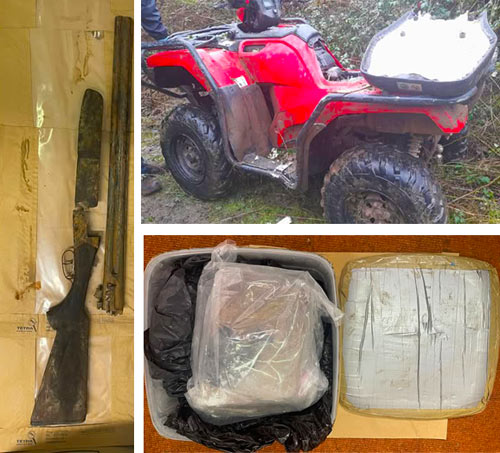
Firearm, stolen vehicle and cocaine, recovered by Gardai.
During a search at the Clonmel site, a stolen vehicle was recovered. The vehicle will now be subject to technical examination, before being returned to the owner.
Ten dogs were also seized during the searches at the site by the Irish Society for the Prevention of Cruelty to Animals (ISPCA), latter due to animal welfare concerns. The dogs are currently receiving veterinary care.
During a search at a property in Emly, a firearm was seized and will be subject to further technical and ballistic analysis. Gardaí also recovered approximately €70,000 worth of cocaine, which will be analysed by Forensic Science Ireland (FSI).
Justice Minister Mr Jim O’Callaghan announces more Efficient Criminal Legal Aid Scheme.
One fee for representation from beginning to end of a case.
Reform of criminal legal aid and restoration of fees fulfils Programme for Government commitment.
Implementation on 1st July, 2026.
The Minister for Justice, Home Affairs and Migration, Mr Jim O’Callaghan has today (24th February) informed the Government of his proposals to reform the criminal legal aid fee structure in the District Court. The reform will lead to greater efficiencies in the District Court and a more sustainable Criminal Legal Aid Scheme.
Minister O’Callaghan is proposing that one flat fee will be paid for representation from beginning to end of a case. This will remove the link between payments and the number of appearances, or legal aid certificates granted.
The proposal fulfils the Programme for Government commitment to reform criminal legal aid and the restoration of fees. Restoration of fees will commence from 1st July 2026.
Engagement with the Law Society of Ireland and relevant stakeholders will continue in advance of implementation on 1st July 2026.
Minister O’Callaghan said; “My department reviewed more than 350,000 District Court cases which took place during 2022 and 2023. The reform I am announcing today aims to address structural issues identified during this review, such as unnecessary adjournments resulting from the payment per appearance model. I have informed Government of my proposal to replace the existing fee structure with one flat fee. This will be payable regardless of the number of appearances, multiple certificates for cases heard together, or number of accused represented. This reform will lead to a more efficient system by reducing unnecessary adjournments. It will also simplify the administration of criminal legal aid, resolve cases sooner, and ensure practitioners are remunerated fairly.”
While the volume of criminal cases in the District Court has decreased, expenditure on criminal legal aid has nearly doubled; from €19 million in 2015 to €37 million in 2024.
The proposed payment of one fee for cases in the District Court will:
Encourage earlier case resolution.
Reduce administrative burden.
Support more efficient court sittings.
Ensure fair remuneration for practitioners.
As stated, there will be extensive engagement over the coming months with key stakeholders, including legal professionals, in advance of its implementation on 1 July 2026.
An Garda Síochána has published provisional crime statistics for 2025 showing a substantial increase in reported fraud and economic crime, alongside reductions across many traditional crime categories.
Fraud Rise Linked to Online Offending and Reporting Backlogs. Gardaí note that part of the increase reflects a backlog in reporting from previous years, while also pointing to online-enabled offending as a key driver behind the surge.
Digitally Driven Harmful Communications Also Increase. “Harmful communications” was among the few other categories to show a notable rise, with 750 incidents being reported in 2025, up from just under 600 in 2024. Reports involving the distribution of “grossly offensive communication” increased by 68%.
Traditional Crime Trends: Robberies and Burglaries Down. Provisional data indicates fewer reported instances of most major crimes, including a significant fall in robberies. In Dublin, this equated to 230 fewer robberies in 2025 compared with 2024. Burglaries also declined, with the north-west recording the most dramatic change, including a 34% drop in non-aggravated burglaries.
Operation Thor Cited in Burglary Reductions. Gardaí attributed improved burglary trends in part to Operation Thor, targeting organised burglary gangs and repeat offenders. Garda statements indicate residential burglary has reduced by approximately 75% over the past decade.
Enforcement Snapshot: Drugs, Cash and Gold Seized. During 2025, Garda teams reported seizures of €147 million worth of illegal drugs and approximately €6 million in cash and gold.
Public Order: Demonstrations Increase. Garda figures also indicate an increase in public demonstrations, with around 1,300 events in 2025 — approximately 12% higher than 2024.
Road Safety: Fatalities and Collisions Remain a Major Concern. The crime-statistics summary notes 188 deaths on Irish roads in 2025 and a 4% rise in total crashes. Separate road-safety updates reported around 190 fatalities in 2025 based on provisional collision figures.
Domestic Abuse: High Volume of Calls for Assistance. Gardaí reported receiving almost 67,000 calls relating to domestic abuse in 2025, close to 1,300 calls per week.
Homicide: Levels Unchanged Year-on-Year. The number of murder and manslaughter offences remained consistent with 2024, with 40 deaths recorded as a result of homicide-related offences in 2025.
Background Context. Garda commentary referenced CSO data showing Ireland recorded a 7% reduction in overall crime between 2019 and 2024, despite population growth over the same period.
Tipperary dentist sentenced for HSE deception – one-year jail term and a €100,000 payment order.
A county Tipperary dentist has been sentenced to a one-year custodial term and ordered to pay €100,000 to the Health Service Executive (HSE) after admitting deception-related offences connected to claims made under the Dental Treatment Services Scheme.
Mr Jerome Kiely, aged 47 years, of Acraboy House, Monard, Co Tipperary, pleaded guilty at Dublin Circuit Criminal Court to a number of sample charges of dishonestly inducing the HSE to make payments, including a claim of €326 for dentures, dated May 12th, 2015.
The court heard the HSE had placed trust in Mr Kiely as a practitioner, but that this trust was “misplaced”, Judge Martin Nolan said in delivering sentence. The judge accepted evidence that Mr Kiely has a history of depression and mental health difficulties, and also heard personal mitigation including a letter from his wife and references noting community involvement.
Judge Nolan imposed a three-year sentence, suspending the final two years subject to conditions. These include payment of €100,000 to the HSE within three months; a figure the court noted exceeds the amount proven and was described as an additional punitive element.
The court also heard that two bank accounts in Mr Kiely’s name, reported as containing approximately €830,000 and €667,000, have been frozen.
The Dental Treatment Services Scheme enables eligible adult medical card holders to access dental treatments and appliances through participating dentists.
This website uses cookies to improve your experience. We'll assume you're ok with this, but you can opt-out if you wish.AcceptRead More
Privacy & Cookies Policy
Privacy Overview
This website uses cookies to improve your experience while you navigate through the website. Out of these, the cookies that are categorized as necessary are stored on your browser as they are essential for the working of basic functionalities of the website. We also use third-party cookies that help us analyze and understand how you use this website. These cookies will be stored in your browser only with your consent. You also have the option to opt-out of these cookies. But opting out of some of these cookies may affect your browsing experience.
Necessary cookies are absolutely essential for the website to function properly. This category only includes cookies that ensures basic functionalities and security features of the website. These cookies do not store any personal information.
Any cookies that may not be particularly necessary for the website to function and is used specifically to collect user personal data via analytics, ads, other embedded contents are termed as non-necessary cookies. It is mandatory to procure user consent prior to running these cookies on your website.








Recent Comments