There are moments in public life when ceremony becomes more than ceremony. There are moments when the formalities of State, handshakes, photographs, motorcade escorts, polished floors and diplomatic language carry a moral weight far beyond protocol.
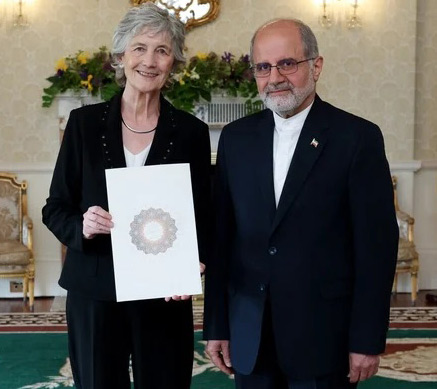
The decision to receive and photograph Iran’s ambassador at Áras an Uachtaráin, with the agreement of the Irish Government, was one such moment.
Of course, it will be said that this was merely a credentials ceremony. It will be said that diplomatic relations must continue, that ambassadors represent states whether we approve of those states or not, and that Ireland must keep channels of communication open. There is truth in that. Diplomacy is not friendship, and accreditation is not endorsement.
But symbols matter. They matter especially when they involve regimes that are still executing, imprisoning and torturing their own people.
Iran is not simply another difficult state with whom Ireland has disagreements. It is a regime whose record on executions is among the worst in the world. Human rights organisations have documented shocking numbers of executions, including executions following unfair trials, executions for political or security-related accusations, and executions connected to wider efforts to crush dissent. Reports of torture, forced confessions, arbitrary detention and brutal repression are not historical footnotes. They are part of the present reality faced by Iranians who dare to protest, speak, organise or simply refuse to submit.
That is why the image of Iran’s ambassador being formally welcomed and photographed with the President of Ireland (See above left), jars so deeply.
President Connolly now occupies an office that is, by design, above ordinary party politics. The President does not make foreign policy in the same way a government minister does. But the President does embody the State. The President’s actions, appearances and words carry ethical significance. When the President receives an ambassador from a regime carrying out executions and torture, the question is not whether the constitutional paperwork was correct. The question is whether the moral message was adequate.
Was there any public word for the prisoners awaiting execution? Was there any public acknowledgement of torture? Was there any mention of women, students, dissidents, trade unionists, journalists and minorities who have faced repression? Was there any reference to the many thousands alleged to have been killed in past massacres and crackdowns, or to the victims of the present wave of executions? If the above concerns were raised privately, the Irish public has not been clearly informed. If they were not raised at all, that is worse.
Ireland has often prided itself on speaking for human rights, international law and the dignity of small nations and oppressed peoples. We invoke that tradition when we speak about Palestine. We invoke it when we speak about Ukraine. We invoke it when we condemn apartheid, colonialism, war crimes and political imprisonment elsewhere. But a human-rights policy cannot be selective. It cannot be passionate in one case and ceremonially silent in another.
This is not an argument for cutting off all diplomatic contact with Iran. There may be Irish citizens, dual nationals, prisoners, humanitarian issues and international concerns that require a diplomatic channel. But maintaining a channel is not the same as offering the optics of normality.
Ireland could have handled this differently. The ceremony could have been accompanied by a strong public statement. The Government could have made clear that accreditation did not soften Ireland’s condemnation of executions, torture and repression. The President could have used the occasion, even in restrained constitutional language, to reaffirm Ireland’s concern for human dignity and human rights. There could have been a visible refusal to allow diplomatic protocol to become moral camouflage.
Instead, what the public saw was the familiar theatre of State recognition.That is the problem. Because for the families of those executed, for prisoners under sentence of death, for women beaten for defying compulsory controls, for protesters tortured into silence, and for exiles watching from Ireland, these images do not look neutral. They look like respectability being extended to the representative of a regime that has not earned it.
The office of President is not powerless. Its power lies in moral authority, in language, in symbolism, in the ability to remind the State of its values when convenience and protocol threaten to dull them. At a minimum, that moral authority should not be seen to soften the image of a regime still carrying out executions and torture.
Ireland must engage with the world as it is. But it must not forget what it claims to stand for. Diplomacy may require doors to remain open. Conscience requires that, when those doors open, the truth walks in as well.
Members of the Divisional Drugs Unit have executed a warrant under the Drugs Act at a premises in Thurles suspected of selling cannabis, cannabis jellies and cannabis vapes.
During the search, Gardaí obtained a positive result, pending further analysis. An investigation has now commenced.
We would like to thank members of the community who brought this matter to attention through Community Policing. Your continued engagement and support play an important role in helping to keep our towns and villages safe.
Anyone with information relating to the sale or supply of illegal drugs is encouraged to contact their local Garda Station or the Garda Confidential Line.
Ní neart go cur le chéile – There is no strength without unity.
A man and a woman, both aged in their 20s, have been charged following the seizure of €280,000 worth of suspected cocaine in Nenagh, Co Tipperary.
The operation was carried out on Tuesday, May 19th, by the Garda National Drugs and Organised Crime Bureau (GNDOCB) alongside the Tipperary Divisional Drugs Unit, during which approximately four kilograms of suspected cocaine were recovered.
According to Gardaí, the drugs seized have an estimated street value of €280,000.
The two suspects were arrested and detained under Section 50 of the Criminal Justice Act 2007 at a Garda station within the Clare-Tipperary Division.
Both have since been formally charged in connection with the investigation and are scheduled to appear before Nenagh District Court this morning, Thursday, May 21st, at 10:00am.
The suspected drugs will now undergo forensic examination by Forensic Science Ireland (FSI), while Garda investigations remain ongoing.
The Central Criminal Court has heard that “no one knows exactly what happened” on the night a 32-year-old Polish man died, following an incident at a house in Co Tipperary.
Mr Tomasz Rozpeda, aged 29, of no fixed abode, previously pleaded guilty to the manslaughter of Mr Maciej Nowak, who died at Ballycranna, Kilross, Co Tipperary, during the early hours of December 27th, 2023.
During the sentencing hearing today Tuesday, the court heard that both men had consumed large quantities of alcohol and drugs, while socialising together on St Stephen’s Day. A toxicology report showed Mr Nowak had an extremely high level of amphetamines in his system, close to a fatal level, although medical experts ruled this out as the cause of death.
The court heard Mr Rozpeda called emergency services and claimed his friend had “gone crazy”, hitting himself and smashing items around the house. However, pathologists later determined that Mr Nowak died from blunt force trauma to the head and neck, injuries which were not consistent with self-inflicted harm.
Medical evidence revealed Mr Nowak suffered extensive injuries, including dozens of bruises and trauma caused by the brain twisting within the skull. Gardaí also found blood-stained broken bottles scattered across the kitchen floor of the house.
Prosecution counsel told the court that CCTV footage showed the two men together at an Applegreen service station outside Tipperary town, before returning to Mr Nowak’s home. Additional evidence included phone calls and voice messages sent by Mr Rozpeda during the night, in which he reportedly told friends he had “f**ked up” and that an accident had happened.
Gardaí later arrested Mr Rozpeda, who initially denied responsibility and attempted to distance himself from the incident. Investigators said a number of untruths were told during interviews.
Victim impact statements were read to the court from Mr Nowak’s sister and fiancée. His sister described learning of her brother’s death as the moment her “world came to a standstill”, while his fiancée said she had lost “the love of her life” and struggled to cope emotionally since the tragedy.
The court also heard that Mr Nowak was a father of three children and had been due to marry in June 2024.
Defence counsel said the men had been friends for approximately ten years and there had been no previous animosity between them. He described the events as a tragic escalation during a night where both men had consumed substances “to excess”.
Counsel for Rozpeda apologised on behalf of his client and said there was no evidence that he had brought a weapon to the house or intended serious violence.
The Director of Public Prosecutions accepted the guilty plea to manslaughter, with the original murder charge set aside.
Ms Justice Eileen Creedon remanded Mr Rozpeda in custody ahead of sentencing on July 6 next.
Something is deeply wrong, when Ireland tolerates terrorist symbols but ignores the murder of Private Seán Rooney.
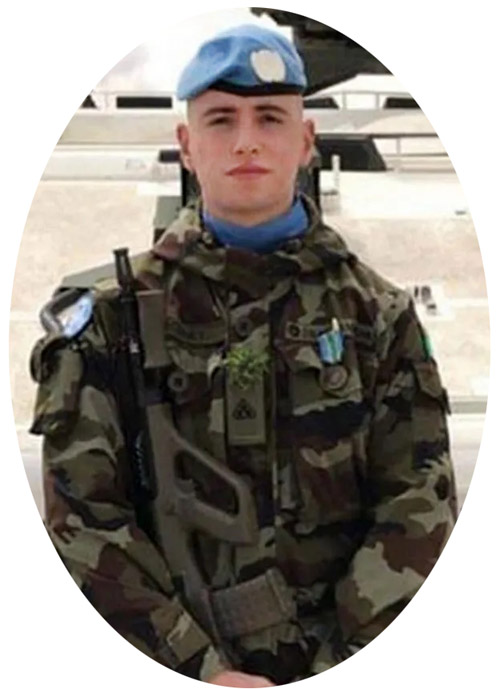
Private Seán Rooney was not a politician, activist or a celebrity; he belonged to a far higher order of human achievement and character. He was a 24-year-old Irish soldier from Donegal serving his country on a United Nations peacekeeping mission in Lebanon. By all accounts he was courageous, decent and deeply committed to protecting his fellow soldiers.
Private Seán Rooney, Irish Soldier Murdered by Hezbollah in Lebanon.
On December 14th 2022, just 11 days before Christmas, while travelling in a clearly marked UN vehicle near the Hezbollah stronghold of Al-Aqbiya, Private Seán Rooney and his colleagues came under sustained gunfire from Hezbollah-linked attackers. Seán, sadly, was killed trying to protect his comrades, while another Irish soldier was seriously injured.
The aftermath of this event has been a grotesque insult to his family and indeed to the Island of Ireland itself. The main suspect, Hezbollah member Mohammad Ayyad, was eventually convicted and sentenced in his absence after repeatedly avoiding court appearances. He still remains at large today, after previously being released on “medical grounds.” Meanwhile, others involved received sentences so absurdly lenient that even the Irish Government publicly condemned them as unacceptable. Private Seán Rooney’s mother correctly described the process as a “sham trial” and said justice had neither been done nor even seen to be done.
While Seán Rooney’s family continue to fight for accountability, Ireland has witnessed crowds marching openly through Dublin and Cork waving Hezbollah and Hamas flags, latter organisations synonymous with sectarian violence, terrorism, hostage-taking and the murder of civilians.
Perhaps nothing captures the moral confusion of our modern-day Ireland more than the sight of Irish Tricolours being waved beside Hezbollah and Hamas flags on the streets of Dublin and Cork, as though the values represented by our national flag are somehow compatible with organisations linked to terrorism, sectarian hatred and the murder of an Irish peacekeeper, Private Seán Rooney.
For Seán Rooney’s family, and for many decent Irish people, that image is not “solidarity” or “activism.” It is a profound national disgrace and an insult to the memory of a young Irish soldier who died serving under the UN flag at the hands of Hezbollah-linked gunmen.
What is truly repellent is not only that these flags appear, but that so many so-called and self-appointed champions of “human rights” refuse to condemn them. Many politicians, activists and celebrity figures appear far more interested in performative anti-Israel activism than in showing even basic solidarity with the family of an Irish peacekeeper, murdered by extremists, linked to Hezbollah. That silence is not moral courage; it is moral bankruptcy.
Jerome Lawrence rightly warned in his 1955 play, “Inherit the Wind”, that: “Fanaticism and ignorance is forever busy, and needs feeding.”
That is exactly what we are witnessing today. Fanaticism survives when hatred becomes fashionable, when ideological tribalism replaces moral consistency, and when people excuse or romanticise violent extremism because it aligns with their political worldview. Bigotry is not confined to race or religion; it also includes the irrational hatred and dehumanisation of anyone considered politically inconvenient, including Israelis, Jews, or even Irish soldiers whose deaths disrupt a preferred narrative.
Supporting innocent Palestinians does not require anyone to glorify Hamas or Hezbollah. But too many people in Ireland have crossed that line. They excuse terrorist symbolism, ignore antisemitism when it comes disguised as activism, and remain conspicuously silent about the murder of Private Seán Rooney because acknowledging it would force them to confront uncomfortable truths about the movements they openly, through ignorance, tolerate.
The Rooney family deserved national outrage, unity and relentless demands for justice. Instead, they got evasions, hypocrisy and silence from people who claim to stand against violence and extremism; latter a disgrace on modern Ireland.
This website uses cookies to improve your experience. We'll assume you're ok with this, but you can opt-out if you wish.AcceptRead More
Privacy & Cookies Policy
Privacy Overview
This website uses cookies to improve your experience while you navigate through the website. Out of these, the cookies that are categorized as necessary are stored on your browser as they are essential for the working of basic functionalities of the website. We also use third-party cookies that help us analyze and understand how you use this website. These cookies will be stored in your browser only with your consent. You also have the option to opt-out of these cookies. But opting out of some of these cookies may affect your browsing experience.
Necessary cookies are absolutely essential for the website to function properly. This category only includes cookies that ensures basic functionalities and security features of the website. These cookies do not store any personal information.
Any cookies that may not be particularly necessary for the website to function and is used specifically to collect user personal data via analytics, ads, other embedded contents are termed as non-necessary cookies. It is mandatory to procure user consent prior to running these cookies on your website.



Recent Comments