Pre-deceased by her husband Larry, sisters Maura (McCarthy), Margaret (O’Connell) and Kathleen (O’Donnell), brother Billy (Skehan); Mrs Hayes passed away peacefully, surrounded by her loving family, while in the care of staff at Acorn Lodge Nursing home, Cashel, Co. Tipperary.
Her passing is most deeply regretted, sadly missed and lovingly remembered by her sorrowing family; loving sons Noel and JJ, daughters Sheila, Mary and Brid, daughter-in-law Lucy, grandchildren Sophie, Brian and Kieran, brother Thomas (Skehan), sisters-in-law Mary-Frances and Eileen, nieces, nephews, extended relatives, neighbours and friends.
Requiescat in Pace.
Funeral Arrangements.
The earthly remains of Mrs Hayes will repose at Hugh Ryan’s Funeral Home, Slievenamon Road, Thurles, (Eircode E41 CP59) on Sunday afternoon, July 12th, from 4:00pm until 6:00pm, before arriving at St Kevin’s Church, Littleton, Thurles, at 6:45pm. Requiem Mass will be offered for Mrs Hayes on Monday morning, July 13th, at 11:30am, followed by interment, immediately afterwards, in the adjoining graveyard.
For those persons who would wish to attend Requiem Mass for Mrs Hayes, but for reasons cannot, same can be viewed streamed live online, HERE.
The extended Hayes and Skehan families wish to express their appreciation for your understanding at this difficult time, and have made arrangements for those persons wishing to send messages of condolence, to use the link shown HERE.
Note Please: House strictly private except for immediate family and close friends.
Solas na bhflaitheas agus leaba i measc na n-aingeal di.
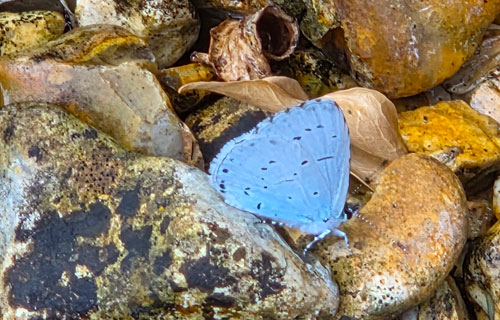
The small Holly Blue butterfly is one of those bright, delicate insects that can be missed until it suddenly flashes pale blue in front of you. This one was spotted in Thurles, Co. Tipperary, drinking water from damp stones; a behaviour butterflies often use to take in moisture and dissolved minerals.
The Holly Blue Butterfly, (Celastrina argiolus). Picture: George Willoughby.
The Holly Blue, (Celastrina argiolus), is a small butterfly with a wingspan of about 2.6 – 3.4cm (1.02 -1.34 Inches approx). It is usually the first “blue” butterfly, that people see in spring, and it can appear again later in summer. Unlike the Common Blue, which is more often seen low over grassland, the Holly Blue tends to fly higher around hedges, shrubs, trees, gardens, parks and woodland edges. Its pale silvery-blue underside, marked with small black spots but no orange markings, is a useful identification feature.
So how rare is it in Co. Tipperary? Nationally, the Holly Blue is not considered threatened. The Irish Red List assessment lists it as Least Concern, describing it as common and widespread in Ireland, with evidence of spread in suburban habitats. However, that does not mean every sighting is ordinary at local level. In Tipperary, Holly Blues are present but still worth recording, especially because they can be easily overlooked as they move quickly through gardens and hedgerows. A recent Butterfly Conservation Ireland note describes the Holly Blue as a successful garden and woodland-edge species, seen in wooded parks, gardens, hedges and woodland, with a second generation often emerging in July.
Its success is closely linked to two familiar plants; namely holly and ivy. In spring, females lay eggs mainly on holly flower buds; later in the year, ivy becomes especially important for the summer generation. This is why mature hedges, old gardens, churchyards, woodland margins and ivy-covered walls can be surprisingly good places to find them.
The Thurles sighting is a lovely local record because it shows the species using an everyday urban or garden-edge habitat. Damp stones, puddles and wet paths can attract butterflies when they need moisture, particularly during warm weather. Leaving a little wildness helps: keep ivy where safe, allow holly to flower, avoid cutting all hedges at once, and grow nectar plants such as bramble, bugle, thistles and other native flowers. In short, the Holly Blue is not rare in Ireland overall, but a confirmed sighting in Thurles is still a valuable reminder that Co. Tipperary’s gardens, hedgerows and green spaces can support beautiful native butterflies.
Anyone who sees one should consider submitting the record to the National Biodiversity Data Centre, as local sightings help build a clearer picture of how this small blue butterfly is doing across the county.
Mrs Mulvey passed away peacefully at her place of ordinary residence, surrounded by her loving family.
Her passing is most deeply regretted, sadly missed and lovingly remembered by her sorrowing family; loving son David, daughters Catherine, Jennifer and Patricia, son-in-law Tony, adored grandsons Matthew, Dylan and Adam, extended relatives, neighbours, friends and all who had the privilege of knowing the deceased.
The extended Mulvey family wish to express their appreciation for your understanding at this difficult time, and have made arrangements for those persons wishing to send messages of condolence, to use the link shown HERE.
“The family of Mrs Mulvey would like to thank most sincerely Mr Michael Dalton and staff and Ms Roisin Cleere”.
In his 91st year and pre-deceased by his parents Tom and Bridget, sisters Madie and Julia, brother Paddy-Joe; Mr Moore passed away peacefully while in the presence of his loving family.
His passing is most deeply regretted, sadly missed and lovingly remembered by his sorrowing family; loving and heartbroken wife Maureen (Pidge), daughters Stephanie Ryan (Annacarthy) and Gena Carroll (Thurles), sons Thomas, Séan, Fergus and Aidan, sons-in-law Michael and Liam, daughters-in-law Breda, Nicola, Niamh and Pauline, adored grandchildren David, Jack, Niall, Ellen,Lauren, Emily, Luke, Sara-Jane, Grace, Rachel, Daniel, Ben, Robyn, Milly, Will and Fiadh, brother Michael, brothers-in-law Paddy Burke and Neddy Butler, nephews PJ and Eamon, extended relatives, neighbours and a wide circle of friends.
The extended Moore and Pidge families wish to express their appreciation for your understanding at this difficult time, and have made arrangements for those persons wishing to send messages of condolence, to use the link shown HERE.
Her passing is most deeply regretted, sadly missed and lovingly remembered by her sorrowing family, extended relatives, former staff and management of Hayes Hotel, Thurles, neighbours and many friends.
Note Please: Family flowers only. Donations in lieu, if desired, to Suir Haven, Thurles, Co. Tipperary, in memory of Ms Christina (Chris) Ryan.
For those persons who would wish to attend Requiem Mass for Ms Ryan, but for reasons cannot, same can be viewed streamed live online, HERE.
The extended Ryan family wish to express their appreciation for your understanding at this difficult time, and have made arrangements for those persons wishing to send messages of condolence, to use the link shown HERE.
Solas na bhflaitheas agus leaba i na n-aingeal di.
This website uses cookies to improve your experience. We'll assume you're ok with this, but you can opt-out if you wish.AcceptRead More
Privacy & Cookies Policy
Privacy Overview
This website uses cookies to improve your experience while you navigate through the website. Out of these, the cookies that are categorized as necessary are stored on your browser as they are essential for the working of basic functionalities of the website. We also use third-party cookies that help us analyze and understand how you use this website. These cookies will be stored in your browser only with your consent. You also have the option to opt-out of these cookies. But opting out of some of these cookies may affect your browsing experience.
Necessary cookies are absolutely essential for the website to function properly. This category only includes cookies that ensures basic functionalities and security features of the website. These cookies do not store any personal information.
Any cookies that may not be particularly necessary for the website to function and is used specifically to collect user personal data via analytics, ads, other embedded contents are termed as non-necessary cookies. It is mandatory to procure user consent prior to running these cookies on your website.





Recent Comments