|
|
Garda Forensic Collision Investigator, (Tipperary Divisional Traffic Corps) M/s Annastatia Murphy reports:-
 “A Road Safety Seminar for Transition Year students will be held at LIT Thurles on tomorrow Thursday May 4th 2017. This day will focus on raising road safety awareness.
Students from the District of Thurles will be in attendance on both days. This is the 7th successive year that this event has taken place, however it is the first year it is being held outside of the An Garda Síochána College.
Previously the event has been held at An Garda Síochána College, Templemore, however due to the rapid and recent increase in Garda students, the college are unable to facilitate this year. In February 2017, we held a similar event in St Patrick’s Campus of the Mary Immaculate College, Thurles. For tomorrow’s event, LIT Thurles have graciously facilitated us on their campus.
Approximately 180 students from CBS Thurles and Presentation School Thurles are expected to be in attendance. An additional 25 persons will also be in attendance to include, guest speakers, VIPs and teachers. The event is expected to commence at 10.00am, ending at 3.00pm.
As this seminar is focussing on Road Safety, we have invited a number of subject relevant guests to participate. These will include representatives from the Road Safety Authority, An Garda Síochána Traffic Corps and a serious injury collision survivor.
The event has been a huge success in the past and has received very positive feedback, in promoting road safety and in turn helping to reduce serious and fatal road traffic collisions.”
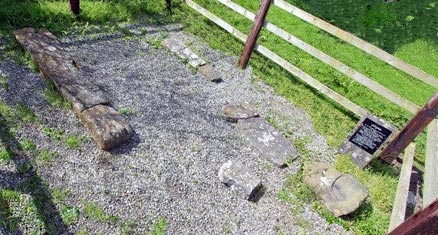 Grave of Gobán Saor, 16km (10Mls), from Thurles at Derrrynaflan, Ballinure, Co. Tipperary. Little is truly known about ‘An Gobán Saor’, pronounced Gubawn Seer, (Gobban the Builder; free smith, free mason or free carpenter), whom legend states is buried 16km (10mls), from Thurles, at Derrrynaflan, Ballinure, Co. Tipperary.
Back in the days when our present ancient stone castles, monasteries, round towers and churches (now, alas, many, for the most part, in ruins), were originally being constructed, stone-masons /smiths /architects, just like ‘An Gobán Saor’ (also spelt Gubin Saor & Gobban Saer) and other possibly lesser skilled, associates, would have assembled at prearranged building sites, in the hope of obtaining gainful employment. Non-locals selling their skills would have travelled with their whole families, setting up camp close to the area where there was a promise of construction work.
According to legend, the father of the Gobán Saor was himself a famous mason and architect. Convention states that the Gobán Saor lived sometime around the seventh century. Folklore also indicates that he married a respectable and very beautiful Sligo woman. He possibly travelled extensively, often incognito, not just in Ireland, but also in England and even on the Continent, designing splendid sturdy edifices, while working as a common stone mason.
Folklore indicates that An Gobán Saor was highly intelligent, jovial and at all times generous with his knowledge. From the many tales told we learn that the traits he finds most difficult to understand are miserliness combined with greed.
 Picture (A) Abbey Rd. area of Thurles and St. Brigid’s Graveyard (Shown circled in green), as it existed prior to 1846. Picture (B) The mason’s mark or symbol of ‘An Gobán Saor’, on a pillar beside St. Brigid’s Graveyard (Shown circled in red). The 2.4m pillar on this site was constructed in much more recent times possibly from stones relating to an older church building no longer evident on site.
To build these stone structures; these itinerant, skilled, stone masons would have remained camped in areas for many years, living, not in huts or houses, but in temporary tent-like dwellings, roofed over using bent, flexible, saplings covered in an oiled cloth to repel the weather. These nomadic skilled individuals were the past artists, designers, and architects, while also working as stone mason.
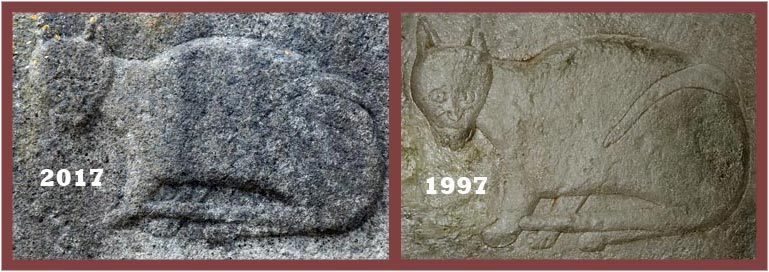 Stone carving of the cat with two tails, the mason’s mark or symbol of ‘An Gobán Saor’, in Thurles Co. Tipperary. This feline demonstrates a somewhat sad, frightened, stare at the visitor, while its set of whiskers points downwards.
Tales of An Gobán Saor‘s exploits verbally related down through the years’ state that he once applied seeking work to the master builder of a Cathedral. The master builder placed him in a work-shed by himself, and pointed to a block of stone inviting him to carve from it a cat with two tails. Next morning Gobán had disappeared, but when the master unfastened his shed and looked in, he found that the block of stone had been most beautifully carved into a cat with two tails. The Cathedral builder was heard to exclaim that this could only have been the work of An Gobán Saor himself, as no other human could have produced such superb work, and so fast.
So was born the mason’s mark or symbol, associated with An Gobán Saor; the cat with two tails, as shown above.
The story is also told that while building a monastery, the monks demanded that he lower his agreed price. To force this issue, they removed his climbing ladder from a castellated area he was building, preventing him from easy descent. Gobán began to slowly dismantle the stones structure, tossing the building materials to the ground, genially informing his employers below that this method of reaching the ground was as good as any. The monks are said to have quickly returned his ladder, and paid him his agreed price.
Because of the skilled ability of these itinerant builders, they were usually allowed, for the most part, to govern themselves. Sons inherited their skills and the trade secrets from their fathers, thus it was essential, that they would also develop their own private signs and a clandestine language, to ensure that these same trade secrets remained covert.
So also did the Tinkers; those specialising in skilled metal work, and some of this secret language, over the years, has made its way into the public domain; words like:- Kuenig (Eat), Án or Tes (Bread), Lokh or Lima (Milk), Chiman (Stick), Bós (Fist), Rístan (Prison), Krub (Foot), and a word used quite often today in conversation, which we relate to unemployment benefit; the word Dóle, which back then meant ‘Bread Trough’.
A Gobán Saor symbol can also be viewed by visitors attending at the Swiss Cottage, Cahir, Co. Tipperary, although same was possibly moved to this spot, in more recent times.
 A 28 year old Thurles native named as Mr Daniel (Danny) Whelan, previously with an address at Monakeeba, Thurles, Co. Tipperary and currently of no fixed abode, will be charged with the murder of M/s Samantha Walsh, a mother-of-four, in Waterford this morning.
The body of M/s Walsh aged 31 years, from Central Avenue in Lisduggan, was found at a flat in Thomas Court, Thomas Street, in Waterford city, at the weekend.
Detectives investigating the killing of M/s Walsh arrested the man at approximately 3.00pm on Sunday afternoon last, under Section 4 of the Criminal Justice Act, which allows for detention for up to 24 hours. Following his arrest Mr Whelan was brought to Waterford Garda station in Ballybricken for questioning.
The body of M/s Walsh, will be buried following Requiem Mass at St Paul’s Church, in Lisduggan at 10.00am on Tuesday, followed by interment afterwards in Kilbarry Cemetery.
 Global US drug manufacturers MSD are to invest €40m in their Biotechnology facility at Kilsheelan House, Ballydine, Clonmel, Co. Tipperary this year; installing new technology which it intends to use to further improve a number of its products.
The MSD plant has been in operation for over 40 years, and currently exports to some 30 countries, including destinations in Europe, Japan and the USA.
The site at Ballydine, Co Tipperary, which currently employs 600 people, (some 1,800 people employed by the company in Ireland), develops and supplies the active ingredients for a range of its medical products.
This promised investment brings MSD’s total investment; spent over a three-year period, to €75m, in upgrading this Tipperary facility.
The new technology to be installed, under the current €40m investment promised, includes a spray drying facility, which is used in the production of a number of new products; increasing their solubility and improving how they are absorbed into the human body by patients.
Mr Ger Carmody, Associate Vice President, and Plant Manager at MSD Ballydine, has stated that this current investment truly reflects the growing importance of MSD in Ireland and its overall operations in the group’s global network.
Two Thurles brothers have appeared in court charged in relation to the seizure of more than €50,000 worth of tools and equipment, which it is alleged was stolen in the UK.
The men detained today at Dublin Port, after arriving from the UK, were originally questioned at Irishtown Garda station under Section 4 of the Criminal Justice Act.
The industrial tools and equipment, believed destined for the black market, were discovered in two vehicles, one of which was allegedly stolen, at Dublin Port on Saturday evening last.
Mr Jason O’Donoghue, aged 38 years, of Toreen, Bothar na Mona Road, Thurles, Co. Tipperary, and Mr Darren O’Donoghue, aged 29 years, of Croke Gardens, Croke Street, Thurles, Co. Tipperary, appeared before Judge John Cheatle this morning, at Dublin District Court.
Both men were charged with handling stolen property, while Mr Darren O’Donoghue was also charged with being in possession of false vehicle registration plates, and allowing himself to be carried in a vehicle known to be stolen.
Both men have been granted bail on agreed conditions that; (1) they reside at the addresses supplied and obey a curfew from 10pm to 7am: (2) that Both men must sign on daily at Thurles Garda station; (3) must not associate with each other; (4) must provide a mobile phone number to Thurles Gardaí, enabling themselves to be contacted during the 24 hours of each day.
There was an objection to Legal aid by Gardaí on the basis that each of the accused had access to large sums of cash. Each man was also ordered to pay a cash surety of €500 and must now appear before Dublin District Court on June 26th.
Investigations are now under way with UK authorities to identify the owners of the property seized at Dublin Port.
|
Support Us Help keep Thurles.info online by donating below. Thank you.
Total Donated 2026: €300.00
Thank You!
Daily Thurles Mass Livestream
|



Recent Comments