|
|
 It was with great sadness that we learned of the death yesterday, Thursday 13th September 2018, of Mr Denis (Dinny) Maher, Roxboro, Hillview Drive, Thurles, Co. Tipperary and formerly of Gouldscross, Clonoulty, Co.Tipperary.
Beloved husband of the late Josie (née Guthrie); Mr Maher passed away peacefully after a short illness.
His passing is most deeply regretted by his daughters Kathryn and Denise; son Niall; grandchildren Joseph, Robert, Lily-Kate, James and Billy; sons-in-law John and Colm; brother Nicky; nephews; nieces; the Guthrie family; extended relatives; neighbours and friends.
Funeral Arrangements
The earthly remains of Mr Maher will repose at Hugh Ryan’s Funeral Home, Slievenamon Road, Thurles on Monday evening, September 17th, from 5.00pm to 7.00pm, to arrive at the Cathedral of The Assumption, Thurles at 7.30pm.
Requiem Mass will take place on Tuesday September 18th at 11.00am, followed by interment immediately afterwards in Holycross Abbey, cemetery.
Note Please: House Private.
Ar dheis Dé go raibh a anam dílis.
The Community Hall, which sits in the centre of the picturesque village of Two-Mile-Borris, near Thurles, Co. Tipperary, is being currently offered for sale.
The hall’s closure in recent times had caused many living within the local community, to pause regarding the issue of its closure, while they considering its immediate future.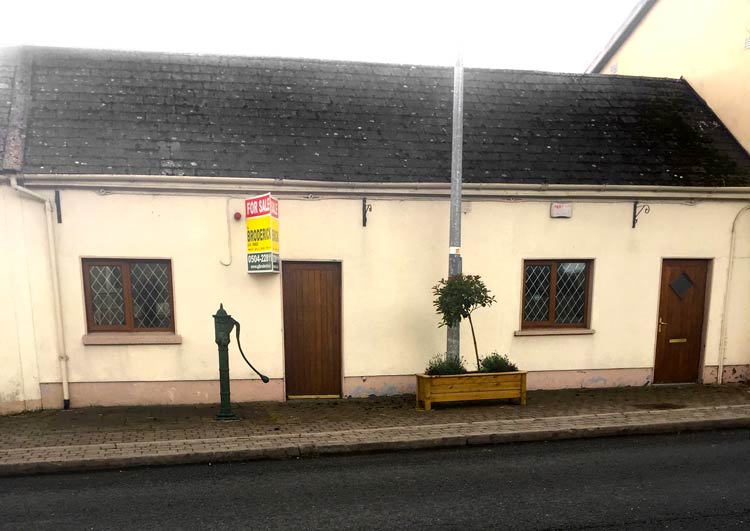
However in recent weeks a ‘For Sale’ sign has materialised; displayed on its front portals, without, according to some very upset locals, any consultation with the local village population.
Same sale within this tight knit community has generated no little hidden anger, with many viewing this decision as ‘high handed’, according to some individuals with whom we spoke.
In 1995 the hall was placed in the care of the parish, before being later invested in the Roman Catholic Diocesan Trust. A committee had been formed to look after the day-to-day running of this local asset, however a recent lack of maintenance and supervision etc, brought about its temporary closure.
Known History Of Two-Mile-Borris Community Hall
The hall, we understand, originated back in the latter part of the 19th century; around the 1890’s, when the Irish Agricultural Organisation Society (IAOS), latter a co-operative movement became established in Ireland. A group of innovative farmers in the area came together to form the Two Mile Borris Agricultural Society; becoming shareholders.
The initial aim of this Society was to purchase seed; fertiliser, and farm machinery, hiring out the latter to aid the local farming community. Part of the building was also used as a dwelling house.
The first secretary of the Society was Mr Tom Fanning from the townsland of Skehana, Two-Mile-Borris. The Society eventually went out of existence after some years.
Up until 1960 the ‘Society’, as the building was known, was used as a storeroom. Then the Fanning Family, from Skehana granted the use of the premises, including the now vacant dwelling area, to the Legion of Mary. Renovations were undertake by Mr John McGuire, a local building contractor and by local voluntary labour, before the Legion of Mary began to use the hall as a meeting place; a venue for fund-raising and as a tea rooms.
In the 1970’s Two-Mile-Borris Festival Committee used the hall, carrying out further developments in subsequent years. This same Festival Committee also purchased the field beside the school, without financial assistance from any lending agency. Locals were adamant in their praise of these former, hard working, community members, latter who raised the finance for both of these aforementioned two projects.
[We learn that this former committee included names such as: Fr. Bobby Harkin C.C., Mr Richard Ryan, Mr Jimmy Moloughney, Mr Gerry Bowe, Ms Josie Fanning, Mr Thomas Cussen and Mr Sean Cussen, latter all clearly visible to the fore and at the helm of this organisation in the past.]
Interesting to note that some of the community then sought a ‘Vegas’ type hall at that time, but all were ruled out of order.
In 1989 the late Mr Harry Ryan, Galboola, Littleton, then Chairperson of Tipperary Co. Council, for the first time since the halls inception, held a meeting of the Council Authority here in his own native Two-Mile-Borris.
It was with great sadness that we learned of the death yesterday, Wednesday 12th September 2018, of Mr Michael Stakelum, Atlanta Nursing Home, Bray, Co. Wicklow and formerly of Glenreigh, Holycross, Thurles, Co. Tipperary.
Mr Stakelum passed away peacefully at St. Vincent’s University Hospital, Dublin; most deeply regretted by his family; friends; residents; management and staff at Atlanta Nursing Home.
Funeral Arrangements
The earthly remains of Mr Stakelum will repose at Colliers Funeral Home, Old Connaught Avenue, Bray, on Saturday next, September 15th, from 9.15am before being removed at 10.00am to the Church of Our Lady Queen of Peace, Putland Road, Bray, Co. Wicklow, arriving for 10.30am Requiem Mass, followed by private cremation.
Ar dheis Dé go raibh a anam dílis.
 It is with great sadness that we learned of the death today, Wednesday 12th September 2018, of Mrs Helen (Ellen) Brennan (née Maher), No. 10 St. Mary’s Road, Killenaule, Thurles, Co. Tipperary.
Predeceased by her husband Michael (Mick); the passing of Mrs Brennan is most deeply regretted by her loving family Patrick, Lena, Ann, Patricia, Thomas, Michael, Noelle and Eddie; brother Marks; sons-in-law; daughters-in-law; partners; sisters-in-law; brother-in-law; grandchildren; great-grandchildren; nieces; nephews; extended relatives; neighbours and friends.
Funeral Arrangements
The earthly remains of Mrs Brennan will repose at O’Connell’s Funeral Home, Killenaule, Thurles, on Friday evening, September 14th, from 4.30pm to 7.00pm, to arrive at St. Mary’s Church, Bailey Street, Killenaule at 7.30pm.
Funeral Mass will be held on Saturday, September 15th, at 11.30 am, followed by burial immediately afterwards in Crosscannon Cemetery, Killenaule, Co. Tipperary.
Please Note: Family flowers only. Donations in lieu, if desired, to South Tipperary Hospice movement, (STHM).
Ar dheis Dé go raibh a h-anam dílis.
 In more recent decades a Census here in Ireland, as a general rule, takes place in every year that ends in 1 or 6, except in any year that experienced some kind of catastrophe, e.g. Foot and Mouth disease as in 2001, Famine, World Wars, etc.
Two years ago, in the 2016 census, the Irish population stood at 4,757,976 persons. Nationally, our birth rate was 13.7 births per 1,000 population while our death rate was 6.5 deaths per 1,000 population.
Our life expectancy averaged around 80.19 years [males 78 years – females 82.6 years]. Our infant mortality rate was 3.85 deaths per 1,000 live births. Our net population movement rate to a new area or country in order to find work or better living conditions averaged 0.86 migrants per 1,000 population.
The population of the entire county of Tipperary was calculated as being 160,441 in this same 2016 census, with the largest towns remaining identified as Clonmel, Nenagh and our own town of Thurles .
Data now recently assembled from a comparison between the 2016 Census and the Census of ten years previously, in 2006, now confirms; as if confirmation was needed, that the number of people at work, remains below pre economic crash levels in more than 70 towns across rural Ireland.
Despite political claims, new figures show how the economic recovery has left vast swathes of rural Ireland behind, with fewer people working, compared with the year 2006 when our economy was thriving. Nationally, more than 40% of our towns and villages have not managed to secure any additional employment over this period, while revealing that job losses have not been regained in some of our cities, where a small recovery, at the very least, might have been expected.
In some 167 settlements the number of people seeking employment rose in just 96, disclosing a fall off in 71. Large towns such as Clonmel in Co Tipperary failed to recover during this period, showing a drastic reduction in real employment of some 751 persons, when compared.
These newly compiled figures do not summarise the number of workers who were forced to emigrated, migrate or retired. Neither do they take account of growth over the past two years in any one area, however they do confirm that many rural areas continue to be ignored and left behind because of demographics.
Comparing both these census figures we learn that almost 45% of Irish employment growth was, not surprisingly, in Dublin city and suburbs, with the numbers at work here rising by 34,209. The cities of Dublin, Cork and Galway together saw some 53% of all jobs created within Ireland.
In the province of Munster, the numbers at work fell in 24 of 51 towns. Out of a total of ten Tipperary towns, despite Labour / Fine Gael promises and announcements, eight such towns experienced job losses during this same period examined.
|
Support Us Help keep Thurles.info online by donating below. Thank you.
Total Donated 2026: €300.00
Thank You!
Daily Thurles Mass Livestream
|



Recent Comments