A €10-a-week increase in the State pension and core social welfare payments is now set to form part of Budget 2027, as Government leaders enter the final stages of negotiations ahead of Tuesday’s announcement.
The increase is expected to apply across the main welfare rates, including payments to pensioners, people with disabilities, carers and jobseekers. An earlier figure of €7.50 had been under consideration, but negotiations have since moved to the higher €10 increase. Energy and the cost of living remain central to the final Budget discussions.
Taoiseach Mr Micheál Martin has signalled that further carbon tax increases on home-heating oil will be halted for the remainder of the Government’s term. He has also confirmed that eligible pensioners and long-term welfare recipients can expect the traditional Christmas bonus payment this year.
Further targeted assistance for households facing high heating costs is still being discussed. One proposal under consideration is a once-off payment for Fuel Allowance recipients, with figures of around €300 mentioned during negotiations. However, the final form of this support has not yet been confirmed.
A new annual cost-of-disability payment is also expected, with current discussions putting its value in the region of €400 to €500. An increase in the Living Alone Allowance is among the measures expected to feature in the final package.
The Government is also examining ways of reducing household energy costs, while final decisions on childcare supports are being worked out during talks in Government Buildings today.
Budget 2027 is scheduled to be announced on Tuesday next, October 6th, with the overall package expected to include approximately €7 billion in additional spending and €1.5 billion in tax reductions.
Final decisions on several measures are still being made, so figures relating to Fuel Allowance, disability supports, childcare and other cost-of-living measures should be treated as proposals until formally announced on Budget Day.
Race Horse trainer, Mr Ray Hackett, has been fined a total of €4,250 following a positive test for cobalt returned by Nowwhatdoyouthink, after the gelding won a maiden hurdle at Thurles in March 2025.
Nowwhatdoyouthink subsequently developed into a high-class chaser for Mr Hackett, winning a Grade 3 contest at Cork and finishing third in the Grade 1 Champion Novice Chase at Punchestown. He was later sold privately and transferred to Gordon Elliott, making his first start for his new trainer when finishing fourth in the Galway Plate in July.
The positive sample was taken after Nowwhatdoyouthink won the ThurlesRaces.ie Maiden Hurdle on March 6th, 2025. Analysis detected cobalt, with a subsequent B sample also confirming its presence.
During an IHRB investigation, Mr Hackett explained that Growvite Sheep, an over-the-counter supplement containing cobalt, had been administered to racehorses in his care in an effort to maintain their condition. Mr Hackett said he had not realised the product’s use needed to be entered in his Medicines Register. He told the Referrals Committee that he has since changed his feeding practices and no longer uses the supplement.
The committee found Mr Hackett in breach of several rules relating to prohibited substances and medicines records. Nowwhatdoyouthink was disqualified from his Thurles victory, with Joueuse Royale promoted to first place.
Hackett was fined €1,000 in relation to the prohibited-substance breach, €1,500 and €1,000 for separate breaches of Rule 148, and a further €750 over deficiencies relating to the Medicines Register, bringing the total to €4,250.
Harnett successful on appeal. Mr Paddy Harnett was partially successful in his appeal against a nine-day suspension imposed for improper riding at Clonmel on September 16.
Harnett informed the Appeals Body that he believed his saddle had slipped during the closing stages. After considering the evidence, the panel concluded that his riding was at the severe end of careless riding rather than meeting the threshold for improper riding. His suspension was consequently reduced from nine days to six.
Pre-deceased by his wife Sadie (née Ryan), parents Tom and Margaret (Babs, née Delahunty), brother Michael, sister Anna (Maher, Kilrush), Mr Kelly passed away peacefully, surrounded by his loving family while in the care of staff at Ardeen Nursing Home, Abbey Rd, Garryvicleheen, Thurles, Co. Tipperary.
His passing is most deeply regretted, sadly missed and lovingly remembered by his sorrowing family; loving daughter Margaret (Irons), sons John, Jeremiah, Pairic, Michael and Thomas, grandchildren Joshua, Caicey, Shona, Grace, Jamie, Douglas, Callum, Ruaridh, Sadie, Ronan and Jack, son-in-law Mark, daughters-in-law Melanie, Siobhan and Caoimhe, twin sister Mairette (O’Donnell), sister Mary (Kelly), nephews, nieces, brothers-in-law, sisters-in-law, extended relatives, neighbours and friends.
The extended Kelly and Ryan families wish to express their appreciation for your understanding at this difficult time, and have made arrangements for those persons wishing to send messages of condolence, to use the link shown HERE.
Note Please: House Strictly Private. Donations to Irish Cancer Society in memory of Mr Paddy Kelly
“The Kelly family wish to thank Ardeen Nursing Home, Thurles; Fennor Hill Care Facility, Urlingford; Tipperary University Hospital; Thurles Care; Dr Murphy and all those who cared for Mr Kelly during his illness”.
The Defence Forces are expanding towards a planned strength of 11,500 personnel by 2028, and an increasing proportion of new recruits were born outside Ireland.
According to reported figures, between 13% and 18% of recruits since 2022 have been born outside the Irish State. That statistic deserves discussion, but we need to ask the right question. Being foreign-born does not make somebody a security threat. Many foreign-born people have lived in Ireland for years, have built their lives here and subsequently become Irish citizens. Others eligible to join include EEA nationals, recognised refugees and people with subsidiary protection who meet residency and other requirements.
The real national-security issue is therefore not someone’s place of birth. It is how Ireland vets military personnel and decides who gets access to our most sensitive capabilities. Every Defence Forces applicant undergoes security vetting. The Department of Defence has confirmed that this is carried out with the assistance of An Garda Síochána and that cases involving an overseas or non-national component can require contact with international vetting authorities.
That is reassuring. But as Ireland invests heavily in defence, cyber capabilities, intelligence, radar, communications, weapons systems and maritime security, another question arises; should every person who can join the Defence Forces automatically be eligible for every sensitive military appointment?
Other democracies make an important distinction between being eligible to serve and being eligible to access highly classified information. The United States allows lawful permanent residents to enlist, but non-US citizens generally cannot obtain a personnel security clearance. That restricts access to classified information and certain sensitive military occupations.
The United Kingdom also recruits some non-UK nationals but operates several levels of national-security vetting. Higher-level vetting can examine overseas connections, financial circumstances, family relationships and other vulnerabilities relevant to foreign influence or coercion. Some particularly sensitive national-security and intelligence positions may also be restricted by nationality.
Canada permits permanent residents to serve in its armed forces, but its security system is similarly graduated. Under recent reforms, Canadian citizenship is required for Top Secret and Enhanced Top Secret clearance, alongside stronger continuing security checks.
So what is Ireland’s equivalent? That is the question I believe deserves a clear public answer. Ireland should be able to welcome people who genuinely wish to serve their adopted country, while simultaneously protecting intelligence, cyber systems, strategic communications, weapons and other sensitive military capabilities. Those two objectives are not contradictory. A modern security system should assess the individual, not stereotype somebody according to birthplace. But it should also recognise that foreign intelligence services seek leverage through relationships, financial pressure, overseas connections, coercion and access to information. And those risks can apply to Irish-born personnel too.
Perhaps Ireland therefore needs a more clearly defined system in which eligibility to join the Defence Forces; eligibility to receive particular security clearances; and eligibility to work in the most sensitive areas of intelligence, cyber, communications and strategic defenceare treated as separate questions.
There may already be classified safeguards that cannot sensibly be made public. But the Government should at least be able to explain the principles governing the system. With the Defence Forces expanding rapidly and Ireland facing a much more complicated international security environment, this is not a question about ethnicity or immigration. It is a question about national security, loyalty, vetting and access to sensitive information. Ireland should welcome anyone who is eligible and genuinely committed to serving the Irish State. But the State also has a duty to ensure that whoever gets access to its most sensitive military capabilities, Irish-born or foreign-born, has been vetted to a standard appropriate to that responsibility.
As we expand our Defence Forces, perhaps the question we should be asking is; “Do Ireland’s security-clearance rules match the military we are now trying to build?”
There is an important ocean current called the AMOC, the Atlantic Meridional Overturning Circulation.
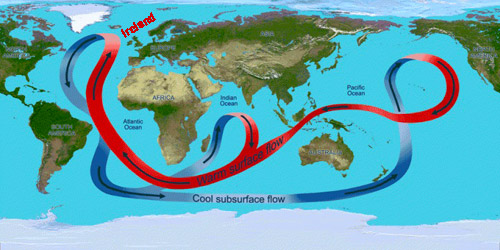
The AMOC includes Atlantic currents at the surface and at great depths that are driven by changes in weather, temperature and salinity (latter the measure of the concentration of dissolved salts, such as sodium chloride, magnesium, sulfate, and calcium, in a body of water). Those currents comprise half of the global thermohaline circulation or “Global Conveyor Belt,”, [See Image hereunder], that includes the flow of major ocean currents, the other half being the Southern Ocean overturning circulation. Think of it as a huge system of moving water in the Atlantic Ocean. It carries warm water north and colder water south. This movement helps shape the climate of Europe and influences rainfall and weather far beyond the Atlantic.
Thermohaline Circulation.
Scientists are watching an unusual area of cooler water south of Greenland. It is sometimes called the “Cold Blob” or North Atlantic Warming Hole. While much of the world is getting warmer, this part of the North Atlantic has not warmed as quickly and has sometimes cooled. Scientists believe changes in the AMOC are one important reason.
Why is this happening? Greenland is losing enormous amounts of ice as the climate warms. Between 2002 and 2023, Greenland lost about 270 billion tonnes of ice each year on average. When this freshwater enters the North Atlantic, it can make the ocean water less salty and less dense. Along with warmer ocean temperatures, this can make it harder for the normal overturning circulation to work as strongly.
Is the AMOC already collapsing? No. Scientists do not currently know that an AMOC collapse is happening or about to happen. But scientists are confident that the AMOC is expected to weaken during this century as the planet continues to warm. A complete collapse before 2100 is considered less likely, but it cannot be completely ruled out.
Why should we care? A major weakening of the AMOC could change weather patterns across large parts of the world. It could affect:
Temperatures and weather in Europe.
Rainfall in Africa, Asia and the Americas.
Farming and food production.
Sea levels around parts of the Atlantic.
Marine life and ocean ecosystems.
A complete collapse would cause much bigger changes, including major shifts in rainfall and regional climate.
The important message is the “Cold Blob” does not mean disaster is certain. But it is one of several important changes scientists are carefully watching in the North Atlantic. Our oceans are connected. What happens around Greenland and in the Atlantic can affect climate and rainfall thousands of kilometres away. The main long-term pressure on this system is human-caused global warming. Reducing greenhouse gas emissions lowers the amount of future warming, and reduces the risk of large, dangerous changes to our oceans and climate.
Awareness matters. Facts matter. And what we do now still matters.
This website uses cookies to improve your experience. We'll assume you're ok with this, but you can opt-out if you wish.AcceptRead More
Privacy & Cookies Policy
Privacy Overview
This website uses cookies to improve your experience while you navigate through the website. Out of these, the cookies that are categorized as necessary are stored on your browser as they are essential for the working of basic functionalities of the website. We also use third-party cookies that help us analyze and understand how you use this website. These cookies will be stored in your browser only with your consent. You also have the option to opt-out of these cookies. But opting out of some of these cookies may affect your browsing experience.
Necessary cookies are absolutely essential for the website to function properly. This category only includes cookies that ensures basic functionalities and security features of the website. These cookies do not store any personal information.
Any cookies that may not be particularly necessary for the website to function and is used specifically to collect user personal data via analytics, ads, other embedded contents are termed as non-necessary cookies. It is mandatory to procure user consent prior to running these cookies on your website.







Recent Comments