|
|
 It is with great sadness we learned of the death today, Friday 3rd March 2017, of Mr Brendan Stokes, Gortnahoe, Thurles, Co. Tipperary.
Predeceased by his brother Gerard; Mr Stokes passed away peacefully, while in the care of the Mater Private Hospital, Dublin.
His passing is most deeply regretted by his heartbroken wife Ann; his loving family Jenny, Joanne, P.J. and Caitriona; sons-in-law; grandchild Arwyn; brothers Paddy, John and Tom; sister Maureen; brothers-in-law; sisters-in-law; nieces; nephews; uncle; aunts; extended relatives and a wide circle of friends.
Funeral Arrangements
The earthly remains of Mr Stokes will repose at Doyle’s Funeral Home, Urlingford, on Saturday evening from 4.00pm until 7.00pm. Removal from his residence on Sunday morning to the Church of the Sacred Heart, Gortnahoe, arriving for Requiem Mass at 11.15am.
Interment will take place immediately afterwards in the Good Shepherd Cemetery, Gortnahoe.
Note: Family flowers only please, however donations, if desired, to the Irish Heart Foundation.
Ar dheis Dé go raibh a anam dílis.
 It is with great sadness we learned of the death today, Friday 3rd March 2017, of Mr Patrick (Patsy) Ryan, Gortahoola, Drombane, Thurles, Co. Tipperary.
Predeceased by his sister Alice, brothers John, Denis, Michael, Stephen and Bernard; Mr Ryan passed away while in the loving care of the Matron and Staff of St. Theresa’s Nursing Home, Dublin Road, Thurles, Co. Tipperary.
His passing is most deeply regretted by his loving sisters Mary and Chris; brothers Andrew and Con; sisters-in-law; brothers-in-law; nieces; nephews; neighbours; extended relatives and friends.
Funeral Arrangements
The earthly remains of Mr Ryan, will repose at O’Dwyer’s Funeral Home, Upperchurch, Thurles tomorrow Saturday from 5.00pm with removal at 7.00pm to St. Mary’s Church, Drombane, Thurles, Co Tipperary.
Funeral Mass will be held on Sunday at 10.00am, followed by interment immediately afterwards in Clogher Cemetery, Clonoulty, Tipperary.
Ar dheis Dé go raibh a anam dílis.
It is with great sadness we learned of the death yesterday, Wednesday 1st March 2017, of Mrs Mary B. Ryan (née Commins), Tonagha, Thurles, Co. Tipperary and formerly of Clobanna, Thurles, Co. Tipperary.
Predeceased by her husband Jimmy; Mrs Ryan passed away following an illness, borne bravely for several years.
Her passing is now most deeply regretted by her loving sons Sean, Seamus, Denis, Joe and Paddy; daughters Sarah and Camilla; sons-in-law; daughters-in-law; grandchildren; great-grandchildren; brothers-in-law; sisters-in-law; nephews; nieces; extended relatives; neighbours and the wide circle of friends and carers who assisted her during her period of illness.
Funeral Arrangements
The earthly remains of Mrs Ryan will repose at Egan’s Funeral Home, Thurles on tomorrow, Friday evening March 3rd, from 3.00pm to 7.00pm, before arriving at the Cathedral of The Assumption at 7.30pm.
Funeral Mass will be held on Saturday, 4th March, at 11.00am, followed immediately afterwards by interment in St. Patrick’s Cemetery, Moyne Road, Thurles, Co. Tipperary.
Note: Family flowers only, however donations, if desired, to The Alzheimer Society of Ireland.
Ar dheis Dé go raibh a h-anam dílis.
It is with great sadness we learned of the death today Thursday 2nd March 2017 of Mrs Kitty Ryan (Darby) (née Ryan), Foilnacanna, Kilcommon, Thurles, Co Tipperary.
Predeceased by her husband Ger; Mrs Ryan passed away peacefully while in the care of the Padre Pio Nursing Home, Holycross, Thurles, Co. Tipperary.
Her passing is most deeply regretted by her daughter Kay O’Dwyer (Ballytarsna, Cashel); son Conor; sister Hannah; grandchildren Laura, Paul, Colm and Niall; son-in-law Gerry; sisters-in-law; brothers-in-law; nephews; nieces; extended relatives; neighbours and friends.
Funeral Arrangements
The earthly remains of Mrs Ryan will repose tomorrow, Friday evening, at Our Lady Queen of Peace Funeral Home, Kilcommon from 5.00pm, with removal at 8.00pm to St. Patrick’s Church, Kilcommon.
Requiem Mass will be held on Saturday at 11.30am, followed by burial immediately afterwards in the new cemetery, Kilcommon, Thurles, Co. Tipperary.
Note: Family flowers only please.
Ar dheis Dé go raibh a h-anam dílis.
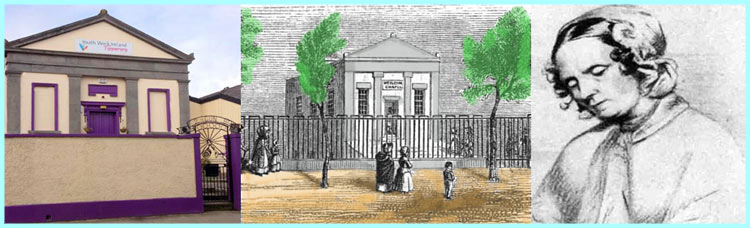 L-R. Pic (1) Wesleyan Methodist chapel today. Pic (2) Initial Drawing of Wesleyan Methodist chapel 1847. Pic (3) Drawing of the Missionary Mrs Asenath Hatch Nicholson, who visited Thurles in 1848. The Wesleyan-Methodist chapel, built originally 1848, was described back then as being a detached three-bay gable-fronted building, having three-bay two-storey side elevation with lean-to extension to the rear, and with a pitched artificial slate roof with rendered chimney stacks. Lined-and-ruled rendered walls to the front with square-headed niches with limestone sills and moulded render surrounds, ashlar limestone pilasters, and limestone pediment with fascia and acroteria with anthemion motif. Central square-headed replacement timber panelled double doors with render cornice with consoles and limestone steps.
In more recent years its continued use would see it become the home of Thurles FCA [Currently known as the Reserve Defence Force, (RDF)]
and even more recently the newest home to Thurles Youth Centre.
However a report sent to the editor of the Wesleyan-Methodist Magazine[1] records the opening of the Thurles Wesleyan-Methodist chapel; situated as it does today on the west side of Slieve-na-Mon Road, in Thurles, Co. Tipperary. Remember 1848 Thurles was still experiencing the aftermath of three years of the Great Famine of 1845 -1849.
Note: The Wesleyan Methodist Magazine[1] was a monthly magazine published between 1778 and 1969. Founded by John Wesley as the ‘Arminian Magazine’, it was later retitled the Methodist Magazine in 1798 and later again, in 1822, the Wesleyan Methodist Magazine.
A report by Mr Robert Bruce of Roscrea (Tullamore Methodist District) in 1848 reads: “On March 1st a very neat and commodious Wesleyan chapel was opened in Thurles, in the Roscrea Circuit, Ireland by the Rev. Messrs. Croggon and Reilly, who preached very excellent and appropriate sermons, Mr Croggon from Genesis Chapter 28-Verse 17. [And he was afraid, and said, How awesome is this place! this is none other but the house of God, and this is the gate of heaven”] and Mr Reilly from St John Chapter 1 – Verse 29 [The next day John seeth Jesus coming unto him, and saith, Behold the Lamb of God, which taketh away the sin of the world.]“
Mr Bruce reports “The building is 34ft x 25ft and will afford sittings for about 130 persons. There is a very good school-room; there are also apartments for a Master under it. Mr Croggon intends as soon as possible to fix a suitable person here; and in no part of Ireland, so far as scriptural education is concerned is a school more wanted. The building does great credit to the architect, Mr Tinsley, Clonmel and to Mr Leister of Thurles.” [Possibly Thomas or Joshua Leister, Turtulla, Thurles, Millers & Brewers]
Mr Bruce continues, “Through the perseverance and defatigable exertions of the latter, indeed the house has been completed. The cost is £350 of which the sum of £250 has been raised, leaving a debt of only one hundred pounds. It is about thirty years since the Wesleyan Ministers commenced preaching in Thurles, during which time Mr Leister and his excellent wife have been the ardently attached and unwavering friends of Methodism. With our additional advantages we trust we shall enjoy a larger share of the prospering blessing of Almighty God”.
Asenath Hatch Nicholson
Determined to personally investigate the suffering of the Irish poor during the ‘Great Famine’, self appointed missionary Mrs Asenath (Latter name taken from the Book of Genesis) Hatch Nicholson, was also on an unaccompanied visit to Thurles, Co. Tipperary. An American teacher and arthritic widow of 52 years; (Miss Asenath Hatch had married Norman Nicholson, a widower with three children) who had previously been the proprietor of a vegetarian boarding house and who had championed the causes of abolitionism and temperance arrived here around 1848. Walking through the countryside on her mission to bring the Bible to the Irish poor, she arrived in Thurles, to distribute copies of the Bible to those who could read, and read the Bible to those who could not.
“The morning was pleasant”, she writes, “and had not my heart been a little sad, it would have been congenial to every feeling of my mind, so naturally fitted for the enjoyment of rich scenery in nature.
She states, “Thurles is an ancient town in the county of Tipperary, somewhat neatly built. It contains a good market-house, fine chapel, college for Catholics, Nunnery, and Charity-school, with a Protestant church, and a Methodist chapel. My reception here was cordial, and the house in quite American taste. My stay was continued a day or two longer than I at first intended; and as Tuesday was market-day, it presented a favourable opportunity of seeing the peasantry, who appeared more cleanly and comfortable than those of many towns in Ireland, though much like Kilkenny.”
Even back then Mrs Nicholson was challenged government on their record of stewardship of relief resources, and their overall attitude toward the poor, for whom she rightly claimed they were fully responsible.
Even then and just like staff employed by modern charities today, Mrs Nicholson made a distinction between the paid relief officers, whom she characterized as bureaucratic, hierarchical and self-serving; and volunteer relief workers, e.g. Quakers, Coast guardsmen and their families and Local Clergy, latter whom she regarded as being compassionate, egalitarian and selfless. Unlike our modern day highly paid charity executive employees, in the early 19th century Mrs Nicholson was scrupulous about her own personal expenses, allowing herself 23 pence a day for food; a diet of bread and cocoa and reduced her stipend to 16 pence (no cocoa) when her resources showed signs of dwindling.
She raged against the diversion of grain being converted from food into alcohol; charging that grain used for distilling could have fed the Irish poor. She stated in her writings, “Reader, ponder this well. Enough grain, converted into a poison for body and soul as would have fed all that starving multitude.”
Methodism had been introduced into Ireland by John Wesley himself. A body of preachers were attached to travelling circuits, visiting chapels. Of course political correctness was a long way off in the early days of census taking and a number of disabilities were crudely noted revealing a less than sensitive attitude. These census designations were openly identified as, “deaf, dumb, blind, idiot, imbecile and lunatic”. It was seriously noted that the only groupings showing an increase for example in the 1901 census were, yes, “Lunatics and Methodists”.
|
Support Us Help keep Thurles.info online by donating below. Thank you.
Total Donated 2026: €300.00
Thank You!
Daily Thurles Mass Livestream
|



Recent Comments