|
|
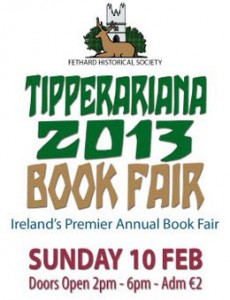 Tipperary will host the 18th Tipperariana 2013 Book Fair, Ireland’s premier annual fair, in The Fethard Ballroom, Fethard, Co Tipperary on Sunday next February 10th. Tipperary will host the 18th Tipperariana 2013 Book Fair, Ireland’s premier annual fair, in The Fethard Ballroom, Fethard, Co Tipperary on Sunday next February 10th.
This event, which is hosted annually by Fethard Historical Society, begins in the afternoon and will run from 2.00pm until 6.00pm.
Entry fee to visitors is just €2.00 and this year’s Fair boasts over thirty book dealers from all over Ireland, all anxious to both buy and sell.
As usual there will be a Café in full operation and a piano player will be on hand to serenade all visitors during the course of the afternoon.
So if you happen to have a loose copy of “Wuthering Heights” for sale, just lying around currently gathering dust and preferably personally signed by Emily Jane Brontë herself, then Fethard, Co. Tipperary is most definitely the place to be on Sunday afternoon next.
If you are buying, there are plenty of bargains also, in fact I got a copy of the hard to find “The Felons Track,” written by Michael Doheny (Latter a member of the Young Ireland movement.) at last year’s Tipperariana fair.
Julia Kavanagh (Born this day, 7th January 1824 – Died 28th October 1877) was an Irish Novelist & Biographer, born in Thurles, Co Tipperary, the only child to parents, Dublin born Morgan, Peter (Latter his Confirmation Name) Kavanagh (Irish author, poet, and novelist 1800 – 1874) and Bridget (née Fitzpatrick, latter who died 1888).
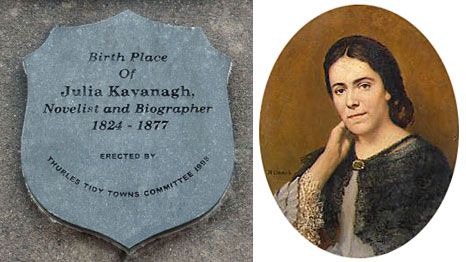 Her once small house sadly no longer exists, but stood at what is today the entrance to the Presentation Convent Secondary School, close to the junction leading from Cathedral Street into Mitchel Street, here in Thurles, Co. Tipperary. Her once small house sadly no longer exists, but stood at what is today the entrance to the Presentation Convent Secondary School, close to the junction leading from Cathedral Street into Mitchel Street, here in Thurles, Co. Tipperary.
An Irish Catholic, life for the young Miss Kavanagh was hard. She was partially crippled from youth (curvature of the spine), nevertheless she, through her own genius and strong connections, would carve out a successful career as a novelist, biographer and travel writer.
Her parents were married in 1823 and moved with Julia from Thurles to London, her father possibly as a teacher of languages. In late 1825 or early 1826 they moved to Paris, before returning to London again in 1837. When they returned to London, over the next year Morgan arranged for Julia to receive special treatment for her spinal problem. They returned to Paris in 1839 and stayed there until the early 1840s. It was during this early life with her parents in Paris, that Julia conquered her initial mastery of the French language and her remarkable insight into French modes of thinking, which was then perfected by her later long residences in Paris, Rouen and Nice.
Morgan was alone when he lived at 28 Dean Street, London in the early 1850s. Julia and her mother had parted from Morgan around 1846 and neither Julia or her mother are listed in the 1851 census for that address.
It was at this same address (28 Dean Street, Soho) that her father would become landlord & sub-lets two rooms to atheist Karl Marx, in Dec. 1850. This same address would also be the location at which Marx would write ‘Das Kapital,’ (1867) with the assistance of fellow revolutionary socialist Friedrich Engels. It was to here also that Friedrich Engels would send postal orders for £1 or £5 notes, each cut in half and sealed in separate envelopes, to avoid postal theft and in order that the impoverished and resident Marx family could pay their rent and continue to survive.
Note: Today, 26-29 Dean Street Soho, London, houses the famous restaurant “Quo Vadis,” (Latin: “Where are you going?”).
Julia now began to support herself and her invalid mother Bridget, with her writing career. Her first book was entitled “The Three Paths (1847), a story for the young, however her first work to attract the attention of her large readership was “Madeleine, a Tale of Auvergne,” (1848), a story of “heroic charity and living faith founded on fact.”
Her other works included; “Woman in France during the 18th Century,” (1850), “Nathalie,” (1851), “Women of Christianity,” (1852), “Daisy Burns,” (1853), “Rachel Gray,” (1855), “Adele,” (1857), “A Summer and Winter in the Two Sicilies,” (1858), “French Women of Letters,” & “English Women of Letters” (1862), “Queen Mab,” (1863), “Beatrice,” (1865) “Dora,” (1868), “Silvia,” (1870), “Bessie,” (1872), “John Dorrien,” (1875) & finally following her death, unmarried, on October 28th, 1877, at Nice, France, “Forget-Me-Nots,” (1878, a posthumous edition with preface by C. W. Wood)
Outside of her life as a novelist, her years appear rather uneventful, with a great part of her time devoted to the care of her invalid & later widowed mother. At the outbreak of the Franco-German War around 1870, Julia with her mother, both of whom were resident in Paris, moved to Rouen and then to Nice, where she died in her fifty-fourth year, following an accident, having fallen from her bed. Julia’s last words are reported to have been spoken in French: “Oh Mama! How silly I am to have fallen….”
Her mother Bridget continued to live in Nice until her death in 1888, but how she managed to cope financially after Julia’s death is not known. However, in 1884 Bridget donated a painting of Julia, by French artist Henri Chanet (dated 1875), to the National Gallery of Ireland.
Julia’s father is known to have entered into a common-law marriage with one Marie Rose in about 1856 and they had three children; Alfred, Matilda and Alexander Morgan. Her father died in 1874 and a Coroner’s Inquest, held at Islington, on February 14th 1874, indicates that, like Julia herself; his death was also caused by a fall.
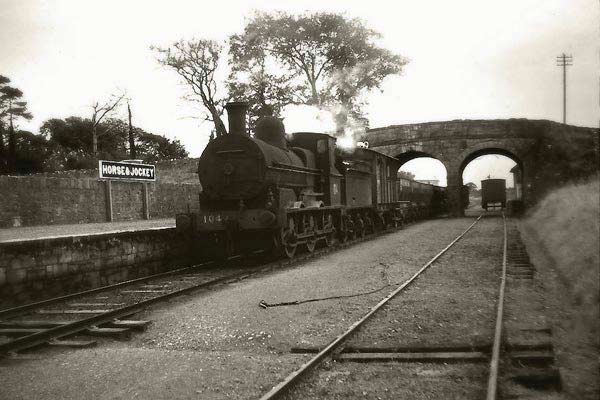 A pictorial record, compiled by ‘Horse and Jockey Remembers its Past,’ committee will be launched on November 24th, at the Horse and Jockey Hotel, Thurles, Co Tipperary. A pictorial record, compiled by ‘Horse and Jockey Remembers its Past,’ committee will be launched on November 24th, at the Horse and Jockey Hotel, Thurles, Co Tipperary.
Horse and Jockey Pictorial Record
This new publication is an amazing collection of some five hundred photographs, in both colour and black/white. The photographs span many decades with images of local people at work, at play, at home, at school, in group settings, social and sporting occasions or involved in club activities.
The memories of the older generation will be stirred and the younger generation will glean a glimpse of the lives and times long past. This is not, strictly speaking, a history book about the ‘most famous cross-roads in Ireland,’ but ‘moments in time,’ captured forever through the camera lens. It is also a very fine visual record of the profound changes that have occurred in this area during the past one hundred years.
This publication will make a most excellent Christmas gift especially for those exiled and living abroad.
The members of the organising committee involved in this venture are: – Liam Ó Donnchú, Tom Egan, John Hassett, Mary Roche, Richard O’Keeffe, Connie O’Keeffe and Averil Clarke.
This unique photo collection sells for €20 and is available from local outlets or from www.horseandjockeyhotel.com.
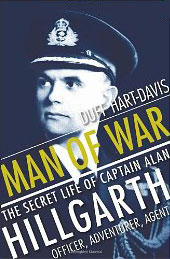 “Man Of War” By Duff Hart Davis His eccentricities possibly made him stand out here in rural Tipperary and local people never really knew what to make of him. He himself wrote in one of his letters, “A lot of people know me, but I’m very much an enigma to most of them and regarded with suspicion, because I don’t fit into any category . . . I’m a trouble-maker. I ride the storm.”
He had travelled widely during his working life, including visits to Ireland, to Morocco and America, settling in 1930 for a period with his second wife Mary at an old farmhouse in the hills of Majorca. Eventually in 1946 he would decide to settle here in North Tipperary, in the village of Ballinderry, having purchased the once-grand but then somewhat ruined house known as ‘Gurthalougha,’ on the shore of Lough Derg, which he had quickly renamed ‘Illannanagh.’
In 1975, a group IRA men, two of which were escaped murderers and who possibly had confused his home with another address in their search for firearms, were not even slightly aware of his mysterious past. Although then aged in his 70’s, he had remained appearing unperturbed, cold, seated & continuing to read his newspaper, when they had surprised him by entering his home. He had insisted that no conversation was ever taking place until they had lowered their weapons. Chastened somewhat by this old man’s non negotiable firm attitude, his unwelcome IRA visitors had consented, later quietly leaving his home, carrying only a couple of shotguns.
Fact Is Often More Exciting Than Fiction
The man of whom I speak was actually born Hugh Evans in 1899, the son of a then prominent London surgeon and his wife. He had enrolled as a naval cadet just before the outbreak of the First World War. By February 1915, this same boy, at just 15 years old, was an acting midshipman aboard the cruiser Bacchante, sailing on its way to participate in the ill-fated Gallipoli campaign against Turkey. Once on shore with Anzac troops, Evans soon found himself in the thick of war & involved in hand to hand fighting. Narrowly escaping death, when a Turkish bullet grazed his scalp, the following year young Evans was invalided home having received even more serious wounds.
Continue reading “Man Of War,” Tipperary Book Of The Month
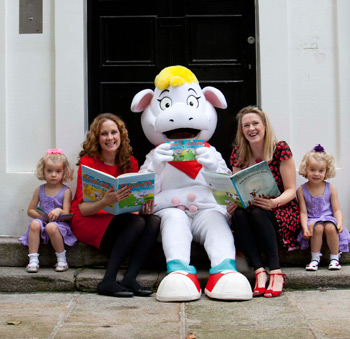 Picture shows L-R: Isabelle Benwell, Karen Willoughby, Munch the Cow, Sarah Webb & Jessica Benwell The Reading Association of Ireland (RAI), Irish children’s author, Sarah Webb, and children’s yogurt brand, Munch Bunch, teamed up today, to promote the importance of storytelling and shared reading, to mark the launch of Munch Bunch’s 2012 Story Writing competition, Munch Time.
Created to highlight the importance of story-telling between parent and child, and the vital role it plays in bonding and supporting a child’s holistic development, the Munch Time story writing competition is calling for budding children’s authors to get writing!
Now its second year, Munch Time is looking for aspiring writers, who are able to capture the imagination of young children, to submit original children’s stories that are between 600-800 words, and begin with the opening line: “Once upon a Munch Time, there was a cow called Munch…”
Topical Research From The Reading Association Of Ireland
The impact that stories and texts, presented in print-based or e-book format, can have on the parent/caregiver and child reading experience, was among a number of topics addressed in a review of research, conducted this month, by Dr. Gerry Shiel of “Reading Association of Ireland.”
Dr. Shiel explains: “Research on young children’s emerging literacy skills has long highlighted the important role that parents and caregivers can play in supporting the development of early reading and writing skills. In a recent publication on oral language development, Ireland’s National Council for Curriculum and Assessment highlighted the importance of not only reading to young children, but also discussing what has been read with them.
“With reading now available through a variety of devices, including e-readers and computer tablets, this research investigates how various mediums impact on a child’s literacy and language development.”
Continue reading Munch Time Story Writing Competition Launched
|
Support Us Help keep Thurles.info online by donating below. Thank you.
Total Donated 2026: €40.00
Thank You!
Daily Thurles Mass Livestream
|
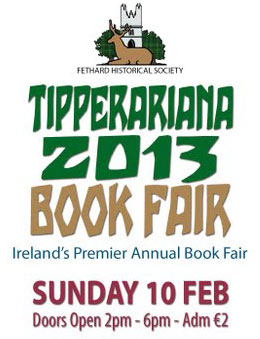 Tipperary will host the 18th Tipperariana 2013 Book Fair, Ireland’s premier annual fair, in The Fethard Ballroom, Fethard, Co Tipperary on Sunday next February 10th.




Recent Comments