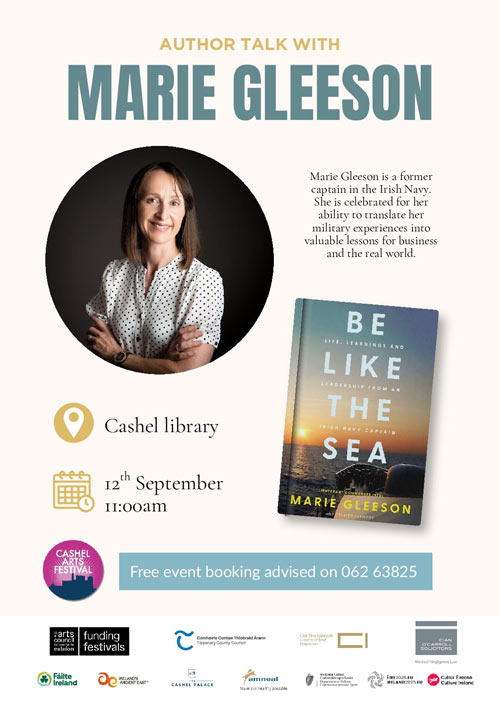
Book “Be Like The Sea”, author Ms Marie Gleeson will be in Cashel library on Saturday morning next, September 12th, at 11:00am as part of the Cashel Arts Festival.
Raised on a farm in landlocked County Tipperary, Ms Gleeson followed an unlikely path to the sea. She became one of the Irish Naval Service’s first female officers and during a career spanning more than two decades, rose from cadet to commanding officer of the LÉ Aoife. Her service included demanding operations at home and overseas, as well as a major cocaine interdiction off the Kerry coast, while she was second-in-command of the LÉ Niamh.
In the book Be Like the Sea, Marie combines memoir with lessons about leadership, resilience and navigating circumstances we cannot control. The sea becomes a powerful metaphor; effective leadership requires us to read changing conditions, remain agile and sometimes work with the current rather than against it.
Marie now brings those lessons to organisations as the founder of NavMar Leadership, helping people build resilient, inclusive and high-performing teams
Please Note: Booking is essential to attend at this FREE event, so please Tel: 062-63825, to be sure of a seat.
You canlocate the Cashel Library building, situated on Friar Street, Lady’s Well, Cashel, Co. Tipperary,HERE. [Eircode E25 K798]
Ms Maura Barrett, Reports Today From Cashel Library:
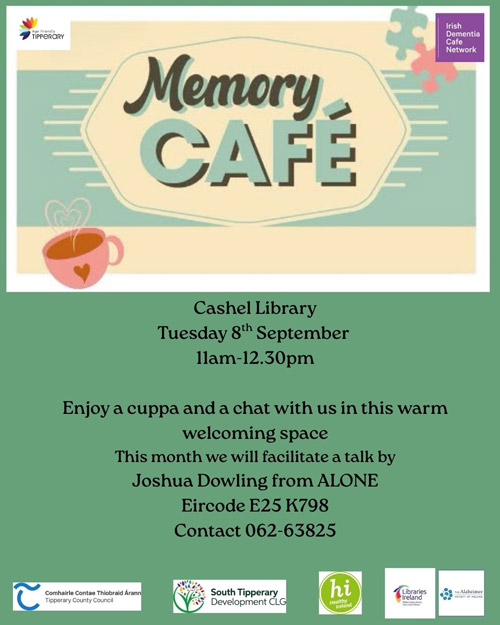
A welcoming space for individuals with memory loss and their caregivers to connect, share experiences, enjoy engaging activities and talks. This memory café offers support and conversation in a relaxed environment. No need to book just come along, leave us your name and number to be contacted each month when the café is taking place. This month we welcome guest speaker Joshua Dowling from ALONE.
You canlocate the Cashel Library building, situated on Friar Street, Lady’s Well, Cashel, Co. Tipperary, HERE. (G487+RX).
One of Ireland’s most important medieval manuscripts; a chronicle of the medieval history of Ireland, has returned to public display in Ireland and it carries a fascinating connection to Emly, Co. Tipperary.
Nearly 1,000 years old, the Annals of Inisfallen comprise 57 vellum leaves handwritten in Irish and Latin. The manuscript preserves a remarkable account of Irish history, from the legendary Tuatha Dé Danann and the arrival of St Patrick, to Viking raids, kings, poets, warfare and the coming of the Normans.
Scholars believe the manuscript was initially copied at the monastery of Lismore, Co. Waterford, using earlier source material created at the great monastic centres of Emly, Co. Tipperary, and Clonmacnoise, Co. Offaly. This connection highlights Emly’s important role as an early centre of religious learning, scholarship and historical record-keeping.
During the 12th century, the manuscript was probably brought to Inisfallen Island in Killarney, where successive scribes continued recording events. Its extraordinary entries include the Viking raids on Skellig Michael in 823, the arrival of a group believed to be Ireland’s first Jewish community in 1079, the great snow of 1047 and the gift of a camel from the King of Scotland to a great-grandson of Brian Boru in 1105. Now preserved by the Bodleian Libraries at the University of Oxford, the manuscript is being exhibited in Ireland for the first time since 1983.
Recording the Past: The Annals of Inisfallen and the Making of Irish History is on display at the Glucksman, University College Cork, until November 1st, 2026.
For the people of Emly and Co. Tipperary, the exhibition offers a welcome opportunity to recognise the contribution their ancient monastic centre is believed to have made to one of Ireland’s greatest written treasures.
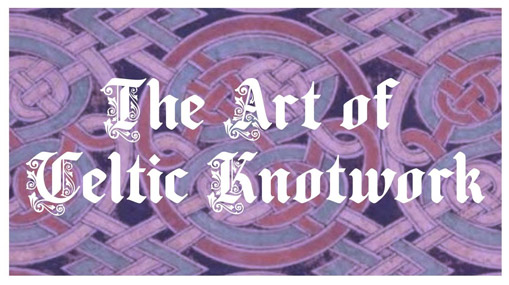
What Is Celtic Knotwork? Discover This Ancient Irish Art at Cashel Library.
Celtic knotwork is a decorative art form made from continuous lines or bands woven over and under one another to create intricate interlacing patterns. These striking designs are closely associated with early Irish art and can be found in illuminated manuscripts, including the Book of Kells, as well as on carved stone monuments and historic metalwork.
Discover how these beautiful patterns are constructed at a free Celtic Knotwork art workshop for adults in Cashel Library.
Date: Tuesday, 18 August 2026 Time: 2:30–4:00 pm Venue: Cashel Library, Friar Street, Cashel Note: Free – but booking is essential
Led by artist Cher Gleeson, the workshop will introduce participants to Celtic design and help everyone create a finished artwork to take home. Cher has more than 25 years of experience in community arts and education, and learners of all abilities are welcome.
Note: Places are limited. Please Tel: 062 63825 to reserve your place.
People wishing to attend the above event can locate the Cashel Library building; situated on Friar Street, Lady’s Well, Cashel, Co. Tipperary, HERE. (Eircode E25 K798).
Funeral Blues by the late British-American poet W.H. Auden (1907 – 1973).
W. H. Auden’s“Funeral Blues”, (Also known as “Stop all the clocks,” a reference to its first line), is a powerful poem that captures the overwhelming grief of losing a loved one. It first appearing in a 1936 play W. H. Auden and Christopher Isherwood called “The Ascent of F6”. The poem was later substantially rewritten and published in its familiar form in 1938.
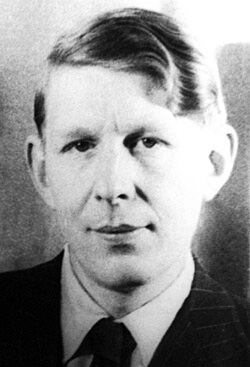
Late W. H. Auden(1907 – 1973)
Through commanding language, stark imagery, and a movement from everyday surroundings to the wider universe, Auden portrays a speaker whose loss feels so immense that time, nature, and society itself should come to an immediate halt. The poem ultimately explores how bereavement can transform a once-meaningful world into one that seems almost empty and without hope.
Funeral Blues (Read here by award winning English character actor Simon Callow.)
Stop all the clocks, cut off the telephone, Prevent the dog from barking with a juicy bone, Silence the pianos and with muffled drum Bring out the coffin, let the mourners come.
Let aeroplanes circle moaning overhead Scribbling on the sky the message ‘He is Dead’. Put crepe bows round the white necks of the public doves, Let the traffic policemen wear black cotton gloves.
He was my North, my South, my East and West, My working week and my Sunday rest, My noon, my midnight, my talk, my song; I thought that love would last forever: I was wrong.
The stars are not wanted now; put out every one, Pack up the moon and dismantle the sun, Pour away the ocean and sweep up the wood; For nothing now can ever come to any good.
This website uses cookies to improve your experience. We'll assume you're ok with this, but you can opt-out if you wish.AcceptRead More
Privacy & Cookies Policy
Privacy Overview
This website uses cookies to improve your experience while you navigate through the website. Out of these, the cookies that are categorized as necessary are stored on your browser as they are essential for the working of basic functionalities of the website. We also use third-party cookies that help us analyze and understand how you use this website. These cookies will be stored in your browser only with your consent. You also have the option to opt-out of these cookies. But opting out of some of these cookies may affect your browsing experience.
Necessary cookies are absolutely essential for the website to function properly. This category only includes cookies that ensures basic functionalities and security features of the website. These cookies do not store any personal information.
Any cookies that may not be particularly necessary for the website to function and is used specifically to collect user personal data via analytics, ads, other embedded contents are termed as non-necessary cookies. It is mandatory to procure user consent prior to running these cookies on your website.



Recent Comments