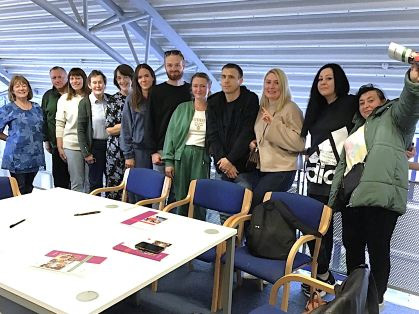
Learn how to make a St Brigid’s Cross – Tuesday next @2.30pm.
Please do remember: As with previous years, places are strictly limited. Advance booking is therefore essential for this free event and places will be allocated strictly on a first-come, first-served basis. Bookings Please to Tel: No. 062 63825.
Visitors attending this informative event can locate the Cashel Library building; situated on Friar Street, Lady’s Well, Cashel, Co. Tipperary, HERE. (Eircode E25 K798).
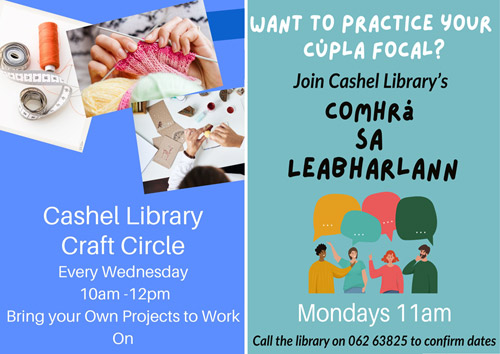
Cashel Craft Circle Join the Cashel Craft Circle every Wednesday from 10am-12pm for their social gathering. Bring along your own project to work on, share ideas, patterns and enjoy a chat and cuppa with others. No need to book for this event, just come along.
Practice your Cúpla Focal. “Bain triail as do chúpla focal sa leabharlann Chaiseal Mumhan. Tá fáilte roimh gach duine”. [“Try your hand at a few words (Irish Language) in the Cashel Munster library. Everyone is welcome”] See poster above for further details.
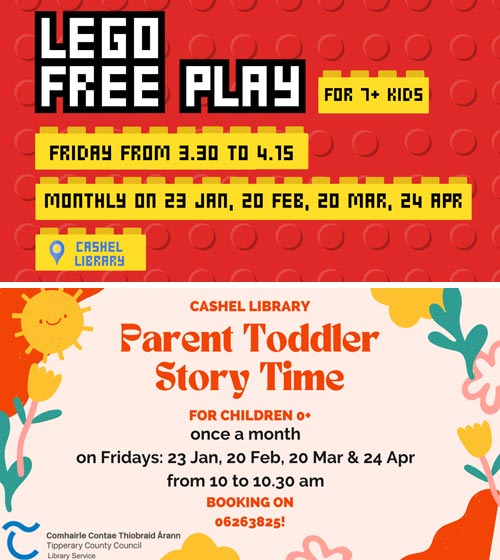
LEGO Free Play in Cashel Library! Join us for creative fun on Fridays: Jan 23rd, Feb 20th, Mar 20th & Apr 24th from 3:30 pm – 4:15 pm. Build, play, and let your imagination soar! Children must be 7+ to take part. Booking required: Tel: 062-63825. _______________________________________
Meanwhile, also join us once a month on Fridays, [Jan 23rd, Feb 20th, Mar 20th, Apr 24th,] from 10:00am to 10:30am for a fun and cozy story time. Enjoy the magic of books and quality time together! See poster above. To book your spot or learn more call Tel. No 062-63825.
Low-income families are increasingly anxious that the next electricity bill will be the one they simply can’t meet, as everyday usage becomes a choice between heat, light and other essentials.
Official figures show that 7.4% of people went without heating at some stage in the past year, due to lack of money, while 4.5% said they were unable to keep their home adequately warm, a stark measure of energy deprivation even before the worst winter pressures bite.
At the same time, the energy regulator’s arrears updates show a significant share of domestic electricity accounts currently remain in arrears, with large numbers in longer-term debt (90+ days), underlining how quickly “a tough month” can become a lasting burden.
Anti-poverty groups, including SVP, warn that once-off supports have faded while costs remain punishing, leaving families fearful of disconnection, mounting repayment plans, and cold homes becoming normal.
However, there is a small glimmer of light at the end of this winter tunnel for people in receipt of Child Support Payments or getting a qualifying social protection payment or taking part in an approved employment, education or training support scheme, so do hang-in there.
Keep in mind that applications will open on June 1st for Back to School Clothing and Footwear Allowance eligibility for 2026. Families who qualify for the Back to School Clothing and Footwear Allowance (BSCFA) can apply from June 1st to 30th September each year, with the Department of Social Protection confirming the scheme window and advising that the 2026 scheme will open in June 2026.
The once-off, means-tested payment is designed to help with the cost of children’s clothing and footwear ahead of the return to school each autumn.
Payment rates. The allowance is paid per eligible child, at two rates: €160 for children aged 4–11. €285 for children aged 12–22 (where eligible). Children aged 18–22 must be returning to second-level education to qualify.
Key change for 2026: extension to children aged 2 and 3. As part of Budget 2026, the Department has confirmed that the €160 rate will be extended to children aged 2 and 3 who qualify, a change that will apply for the 2026 Back to School Clothing and Footwear Allowance BSCFA.
Who qualifies. To be eligible, applicants must meet a number of conditions, including:
Be getting a qualifying social protection payment or taking part in an approved employment, education or training support scheme.
Be getting Child Support Payment (previously Increase for a Qualified Child) for each child claimed (with some exceptions).
Satisfy the household income limit (means test) and be resident in the State, as must each child claimed.
Operational guidelines set out weekly income limits (for 2025, for example: €694 for one child, €756 for two, €818 for three and €880 for four, with an additional €62 for each extra child).
How to apply and who gets paid automatically. The Department says many families will be paid automatically through a data-matching process, with award notices issued to a person’s MyWelfare account or by post in June. However, if you have not received an award notice by the end of June, and you meet the conditions, you will need to apply, even if you were paid automatically in previous years.
Applications are made online via MyWelfare.ie, which requires a verified MyGovID account.
Closing date. The deadline to apply is September 30thof the scheme year.
Extract from a publication by L. M. McCraith, [Mrs Laura Mary McCraith-Blakeney (born 1870)], originally published in 1912.
“The first, the gentle Shure (Suir) that making way By sweet Clonmell (Clonmel), adornes (adorns) rich Waterford;…” (Excerpt from poem Edmund Spenser’s ‘Irish rivers’.)
Some eight miles from Templemore, spreading itself upon both banks of the Suir, is the ancient town of Thurles. The town has a distinctive, old-world, almost ecclesiastical, character of its own. Its name is a corruption of the Irish Durlas, a fortress. In the Annals of the Four Masters we read of a chief of Durlas, by name Maelduin, who was slain in 660 A.D. Thurles was the scene of one of the few signal defeats of the Danes by the Irish. This took place in the tenth century, and was long remembered and recorded locally.
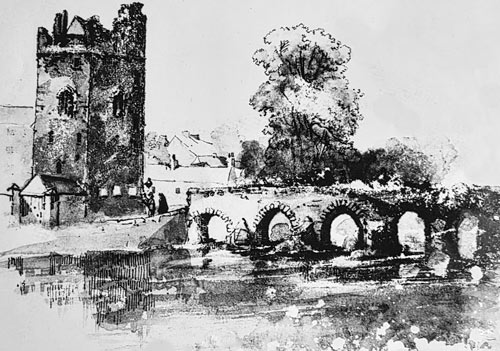
View of a bridge and the ruins of Thurles Castle, County Tipperary, dated 1909. [Artist James Stark Fleming (1834-1922)]
As has been said, Thurles was also the scene of the defeat of Strongbow by a coalition of Irish chiefs in 1174. When Strongbow heard that Conor and Donal Mór were advancing against him, he sent to Dublin for help. A contingent of Danish settlers and Norman soldiers, natural allies, came to his assistance. They endeavoured to join him at Thurles, but there, by the banks of the Suir, many of Strongbow’s men were slain. Donal Mór O’Brien was in command that day, and it would seem that the field was a fortunate spot to him; for when he returned to that same place seventeen years later, to fight another battle against the English, he was again victorious.
In 1197, however, six years afterwards the English took Thurles, and burnt many churches and temples.
View of the ruins of Thurles Castle, County Tipperary. [Artist James Stark Fleming (1834-1922)]
The Suir From Its Source to the Sea. Among the many notable Normans who established themselves in Ireland (and in time became “more Irish than the Irish”) were the Butlers. Theobald Fitzwalter came in the reign of Henry II, in 1172. He was kin to Thomas à Becket, (1119 or 1120 -1170) and it was part of the King’s accepted penance that he should ennoble all the murdered Archbishop’s relatives. Henry II, gave Fitzwalter large grants of Irish land, in return for which Fitzwalter was to act as the King’s Chief Butler and to hand him a cup of wine after his coronation. Hence the name of the family.
The Butlers ever remained loyal to the Sovereign whose vassals they were, and were frequently in opposition to that other powerful Norman house, the Fitzgeralds, or Geraldines, who were descended from Strongbow’s knight, son-in-law, and right-hand, Raymond le Gros, and were represented by the Earls of Kildare and Desmond.
The Butlers obtained large possessions in Wicklow, and in fertile Tipperary, and early in the thirteenth century became possessed of Thurles. The Butlers were ever notable as castle-builders, and founders of religious houses. They began to build on the banks of the Suir. Within the last half-century there were remains of no fewer than nine castles in this town. James Butler was created Earl of Ormonde in 1328. About that time (1324) he caused the castle to be built, the Norman keep of which still guards the bridge across the slow-flowing Suir. The Butlers also built, or endowed, Carmelite and Franciscan monasteries at Thurles; and there, as well as at Templemore, the Knights Templar established a preceptory. Viscount Thurles still remains the inferior title of the Marquis of Ormonde, the head of the Butler family.
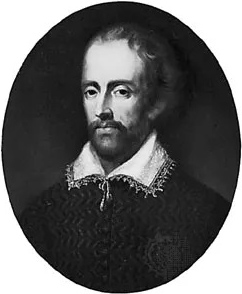
Edmund Spenser
Thurles to-day is an important and thriving town of about —— inhabitants. It has a notable horse fair, and it is the centre of a rich grazing and grain-growing district. It is the seat of the Archdiocese of Cashel and Diocese of Emly, and contains a magnificent Roman Catholic Cathedral and a handsome archiepiscopal residence. The bells and the organ of the Cathedral are notably fine. There is also a fine Roman Catholic College, two convents, and a monastery, the whole forming, as it were, a kind of religious quarter. Thurles was the scene of the famous Roman Catholic Synod in 1850.
From Thurles onward the Suir flows through the country of which the poet Spenser[Edmund Spenser (1552–1599)] said that it was “the richest champain that may else be rid”,(Taken from his unfinished epic poem, ‘The Faerie Queene’ ). Soon there comes in sight the mountain which he speaks of as “the best and fairest hill that was in all this Holy Island’s heights,” namely Galtee Mór, the highest peak of the Galtee range. [ NOTE:Latter description appears in Book VII, Canto VI, Stanza 37 of ‘The Faerie Queene’, specifically within the “Mutabilitie Cantos”. In the poem, Spenser uses Arlo-hill (Aherlow, South Co. Tipperary)as the sacred setting where the gods, led by Nature, gather to hear the plea of the Titaness Mutabilitie. Mutabilitie is a descendant of the ancient Titans, the race that ruled the universe before being overthrown by Jove (Jupiter).]
This website uses cookies to improve your experience. We'll assume you're ok with this, but you can opt-out if you wish.AcceptRead More
Privacy & Cookies Policy
Privacy Overview
This website uses cookies to improve your experience while you navigate through the website. Out of these, the cookies that are categorized as necessary are stored on your browser as they are essential for the working of basic functionalities of the website. We also use third-party cookies that help us analyze and understand how you use this website. These cookies will be stored in your browser only with your consent. You also have the option to opt-out of these cookies. But opting out of some of these cookies may affect your browsing experience.
Necessary cookies are absolutely essential for the website to function properly. This category only includes cookies that ensures basic functionalities and security features of the website. These cookies do not store any personal information.
Any cookies that may not be particularly necessary for the website to function and is used specifically to collect user personal data via analytics, ads, other embedded contents are termed as non-necessary cookies. It is mandatory to procure user consent prior to running these cookies on your website.








Recent Comments