1)What is Prime Day? Prime Day is Amazon’s deal event exclusively to Prime members, featuring personalized deals and top brands. The event came to life first for customers on July 15, 2015, as a way to celebrate Prime members on Amazon’s 20th birthday.
2)How can I prepare to find deals on Prime Day? Join Amazon Prime to participate fully in Prime Day. Some additional ways to prepare include: Check out Prime exclusive member deals and get exclusive discounts on thousands of items when you shop as a Prime member.
3)What is included with Amazon Prime? Membership allows you to access all the Prime Day deals for members, as well as exclusive benefits such as Exclusive Member Deals, Prime Video, Amazon Music, and more………
ToView Amazon Prime – Popular movies and TV shows, link HERE. To ViewAudible Audiobooks, link HERE. ToView Kindle Unlimited, link HERE. To ViewAmazon Wedding List, link HERE.
Note: The site offers a 30-day return window on mostpurchases made during Prime Day.
Love Will Survive (from The Tattooist of Auschwitz)
The book “The Tattooist of Auschwitz” is an truly an extraordinary book, which relates a true story about the extremes of human behaviour existing, each side by side; the calculated brutality alongside impulsive and selfless acts of love.
This true story relates to a fact that in April 1942, pre-war business man Lale Sokolov, [born Ludwig Eisenberg on October 28th 1916 ], latter a Slovakian Jew, was forcibly transported to the WWII concentration camp at Auschwitz-Birkenau. When his captors discover thatLale speaks several languages, he is forced to work as a Tätowierer (German word for tattooist), tasked with the permanently marking of his fellow prisoners arms.
While imprisoned for more than two and a half years, Lale, (latter prisoner number 32407), witnesses horrific atrocities and barbarism, but also incredible acts of bravery and compassion. Now, often risking his own life, he uses his privileged position to exchange money and jewellery, same taken from Jewish prisoners already murdered in the camp, using same to acquire food, thus keeping his fellow prisoners alive.
One day in July 1942, Lale comforts a nervous young woman, latter waiting in line to have the number 34902 tattooed onto her arm. He discovers her name is Gita [(Giselle) Cycowicz (née Friedman)] born in 1927 in Chust, Czechoslovakia, (today Khust, Ukraine), and from his first encounter with her, Lale vows to somehow survive the Auschwitz-Birkenau death camp and marry her, same marriage in fact come to pass in 1945.
Love Will Survive (from “The Tattooist of Auschwitz”)
Vocals: American singer, actress, songwriter, producer and director Ms Barbra Streisand. Lyrics: American songwriter and record producer Charlie Midnight, in collaboration with German-born American film score composer and music producer Hans Zimmer, composer for film and television MsKara Talve and American record producer and songwriter Walter Afanasieff.
Love Will Survive (from “The Tattooist of Auschwitz”)
Until I find you and walk beside you, Until we face every heartache together, I’ll keep believing, feel your breathing, hear your cries, With every season of sorrow, somehow our love survives. As nights grew longer, our prayers grew stronger, And in the darkness, we kept hope alive. We made a promise that love will survive. And in our dreams, we are running from shadows, Leaving behind the tears and the ghosts. Until I’m near you, somehow, I’ll hear you, Your voice will echo inside me forever. And in our dreams, we are running from shadows, Leaving behind the tears and the ghosts, Whilst our years were taken, our spirits shaken, But in the darkness, we kept hope alive. We made a promise that love will survive. Love will survive.
End
The book is a vivid, harrowing, yet ultimately hopeful re-creation of Lale Sokolov’s experiences, as the man who tattooed the arms of thousands of fellow prisoners with what would eventually become one of the most potent symbols of the Holocaust, which was Nazi Germany’s deliberate, organized, state-sponsored persecution and genocide of European Jews. During WWII, this Nazi regime and their collaborators systematically murdered over six million Jewish people.
The book, “The Tattooist of Auschwitz“ is a true testament to the endurance of love and humanity, under the darkest possible conditions of a concentration camp during WWII.
Every May Bealtaine is presented as a nationwide festival celebrating age and creativity.
Tipperary County Library Service, in conjunction with Tipperary Arts Office, are delighted to present a full and varied programme across all the libraries.
Continuing from tomorrow:
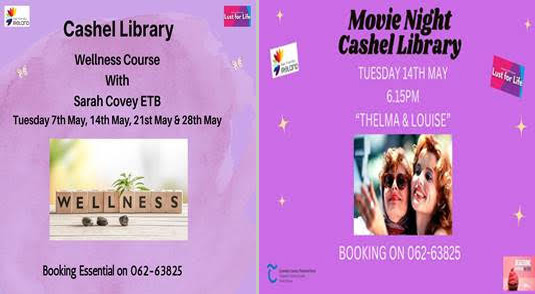
Tuesday 14th May at 1:15pm – Wellness with Sarah Covey ETB.
Tuesday 14th May, at 6:15pm – Movie Night ‘Thelma & Louise’.
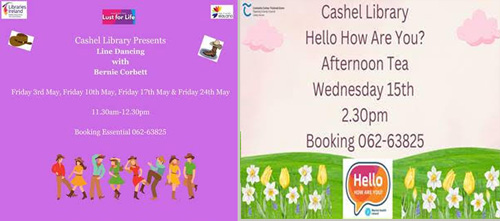
Wednesday 15th May at 2:30pm“Hello How are You- Afternoon Tea.”
Friday 17th May at 11:30pm – Line Dancing with Bernie Corbett.
You canlocate the Cashel Library building, situated on Friar Street, Lady’s Well, Cashel, Co. Tipperary, HERE. (G487+RX)
Note: All events are free, however, booking is essential please – Tel: 062-63825.
“Little Miss Muffet, she sat on her tuffet, eating her curds and whey. Along came a spider, who sat down beside her, and frightened Miss Muffet away.
As promised on April 21st, 2024, a 269 year old recipe, adapted from the manuscript book of Catherine Hughes, Killenaule, Thurles, Co. Tipperary, dated 1755, and published by Mrs Theodora FitzGibbon, in her book ‘A Taste Of Ireland’, published 56 years ago, in 1968, is published hereunder.
Milk going to the creamery, pictured in thelate 19th century,at Killenaule, Thurles, Co. Tipperary.
Cottage cheese, once considered to be the least desirable item to pick up in your supermarket’s dairy aisle, is now being heralded as one of the best items to put in your shopping basket.
Cottage cheese, as the name implies, is a type of cheese made up of curds and whey liquid (yes, the very thing Miss Muffet was eating before being rudely interrupted by that spider). It hasn’t always been celebrated for it lumpy wet consistency, but health enthusiasts highlight that it is a good source of calcium. More importantly, cottage cheese is naturally very high in protein, with on average, a whopping 11g of protein per 100g. Protein is essential for human growth and repair and for helping us to maintain our muscle as we get older.
A quick internet search will yield hundreds of cottage cheese recipes including pancakes, breads and desserts, but here’s a recipe for cottage cheese that is 269 years old.
Curds (Grut in Irish) formed an extensive part of the diet of the ancient Irish. They are mentioned in the earliest documented sources. Various early cheeses were made from them; one cheese being ‘faiscre grotha’, (Irish meaning literally ‘pressed curd’). The Reverend Richard Hopkins Ryland* in ‘The History, Topography and Antiquities of the County and City of Waterford’, dated 1824, says “Cheese made from skimmed milk and called ‘Mullahawn’ was formally an article of commerce in Waterford and was exported in large quantities…”
*Reverend Richard Hopkins Ryland was born in 1788, the descendant of 16th century Protestant planters who had settled in Dungarvan, Co Waterford. Generations of the family became ‘Church of Ireland’ ministers. Rev. Ryland married Isabella Julia Fleury (latter nine years his junior), the daughter of the Rev. Archdeacon George Louis Fleury of Waterford in 1818; at St. Patrick’s Church, Waterford. The couple had six sons and two daughters. His best known historical work was ‘The History, Topography and Antiquities Of The County And City Of Waterford’, (published 1824), which was dedicated to the Duke of Devonshire, while he also published religious pamphlets. He died in 1866, aged 78 years, followed by his wife Isabella Julia in 1873; aged 76 years, in South Kensington, Middlesex, England. The Tipperary ‘Clonmel Chronicle’ newspaper published her official ‘Death Notice’.
Pastry. 6 oz (6 heaped tablespoons) of flour. 3 oz (3 heat tablespoons) butter. 1 tablespoon sugar. ½ teaspoon salt. Water.
Filling. ½ lb (2 cups) sweet curds or cottage cheese. 2 eggs, separated. 2 heaped tablespoons sugar (vanilla sugar if possible). Grated peel and juice of half lemon. 1 tablespoons of butter.
For the topping. 1 egg and one tablespoon each of sugar, flour and melted butter.
First make the pastry by mixing the fat into the flower, sugar, and salt, to a firm pliable dough with a few tablespoons of water. Cool if possible before using. Make the filling by well mixing the curds with the sugar, soft butter, grated peel and juice of the lemon and the beaten egg yolks. Beat is well, then add the stiffly beaten egg whites. Roll out the pastry to fit a flan-tin, 7 in-8 inch across, line the tin with it and paint the bottom with beaten egg (this prevents the bottom pastry becoming heavy).
Put the filling into the pastry case, and, using the rest of the egg, mix it with the topping sugar, melted butter, and flour. Pour this evenly over the top. Bake in a moderate oven (350° F. electric; gas regulo 4) for 35 to 40 minutes, or until the top is golden brown. Serve cold, but not chilled, cut into wedges.
Cashel Library will host an exciting schedule of events for their annual Bealtaine (Irish-Month of May) Festival, which will kick off on Friday May 3rd next.
Hereunder is a full outline of Bealtaine events happening at Cashel Library, Cashel, in Co. Tipperary, however, do keep in mind that booking is essential to all these free events [Tel. No: 062 63825], with a policy of ‘First come first served.’
Friday, May 3rd – 10:00am: “Sing Your Way Down Memory Lane,” a session with Suzanne Buttimer. Friday, May 3rd – 11.30am: Line Dancing Session, with Bernie Corbett. Tuesday, May 7th – 1:15pm: Wellness Course, with Jennie Hannigan. Friday, May 10th – 11.30am: Line Dancing Session, with Bernie Corbett. Saturday May 11th – 10:00am->12:30pm: Memoir Writing Workshop. Monday May 13th – 11:00am->1:00pm: Karoke Sing-A-Long. Tuesday May 14th – 11:00am->1:15pm: ‘Memory Cafe’. Tuesday May 14th – 1:15pm: Wellness Course with Jennie Hannigan. Wednesday May 15th – 2:30pm: ‘Hello How Are You?’ Afternoon tea. Friday May 17th – 10:30am: Performance by St John the Baptist Girl School. Friday May 17th – 11.30am: Line Dancing Session with Bernie Corbett. Tuesday May 21st – 1:15pm: Wellness Course with Jennie Hannigan. Saturday May 18th – 11:00: Upcycling Workshop with Mairead Kennedy. Monday May 20th – 10:00am: ‘Sketchbook of Ireland’, Workshop. Friday May 24th – 11.30am: Line Dancing Session with Bernie Corbett. Saturday May 25th – 10:00am -> 12:30pm: Memoir Writing Workshop. Tuesday May 28th – 1:15pm: Wellness Course with Jennie Hannigan.
You canlocate the Cashel Library building, situated on Friar Street, Lady’s Well, Cashel, Co. Tipperary, HERE. (G487+RX)
Reminder: Booking is Essential – To Tel.: 062-63825 Please.
This website uses cookies to improve your experience. We'll assume you're ok with this, but you can opt-out if you wish.AcceptRead More
Privacy & Cookies Policy
Privacy Overview
This website uses cookies to improve your experience while you navigate through the website. Out of these, the cookies that are categorized as necessary are stored on your browser as they are essential for the working of basic functionalities of the website. We also use third-party cookies that help us analyze and understand how you use this website. These cookies will be stored in your browser only with your consent. You also have the option to opt-out of these cookies. But opting out of some of these cookies may affect your browsing experience.
Necessary cookies are absolutely essential for the website to function properly. This category only includes cookies that ensures basic functionalities and security features of the website. These cookies do not store any personal information.
Any cookies that may not be particularly necessary for the website to function and is used specifically to collect user personal data via analytics, ads, other embedded contents are termed as non-necessary cookies. It is mandatory to procure user consent prior to running these cookies on your website.






Recent Comments