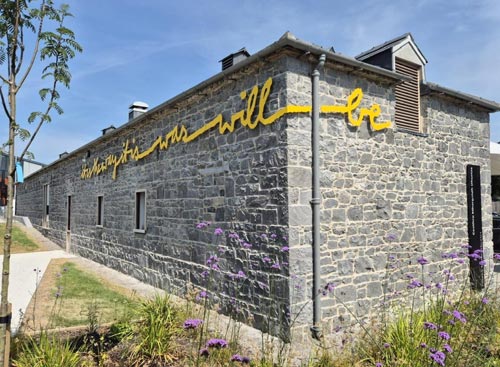
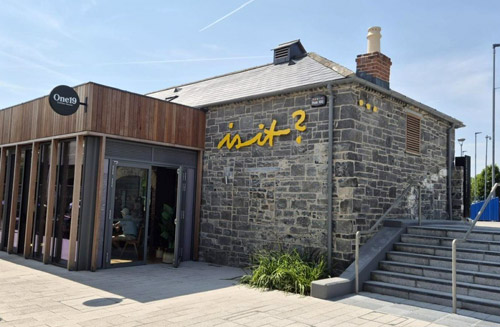
A striking ribbon of yellow now sweeps around the new café at Thurles Market Quarter, carrying with it the voices of the past, the questions of the present and the possibilities of tomorrow.
Thurles.Info has already highlighted the work of talented artist Ms Anja Buchheister, despite previously being unable to identify the artist by name. Our sincere thanks, therefore, to Ms Esther Griffin, (Research Assistant with the Tipperary Arts Office), for bringing the artists name and her magnificent new public artwork, once again, to our attention.
Thurles Market Quarter. Pic: Anja Buchheister.
Created by artist Ms Anja Buchheister, “Flowing Places” is far more than an architectural embellishment. It is a compelling meditation on memory, change and our relationship with place. Wrapped around a building once belonging to the farmyard of nearby St Patrick’s College, the artwork transforms a historic structure into a living conversation between generations.
Cut from powder-coated metal, its words unfold in an endless, thought-provoking sequence: “it is the way it is … was … will be … is it? …”
With this playful reversal of a familiar expression, Ms Buchheister challenges passive acceptance. Is a place simply what it is – or is it also what it was, what it may become and what its community chooses to make of it?
Thurles Market Quarter. Pic: Anja Buchheister.
The artist’s research reached deep into Thurles itself. Old maps and conversations with local residents revealed layers of memory embedded in the former old early 19th century agricultural machinery sheds. These recollections helped shape an artwork that honours the people who came before, while recognising that every landscape remains in motion. Like the nearby River Suir, the words flow continuously around the building. There is no fixed beginning and no final conclusion; only an invitation to pause, remember and imagine.
Originally from Wolfenbüttel, Germany, Ms Buchheister now works from her studio in Templetuohy, Thurles. Drawing on her training in sculpture and graphic design, she has created a poetic intervention that is simultaneously bold and delicate, deeply local and universally resonant.
“Flowing Places” is a magnificent addition to Thurles Market Quarter; an artwork that does not merely occupy public space, but awakens it. It celebrates heritage without trapping it in the past and turns an evolving corner of Thurles into a landmark of curiosity, creativity and civic pride.
Commissioned by Tipperary County Council under the Per Cent for Art Scheme and developed with Thurles Municipal District, the work stands as a powerful reminder that public art can do more than decorate a place, it can give that place a voice.
International pop star Boy George, whose paternal family has strong connections with Thurles, Co. Tipperary has released a new song titled “We Will Dance Again”.
The Culture Club frontman; born George Alan O’Dowd in England, has spoken warmly about his Irish background. In a 2013 Hot Press interview, he said his father’s relatives were from Thurles, adding that his family visited Ireland regularly during his childhood.
George Alan O’Dowd – Boy George.
His new pop-reggae song was posted to X and Instagram under both its English title and the Hebrew title עוד נרקוד (Od Nirkod). Its central message supports Israel and Jewish communities following the Hamas-led attack of October 7th 2023.
The song refers particularly to the attack on the Nova music festival, where 344 civilians and 34 members of the security services were killed and 44 people were taken hostage. Its title adopts a phrase that became an expression of hope and resilience among Israelis following the massacre.
In the song, Boy George rejects allegations of genocide against Israel, characterises its military campaign as a response to the Hamas attack and declares: “I stand with the Jews.” He also criticises musicians and activists whom he believes have condemned Israel without adequately acknowledging the events of October 7th.
The release has generated sharply divided reactions. Supporters have praised Boy George for confronting antisemitism and remembering the Nova victims, while critics say the song disregards the enormous Palestinian death toll and the findings of UN inquiries concerning Israel’s conduct in Gaza. Israel rejects allegations that it has committed genocide.
Boy George is not Jewish but has frequently spoken about his affinity with Jewish people and his determination to support Jewish friends and communities. He has also said that this support does not mean he lacks compassion for Palestinians or agrees with everything happening in Israel.
For Thurles readers, the release carries an additional local point of interest; one of Britain’s most distinctive pop performers has openly identified the town as part of his extended O’Dowd family story.
Lyrics and Vocals: Written and performed by American singer-songwriter Neil Diamond(Neil Leslie Diamond).
Neil Diamond’s song,“I’ve Been This Way Before” is a reflective song about the recurring nature of human experience. The singer has most certainly known success, but also rejection, doubt, happiness and pain, and recognises that these emotional cycles will return. This realisation gives him resilience. Neither praise nor hardship is permanent, so he can accept both without being defined by either. His lyrics may also perhaps carry a spiritual meaning. References to having travelled this path before and encountering familiar souls again, can suggest reincarnation, an afterlife, or a deeper connection that survives death. Listeners commonly describe the song as spiritual and hopeful, particularly in relation to bereavement and reunion.
Neil Diamond.
Released on his 1974 album “Serenade”, “I’ve Been This Way Before” is a deeply contemplative song about resilience, spiritual recognition and the repeating patterns of life. Diamond’s narration arrives at a calm understanding; every experience passes, yet each may return in another form. The song perhaps invites us to face life’s changing fortunes with humility and hope, and perhaps to believe that the people and connections we once treasured are never entirely lost.
I’ve Been This Way Before.
I’ve Been This Way Before.
I’ve seen the light, And I’ve seen the flame, And I’ve been this way before, And I’m sure to be this way again. For I’ve been refused, And I’ve been regained, And I’ve seen your eyes before, And I’m sure to see your eyes again, Once again. For I’ve been released, And I’ve been regained, And I’ve sung my song before, And I’m sure to sing my song again. Once again. Some people got to laugh. Some people got to cry. Some people got to make it through, By never wondering why. Some people got to sing. Some people got to sigh. Some people they never see the light, Until the day they die, But I’ve been released, And I’ve been regained, And I’ve been this way before, And I’m sure to be this way again, Once again. One more time again. Just one more time.
Rain has returned to Thurles this evening, Monday, July 27th 2026, after an unusually long dry spell.
Met Éireann’s provisional summer records show that much of County Tipperary experienced sustained dry conditions through the first three weeks of July, while the nearby Gurteen weather station had recorded a notably wet June. On the available evidence, the last proper measurable rain in the Thurles area appears to have fallen around June 30th, making this evening’s rainfall the first significant rain for almost four weeks.
“Singin’ In The Rain”.
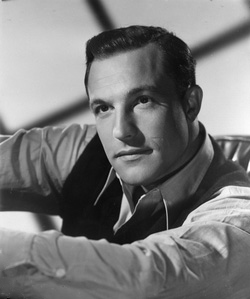
Lyrics: American lyricist and a Hollywood film producer, the late Arthur Freed[Grossman](1894–1973). Vocals: American dancer, actor, singer, director and choreographer, the late Gene Kelly(Eugene Curran Kelly)(1912–1996) latter whose parents were both of second generation Irish decent. [Derry on his mother’s side (Harriet Catherine Curran), and possibly Co. Clare (but not conclusively) on his father’s side (James Patrick Joseph Kelly)]
Late GreatGene Kelly. (Eugene Curran Kelly)(1912–1996).
Few songs capture the pleasure of a rainy evening as perfectly as “Singin’ in the Rain,” famously performed by Gene Kelly in the 1952 musical film of the same name. First introduced decades earlier, the song became immortal through Kelly’s joyful performance as he dances along a rain-soaked street, splashing through puddles and turning an ordinary downpour into an expression of happiness and romance. The sequence remains one of the most recognisable moments in cinema history.
I’m singin’ in the rain, just singin’ in the rain, What a glorious feelin’, I’m happy again. I’m laughin’ at clouds so dark up above, The sun’s in my heart and I’m ready for love. Let the stormy clouds chase everyone from the place, Come on with the rain, I’ve a smile on my face. I walk down the lane with a happy refrain, Just singin’, singin’ in the rain.
Dancing in the rain, I’m happy again.
I’m singin’ and dancin’ in the rain. I’m dancin’ and singin’ in the rain.
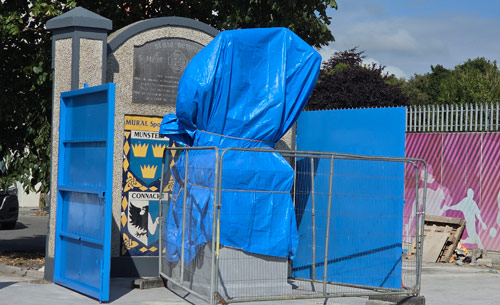
A striking new bronze artwork planned and in place at the entrance to FBD Semple Stadium in Thurles; celebrating Tipperary’s unique place in the history of Gaelic games.
The permanent public artwork was commissioned by Tipperary County Council in partnership with Tipperary GAA and the management of FBD Semple Stadium. It is installed near the stadium entrance, and expected to create a new landmark for supporters, visitors and the wider Thurles community.
Set to be unveiled; artwork celebrating Thurles as birthplace of the GAA. Pic: G. Willoughby.
Rather than honouring one individual player or official, we understand the sculpture is intended to represent Gaelic games more broadly. The original commission sought a bronze design featuring male and female sporting figures, reflecting the traditions of hurling, camogie, Gaelic football and ladies’ football.
The location is particularly significant. The Gaelic Athletic Association was founded in Hayes’ Hotel, Thurles, on November 1st 1884, while the Ladies Gaelic Football Association was also established in the town in 1974. The artwork will therefore recognise Thurles not only as one of Ireland’s great sporting towns, but as the birthplace of organisations that have shaped Irish community life for generations.
Semple Stadium itself has played a central role in that history. It is the home of Tipperary hurling and football and one of the country’s most famous GAA venues. The stadium was named after Mr Tom Semple in 1971 and hosted the historic 1984 All-Ireland Hurling Final, during the GAA’s centenary celebrations.
Full public details of the completed sculpture, including the selected artist and the formal unveiling arrangements, have not yet been clearly published on the council’s official project page.
When unveiled, the new bronze tribute should provide a lasting reminder of Thurles’ proud contribution to Ireland’s national games.
This website uses cookies to improve your experience. We'll assume you're ok with this, but you can opt-out if you wish.AcceptRead More
Privacy & Cookies Policy
Privacy Overview
This website uses cookies to improve your experience while you navigate through the website. Out of these, the cookies that are categorized as necessary are stored on your browser as they are essential for the working of basic functionalities of the website. We also use third-party cookies that help us analyze and understand how you use this website. These cookies will be stored in your browser only with your consent. You also have the option to opt-out of these cookies. But opting out of some of these cookies may affect your browsing experience.
Necessary cookies are absolutely essential for the website to function properly. This category only includes cookies that ensures basic functionalities and security features of the website. These cookies do not store any personal information.
Any cookies that may not be particularly necessary for the website to function and is used specifically to collect user personal data via analytics, ads, other embedded contents are termed as non-necessary cookies. It is mandatory to procure user consent prior to running these cookies on your website.





Recent Comments