€6.9 million for new environmental and climate research awarded by the EPA
EPA funding of €6.9 million has been awarded for 11 new research projects to address climate and environmental challenges.
The funded research will address key knowledge gaps and support the development of vital research capacity in Ireland.
The Environmental Protection Agency (EPA) today announced new research awards of €6.9 million for environmental and climate research in Ireland. This brings to €21.4 million the total research funding announced by the EPA to date in 2025.
The funding will support 11 new and innovative projects, which will involve 98 staff and students across 27 organisations. It will also build research capacity and skills in areas relevant to tackling important environmental challenges. Successful projects will address policy-relevant topics such as:
Understanding the impacts of noise pollution on health and the environment; Exploring young people’s attitudes, knowledge and actions around climate change; Mechanisms to support scaling-up of the circular economy; Understanding how exposure to future sea level rise could impact population dynamics and Studying remote Irish islands to enhance our understanding of the response and resilience of offshore environments to climate change.
Announcing the funding, Dr Eimear Cotter, Director of the EPA’s Office of Evidence and Assessment, said: “The increased scale of research funding being announced by the EPA in 2025 reflects the critical role that research and innovation play in addressing climate change, environmental pollution and biodiversity decline. This new EPA funding will help develop innovative solutions to support Ireland’s response to these challenges. Congratulations to the successful researchers and I look forward to hearing more about these exciting projects in the years ahead.”
The list of funded awards made to date in 2025 is available on the EPA website with full project details in the EPA’s online Research Database.
The EPA Research Programme is a Government of Ireland initiative funded by the Department of Climate, Energy and the Environment. Further details are available on the EPA website.
Mr Symons passed away peacefully, while in the care of staff at Tipperary University Hospital, Clonmel, Co. Tipperary, surrounded by his loving family.
His passing is most deeply regretted, sadly missed and lovingly remembered by his sorrowing family; wife Sinéad (Hanafin), daughters Siobhán (Keith) and Áine (Luke), son James (Jade), grandchildren Saoirse, Lachlan and Aoife, brothers Allan and Geoff (Lindsay), sister Linda (Simon), aunt Vera, brothers-in-law, sisters-in-law, nephews, nieces, Sinéad’s cousin Mary, and a wide circle of friends, especially those involved in Tipperary camogie.
The extended Symons family wish to express their appreciation for your understanding at this difficult time, and have made arrangements for those persons wishing to send messages of condolence, to use the link shown HERE.
Pre-deceased by her husband John; Mrs Sweetnam passed away peacefully, surrounded by her loving family while in the care of staff at St Luke’s Hospital, Kilkenny City, Co. Kilkenny.
Her passing is most deeply regretted, sadly missed and lovingly remembered by her sorrowing family; sons Alfred, Frank and Richard, daughter Ann (Giles), son-in-law Richard, grandchildren Stephen and Cassandra, nephews, nieces, extended relatives, neighbours and friends.
The extended Sweetnam family wish to express their appreciation for your understanding at this difficult time, and have made arrangements for those persons wishing to send messages of condolence, to use the link shown HERE.
“The Sweetnamfamily would like to express their deep appreciation to the many loyal carers of the HSE and the Dovida Home Care service, both who cared for Mrs Sweetnam in her last precious years, granting her great compassion and kindness. Collectively all these people enabled Mrs Sweetnam to remain in her home with her family and her loyal dog, Lily, for so long. We will forever be indebted to you all”.
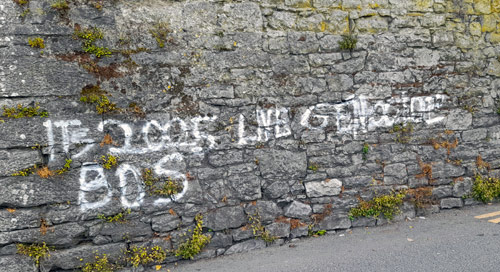
Despite street lighting being left switched on day and night in Thurles town, no person saw the graffiti “tagger” vandalising the wall of the historic Bridge Castle in our town centre.
Sadly, over the past 6 days, it would also appear that our Thurles Municipal District Councillors and officials remain totally unaffected by this errant and infantile behaviour, which now has become systemic, right across our town.
View the work of a delinquent, which now for 6 days remains on show in a town that craves foreign tourism.
Known historic background to Bridge Castle in Thurles Bridge Castle Thurles overlooks Barry’s Bridge in Thurles, Co. Tipperary, latter which provides the main vehicle and pedestrian passage across the river Suir. The latter was originally constructed circa 1650 and was partially reconstructed again circa 1820.
This medieval Bridge Castle or tower house; the now focus of our attention is quite similar to many other such buildings erected across Ireland during the middle of the 15th century. Same was an attempt to control; collect tolls or taxes and if/when necessary to defend river crossings from marauding attacks by rival clans or invaders, using the small garrisons of armed soldiers, kept housed in such buildings.
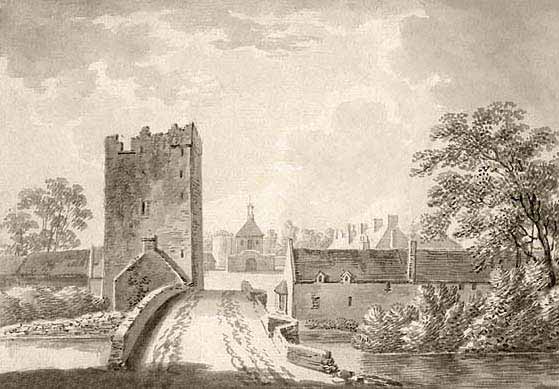
Wash drawing of Bridge Castle, Thurles, 1779-1793.
This wash drawing, shown above, faces westward, (Circa 1779-1793, attributed to English artist J.J. Barralet 1747-1815.) shows the town of Thurles, with Barry’s Bridge and Bridge Castle in the foreground leading into the town centre, with a castle on the left, (Today the entrance to Friar Street.) and a Market House, centre in the town square. (Latter, partially ruined by fire, and eventually demolished in 1901 following the erection of the 1798 monument or Stone Man.) The castle building today still remains in excellent structural condition.
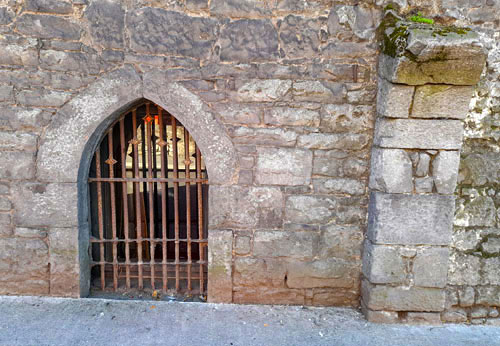
Plan of Bridge Castle,Thurles. The Bridge Castle itself has dominated the Thurles skyline since 1453, built possibly by the Norman invader McRickard Butler of whom history records that he erected, that same year, two castles at Thurles and one at Buaidlic (Boulick). It is a small three storey tower with a vault over the first floor. The original doorway may have been set in the west wall and connects to a spiral stairway which rises in the north west corner, giving full access to all the upper floors. A small fragment of the once original east facing arched gateway of this once walled town protrudes today; attached to the north facing wall of this building. The existing small pointed, arch doorway, a ‘Yett’, also on the north wall was possibly constructed to grant immediate access from the tower, for those charged with guarding this town entrance at this river crossing.
A ‘yett’ and the small fragment of the original east/west arched gateway which still exists on Thurles Castle/Tower House, Co. Tipperary.
Unlike a portcullis, which is raised and lowered vertically using mechanical means, yetts are hinged in the manner of a traditional gate or door and are secured either by bolts attached to the yett or by long bars drawn out from the wall or gateway. Little history actually exists regarding Thurles Bridge Castle, however records do exist showing that on the 17th June 1617, the castle was leased: “Thomas, Lord Viscount Thurles, by deed grants to Richard Power, Donat O’Haly and Rd. Wale, all that castle called Bridge Castle with its appurtenances, parcel of the Manor and Lands of Thurles, for 21 years at £5 per annum and one swine (pig), one sheep and three capons.” *
* Note: A capon is a rooster that has been castrated to improve the quality of its flesh, for eating purposes.
The Down Survey (1655-1656), also known as the Civil Survey, (A mapping of Ireland undertaken by Sir William Petty, English Economist, Scientist and Philosopher), lists James Butler, Earl of Ormond (1610-1688) and Lady Elizabeth Butler (alias Preston) Viscountess Dowager of Thurles, (1615-1685) as the proprietors. Both the latter named are direct progenitors to the present heirs to the British Throne.
History also records that there were great celebrations in Thurles in 1768 when Francis Mathew, 1st Baron Landaff, later 1st Viscount Landaff and again later 1st Earl of Landaff (1738-1806), was elected Tipperary Member of Parliament, a position he held from 1768 to 1783. History informs us that bonfires burned, with the castle,bridge and market house illuminated. Plenty of free drink was available, with soldiers joining the local populace in the ensuing celebrations.
Hopefully, this repair work will be cheaper than the cleaning of Dublin’s Millennium Spire (also known as the Stiletto in the Ghetto; the Pin in the Bin, the Stiffy by the Liffey, the Spire in the Mire, or simply The Spike), which cost taxpayers €420.000 in 2020.
By the way, whoever goes down to clean this unsightly eyesore, same should be charged to remove the long plastic ribbons, found fluttering in the south-westerly breeze from the bridge’s street lights. Local street wardens with their smart phones being used to photograph car reg numbers, should turn their attention to this blatant ribbon littering and prosecute the responsible “flag waving” individual. Someone will end up with an eye cornea damaged by these same razor sharp, plastic, ribbon edges, same being caught by the wind, and blown across the faces of unsuspecting, local pedestrians.
This website uses cookies to improve your experience. We'll assume you're ok with this, but you can opt-out if you wish.AcceptRead More
Privacy & Cookies Policy
Privacy Overview
This website uses cookies to improve your experience while you navigate through the website. Out of these, the cookies that are categorized as necessary are stored on your browser as they are essential for the working of basic functionalities of the website. We also use third-party cookies that help us analyze and understand how you use this website. These cookies will be stored in your browser only with your consent. You also have the option to opt-out of these cookies. But opting out of some of these cookies may affect your browsing experience.
Necessary cookies are absolutely essential for the website to function properly. This category only includes cookies that ensures basic functionalities and security features of the website. These cookies do not store any personal information.
Any cookies that may not be particularly necessary for the website to function and is used specifically to collect user personal data via analytics, ads, other embedded contents are termed as non-necessary cookies. It is mandatory to procure user consent prior to running these cookies on your website.








Recent Comments