There are moments in public life when ceremony becomes more than ceremony. There are moments when the formalities of State, handshakes, photographs, motorcade escorts, polished floors and diplomatic language carry a moral weight far beyond protocol.
The decision to receive and photograph Iran’s ambassador at Áras an Uachtaráin, with the agreement of the Irish Government, was one such moment.
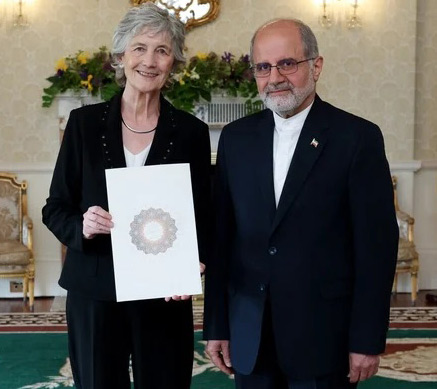
Of course, it will be said that this was merely a credentials ceremony. It will be said that diplomatic relations must continue, that ambassadors represent states whether we approve of those states or not, and that Ireland must keep channels of communication open. There is truth in that. Diplomacy is not friendship, and accreditation is not endorsement.
But symbols matter. They matter especially when they involve regimes that are still executing, imprisoning and torturing their own people.
Iran is not simply another difficult state with whom Ireland has disagreements. It is a regime whose record on executions is among the worst in the world. Human rights organisations have documented shocking numbers of executions, including executions following unfair trials, executions for political or security-related accusations, and executions connected to wider efforts to crush dissent. Reports of torture, forced confessions, arbitrary detention and brutal repression are not historical footnotes. They are part of the present reality faced by Iranians who dare to protest, speak, organise or simply refuse to submit.
That is why the image of Iran’s ambassador being formally welcomed and photographed with the President of Ireland (See above left), jars so deeply.
President Connolly now occupies an office that is, by design, above ordinary party politics. The President does not make foreign policy in the same way a government minister does. But the President does embody the State. The President’s actions, appearances and words carry ethical significance. When the President receives an ambassador from a regime carrying out executions and torture, the question is not whether the constitutional paperwork was correct. The question is whether the moral message was adequate.
Was there any public word for the prisoners awaiting execution?
Was there any public acknowledgement of torture?
Was there any mention of women, students, dissidents, trade unionists, journalists and minorities who have faced repression?
Was there any reference to the many thousands alleged to have been killed in past massacres and crackdowns, or to the victims of the present wave of executions?
If the above concerns were raised privately, the Irish public has not been clearly informed. If they were not raised at all, that is worse.
Ireland has often prided itself on speaking for human rights, international law and the dignity of small nations and oppressed peoples. We invoke that tradition when we speak about Palestine. We invoke it when we speak about Ukraine. We invoke it when we condemn apartheid, colonialism, war crimes and political imprisonment elsewhere. But a human-rights policy cannot be selective. It cannot be passionate in one case and ceremonially silent in another.
This is not an argument for cutting off all diplomatic contact with Iran. There may be Irish citizens, dual nationals, prisoners, humanitarian issues and international concerns that require a diplomatic channel. But maintaining a channel is not the same as offering the optics of normality.
Ireland could have handled this differently. The ceremony could have been accompanied by a strong public statement. The Government could have made clear that accreditation did not soften Ireland’s condemnation of executions, torture and repression. The President could have used the occasion, even in restrained constitutional language, to reaffirm Ireland’s concern for human dignity and human rights. There could have been a visible refusal to allow diplomatic protocol to become moral camouflage.
Instead, what the public saw was the familiar theatre of State recognition. That is the problem.
Because for the families of those executed, for prisoners under sentence of death, for women beaten for defying compulsory controls, for protesters tortured into silence, and for exiles watching from Ireland, these images do not look neutral. They look like respectability being extended to the representative of a regime that has not earned it.
The office of President is not powerless. Its power lies in moral authority, in language, in symbolism, in the ability to remind the State of its values when convenience and protocol threaten to dull them. At a minimum, that moral authority should not be seen to soften the image of a regime still carrying out executions and torture.
Ireland must engage with the world as it is. But it must not forget what it claims to stand for. Diplomacy may require doors to remain open. Conscience requires that, when those doors open, the truth walks in as well.





Leave a Reply