All Things Bright and Beautiful.
Extract by Childrens Hymn Author:- Cecil Frances Alexander [ born in Redcross, Co. Wicklow, Ireland, 1818-1895 ].
“All things bright and beautiful, all creatures great and small,
All things wise and wonderful, the Lord God made them all.
Each little flower that opens, each little bird that sings,
He made their glowing colors, He made their tiny wings”.
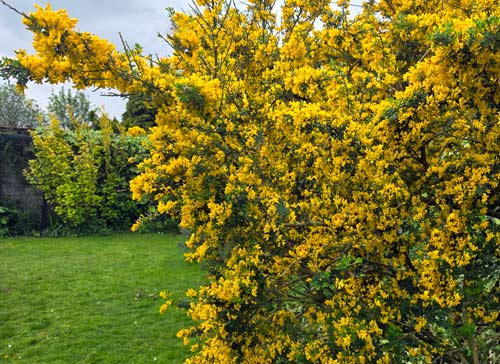
At first glance, the dominance of yellow flowers in early spring might seem like a coincidence. In reality, it is a highly effective evolutionary strategy, shaped by the needs of plants and the behaviour of their pollinators.
Early spring presents a challenging environment for both plants and insects. Temperatures fluctuate unpredictably, with warm spells followed by sudden cold snaps and frost. Sunlight remains inconsistent, and many pollinating insects, such as bees, are only just emerging after winter dormancy.
Their energy reserves are low, and they must quickly find reliable food sources to survive. For flowering plants, this creates a narrow window of opportunity, for they must attract pollinators efficiently and stand out in a landscape that is still largely dull and colourless.
A key factor in this strategy lies in how insects perceive the world. Human vision is based on three primary colours; red, blue, and green, but many pollinators see a different spectrum. Bees, for example, are sensitive to ultraviolet (UV), blue, and green wavelengths, but they cannot perceive red in the same way humans do. Within this visual system, yellow appears especially vivid and highly detectable. It occupies a central position in the range of colours insects can see, making it one of the most noticeable signals a flower can display.
Beyond simple visibility, yellow flowers often have another advantage, they reflect ultraviolet light in distinctive patterns. While these UV markings are invisible to humans, they act as visual guides for pollinators. Sometimes referred to as “nectar guides”, these patterns effectively direct insects toward the centre of the flower, where pollen and nectar are located. This increases the efficiency of pollination, benefiting both the insect and the plant itself.
Temperature is another critical factor in early spring, and yellow flowers offer an advantage here as well. Their pigmentation and structure can help absorb and retain heat from available sunlight. In some cases, the interior of a yellow flower can be a few degrees warmer than the surrounding air. For cold, energy-depleted insects, this slight increase in temperature can make a meaningful difference. A warmer flower provides not only food but also a place to briefly conserve energy and raise body temperature, allowing insects to remain active in otherwise challenging conditions.
In addition, the broader environment, during early spring, enhances the effectiveness of yellow. The landscape is often dominated by muted tones, e.g browns, greys, and dull greens, left over from winter. Against this subdued background, bright yellow flowers create a strong visual contrast, making them even easier for pollinators to locate from a distance.
Taken together, these factors explain why yellow is so prevalent among early-blooming flowers. It is not merely an aesthetic choice, but a refined adaptation that maximises visibility, guides pollinators efficiently, and even provides a small thermal benefit. By aligning their characteristics with the sensory abilities and needs of insects, these flowers improve their chances of successful pollination at a time of year when conditions here in Ireland and elsewhere are far from ideal.





Leave a Reply