ESB Networks Under Pressure to Explain Smart Meter Failure and Full Extent of Data Error.
ESB Networks is facing mounting pressure to provide a full and transparent account of how an internal software failure was allowed to generate grossly inaccurate smart meter readings for customers across Ireland, triggering alarm, confusion and serious questions about oversight, safeguards and accountability. The company has confirmed that a planned software upgrade carried out last Friday led to some electricity usage data being processed incorrectly, resulting in highly inflated figures appearing on customer accounts and supplier platforms.
You may check your ‘not so smart’ reading HERE, if you can trust the system.
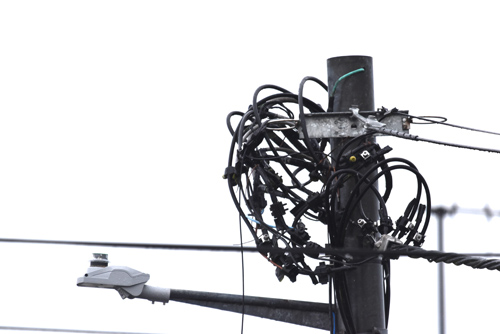
“Behold sky spaghetti”. Somewhere inside that knot is one cable doing all the work.
Pic: G.Willoughby.
While ESB Networks has apologised for the “confusion and concern” caused, the seriousness of the incident goes far beyond inconvenience. Customers reported seeing apparent one-day electricity costs rise to extraordinary levels, in some cases hundreds or even thousands of euro, with usage figures so extreme that they should have been immediately recognised as impossible, by any functioning validation system. Reports included daily costs of €738 and €2,500; figures that have prompted widespread disbelief and anger.
The incident has exposed what appears to be a major failure in internal controls. If abnormal readings of that scale were able to pass through ESB Networks’ systems and appear on customer-facing accounts, it raises unavoidable questions about the adequacy of testing, monitoring and escalation procedures surrounding critical software changes. A planned upgrade to a nationally significant metering system should not have been capable of producing such obviously absurd outcomes without immediate containment. That it did so points to a deeply troubling lapse in operational assurance.
Perhaps most damaging is the lack of clarity over duration. ESB Networks has identified the trigger as last Friday’s software upgrade, but there is still no full public explanation of how long the issue remained live, when it was first detected internally, how many customers were affected, or whether warning signs emerged before the problem became visible to the public. In the absence of that detail, there is every reason for customers to ask whether this issue was caught promptly at all, or whether it only gained urgency once consumers began highlighting impossible charges online.
ESB Networks has insisted that the issue is internal, that smart meters themselves remain reliable, and that affected data will be corrected automatically with no action required from customers. But reassurance alone is unlikely to restore confidence. With smart meters intended to deliver accuracy, transparency and trust, this episode represents a significant reputational failure. ESB Networks must now do more than fix the numbers; it must explain, in full, how this happened, how long it persisted, and why customers were left to discover the problem before the system did.





Leave a Reply