Extract from a publication by L. M. McCraith, [Mrs Laura Mary McCraith-Blakeney (born 1870)], originally published in 1912. (See Part One HERE)
“The first, the gentle Shure (Suir) that making way
By sweet Clonmell (Clonmel), adornes (adorns) rich Waterford; …”
(Excerpt from poem Edmund Spenser’s ‘Irish rivers’.)
Holy Cross.
Beyond Thurles, the Suir, now a broad and shallow stream, flows lazily, through sedge and reeds and fringes of flowering water-weeds, between some of the finest pasture lands in Munster.
About three miles south-west of Thurles, on the right bank, low down by the river-side, stands the lovely ruin of the once far-famed Abbey of Holy Cross.
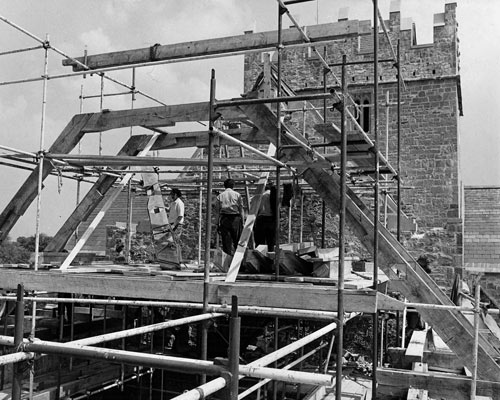
[ Note: This building has since been extensively restored to its former beauty and serenity.]

[Artist James Stark Fleming (1834-1922)]
This Abbey was founded in 1168, for Benedictines, by that indefatigable church-builder, Donal Mór O’Brien, King of Munster. The original charter is still in existence, by which it appears that, about 1182, the Abbey was transferred from the Black Monks to the White, that is, from the Benedictines to the Cistercians.
Early in the twelfth century the Pope, Paschal II, gave to the grandson of Brian Boru, Donough O’Brien, a bit of the True Cross. It was magnificently enshrined and set about with precious stones, and confided to the care of the Cistercians. In 1214 this Abbey was re-built, and about that time the sacred relic, which gave its name to Holy Cross, came to its resting-place on the banks of the Suir.
This relic, being amongst the most revered in Christendom, the Abbey was, for over three and a half centuries, one of the most frequented places of pilgrimage in Ireland. In the reign of Queen Elizabeth the English described the relic as “the idol which the Irish more superstitiously reverence than all the idolatries in Ireland.”
In 1600, the great Hugh O’Neill came in state to Holy Cross to visit the holy relic, for reasons no less political than pious. He marched through the centre of the island at the head of his troops, a kind of royal progress, which he thought fit to call a pilgrimage to Holy Cross. He held princely state there, concerted measures with the southern lords, and distributed a manifesto announcing himself as the accredited Defender of the Faith.
In 1603, Red Hugh O’Donnell came to Holy Cross, on his way to the disastrous battle of Kinsale, and demanded that the fragment of the True Cross should be borne out to him at the west door, to bless him on his way.
The Abbey of Holy Cross was suppressed in 1536, at the break-up of the monastic orders in Ireland. In 1563, Elizabeth conferred the Abbey lands upon Gerald, Earl of Ormonde. The Butlers remained friendly, if not faithful, to the old faith, and the line of Abbots continued at Holy Cross until as late as 1700. The relic also passed eventually into Butler hands. It was exposed for public veneration for the last time in Holy Cross Abbey about the year 1632. In that year, Walter, eleventh Earl of Ormonde, seeing his grandson, the first Duke, had become a Protestant, confided the relic to Catholic keeping until such time as the House of Ormonde should return to the old faith.
Subsequently, it passed through various hands, until in 1809 it was given to the Catholic Bishop of Cork, who deposited the relic in the Ursuline Convent in Cork. It continues in the Ursulines’ keeping, having moved with them to Blackrock.
Perhaps the most interesting thing which remains in ruined Holy Cross Abbey is the lovely little pillared shrine between the two side chapels in the north transept. This arcade is a fine example of thirteenth-century carving. Its pointed arches spring from a double row of beautifully twisted pillars. Its roof is a marvel of graceful groining. Every variety of delightful detail has been lavished upon this little sanctuary. Its sides are elaborately adorned with fine carving.
The design of two doves and two owls, kissing, is repeated upon the panels, and the beautiful Gothic details show a French influence. The elaborate wealth of detail and the loving workmanship point to some special, and important, purpose for this unique feature. It has been suggested that here the dead Cistercians lay before burial. But surely not a dead brother, but rather the Relic, the True Cross itself, occupied such a shrine. Was it within this greatly ornamented little arcade that the Relic was preserved when not exposed upon the Gospel side of the High Altar? This is, however, a matter of controversy.
Another matter of keen controversy is “the Tomb of the Good Woman’s Son.” Who was the “Good Woman”? Why are the Royal Arms of England carved on the shields between the arches of the canopy of the tomb, together with those of Ormonde and Desmond? Was the “Good Woman” an English Queen, her son a Plantagenet Prince? Was he “Pierce the Fair,” son of Isabella of Angoulême, the widow of King John, by her second husband, Le Brun, Count of La Marche, and half-brother of King Henry III? His death is recorded by the Four Masters as having occurred in Ireland in 1233.
Many maintain that this canopied monument is nothing more than a beautifully elaborate three-seated sedilia for the priests. Others suggest that it is the tomb of one who re-built the Abbey of Holy Cross in a far finer style than that of King Donald, at the close of the fourteenth century. The position, at the north side of the High Altar, is that usually assigned to founders.
Legend and tradition tell a more mysterious and interesting tale. The personality of “the Good Woman’s Son” is sufficiently interesting to make it worthwhile to quote the local story, as told by the custodian of the ruins, in her own words:
“The King of England’s son he was, and he was sent over to Ireland to collect the Peter’s Pence for the Pope. Now, there was a family in these parts in those times by name Fogerty, and they knew of all the money the young Prince had with him. So they followed him to a lonely place, and set upon him and killed him there, and stole the money. Then they buried the body in the soft ground in the wood, without waiting to know was the life gone out of it altogether or not.
Now, in the Abbey of Holy Cross at this time there was an old monk, and he was blind. One night he dreamed a dream. He dreamed that the Good Woman, his mother, had placed upon the young prince’s stone here, (set in the corner of the High Altar, of course, it is only set up by the Board of Works to show where the High Altar stood, for the dear knows where the real stones were thrown to by the soldiers when they were quartered in the ruins a hundred years ago), and there is a little round hole right through that stone. That hole was bored through the stone by the dropping of a tear. For seven generations they repented, and as the tear wore the hole through the slab of stone the curse wore away from the Fogertys.“
So some say, anyway, and a priest wrote it all down in a book lately, so I’m told, and sure isn’t it as likely as not it is true, after all?
The chief beauty of Holy Cross Abbey which remains are its windows. Their tracery is perhaps unmatched in perfection in Ireland, and its elaboration points to the fourteenth, rather than the twelfth, century. No doubt they belong to the period of the Abbey’s splendid restoration, whenever exactly that took place. The reticulated (or “honeycomb”) east window is notably fine. It is particularly beautiful when observed from the opposite bank of the Suir, from which the most picturesque view of Holy Cross Abbey may be obtained.
The plan of the Church of the Holy Cross is cruciform, with double side chapels. Quaint bits of carving here and there have escaped the hand of the spoiler and the ignorant. But for many years the Abbey passed from one to another, and fell into a lamentable condition. About thirty years ago the Board of Works took over the ruin, restored it to some decency and order, and ensured its preservation. The cloisters, however, are in private hands, and the cloister garth is used as a croquet ground.
The site of Holy Cross is unimpressive. Thick groves of trees now surround the ruins, which are of great extent, and in remarkably good preservation, all things considered. Little houses cluster round the approaches to the Abbey, as they may have done in the monastic days. It is not easy to picture the stately processions which must have crossed the old bridge and wound their way to the west door.
Holy Cross has still about it a peaceful, graceful, scholastic charm hard to describe or define, not easy to account for. Perhaps the aura of calm, holy, austere lives still lingers, like the perfume in dead rose-leaves. There is a homeliness about Holy Cross, for all that its rule was Cistercian and its Abbots Lords of Parliament and Vicars-General of the Order, as well as “Earls of Holy Cross.”
The Suir at Holy Cross is spanned by an ancient bridge, which was built in 1626 by James Butler, Baron Dunboyne, and his wife Margaret O’Brien, a descendant, doubtless, of King Donald, the Abbey’s founder. Their pious act is recorded in Latin on a carved stone set in the wall facing the ruins. It bears the Butler and O’Brien arms, with the initials of James and Margaret, and a Latin inscription which ends and bids the traveller to say a short prayer that both the builders may escape the Stygian Lake.
It was only natural, in medieval days, that bridge-building should be accounted a blessed and meritorious deed. Women, to whom the difficulties of medieval travelling no doubt came home with special force, were ever foremost in this work in Ireland. The famous and beautiful Margaret O’Carroll, “Áinéigh” (The Bountiful), was long remembered as a builder of bridges, as well as a giver of feasts, in the fifteenth century. In this case, another Margaret evidently followed her example a century later.
END.
Today January 2026 Visiting Tourists Please Note:
Still set on the banks of the River Suir, Holycross Abbey today is one of Tipperary’s great places of quiet grandeur; a medieval Cistercian foundation whose clean lines, cloistered calm and finely worked stone immediately draw you in.
Painstakingly restored in the early 1970s after centuries of ruin, it has regained the sense of harmony and purpose that shaped it in the first place, still serving today as a living place of worship as well as a welcoming stop for visitors.





Leave a Reply