Extract from a publication by L. M. McCraith, [Mrs Laura Mary McCraith-Blakeney (born 1870)], originally published in 1912.
“The first, the gentle Shure (Suir) that making way
By sweet Clonmell (Clonmel), adornes (adorns) rich Waterford;…”
(Excerpt from poem Edmund Spenser’s ‘Irish rivers’.)
Some eight miles from Templemore, spreading itself upon both banks of the Suir, is the ancient town of Thurles. The town has a distinctive, old-world, almost ecclesiastical, character of its own. Its name is a corruption of the Irish Durlas, a fortress. In the Annals of the Four Masters we read of a chief of Durlas, by name Maelduin, who was slain in 660 A.D. Thurles was the scene of one of the few signal defeats of the Danes by the Irish. This took place in the tenth century, and was long remembered and recorded locally.
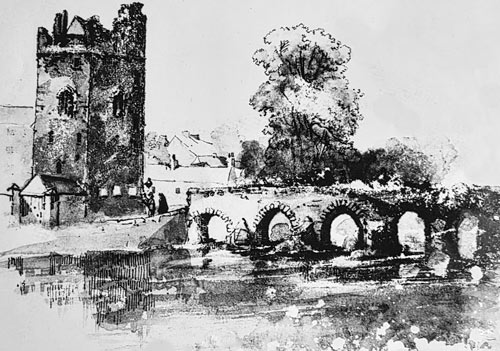
[Artist James Stark Fleming (1834-1922)]
As has been said, Thurles was also the scene of the defeat of Strongbow by a coalition of Irish chiefs in 1174. When Strongbow heard that Conor and Donal Mór were advancing against him, he sent to Dublin for help. A contingent of Danish settlers and Norman soldiers, natural allies, came to his assistance. They endeavoured to join him at Thurles, but there, by the banks of the Suir, many of Strongbow’s men were slain. Donal Mór O’Brien was in command that day, and it would seem that the field was a fortunate spot to him; for when he returned to that same place seventeen years later, to fight another battle against the English, he was again victorious.
In 1197, however, six years afterwards the English took Thurles, and burnt many churches and temples.

[Artist James Stark Fleming (1834-1922)]
The Suir From Its Source to the Sea.
Among the many notable Normans who established themselves in Ireland (and in time became “more Irish than the Irish”) were the Butlers.
Theobald Fitzwalter came in the reign of Henry II, in 1172. He was kin to Thomas à Becket, (1119 or 1120 -1170) and it was part of the King’s accepted penance that he should ennoble all the murdered Archbishop’s relatives.
Henry II, gave Fitzwalter large grants of Irish land, in return for which Fitzwalter was to act as the King’s Chief Butler and to hand him a cup of wine after his coronation. Hence the name of the family.
The Butlers ever remained loyal to the Sovereign whose vassals they were, and were frequently in opposition to that other powerful Norman house, the Fitzgeralds, or Geraldines, who were descended from Strongbow’s knight, son-in-law, and right-hand, Raymond le Gros, and were represented by the Earls of Kildare and Desmond.
The Butlers obtained large possessions in Wicklow, and in fertile Tipperary, and early in the thirteenth century became possessed of Thurles. The Butlers were ever notable as castle-builders, and founders of religious houses. They began to build on the banks of the Suir. Within the last half-century there were remains of no fewer than nine castles in this town. James Butler was created Earl of Ormonde in 1328. About that time (1324) he caused the castle to be built, the Norman keep of which still guards the bridge across the slow-flowing Suir. The Butlers also built, or endowed, Carmelite and Franciscan monasteries at Thurles; and there, as well as at Templemore, the Knights Templar established a preceptory. Viscount Thurles still remains the inferior title of the Marquis of Ormonde, the head of the Butler family.
Thurles to-day is an important and thriving town of about —— inhabitants. It has a notable horse fair, and it is the centre of a rich grazing and grain-growing district. It is the seat of the Archdiocese of Cashel and Diocese of Emly, and contains a magnificent Roman Catholic Cathedral and a handsome archiepiscopal residence. The bells and the organ of the Cathedral are notably fine. There is also a fine Roman Catholic College, two convents, and a monastery, the whole forming, as it were, a kind of religious quarter.
Thurles was the scene of the famous Roman Catholic Synod in 1850.
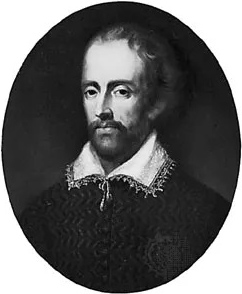
From Thurles onward the Suir flows through the country of which the poet Spenser [Edmund Spenser (1552–1599)] said that it was “the richest champain that may else be rid”, (Taken from his unfinished epic poem, ‘The Faerie Queene’ ). Soon there comes in sight the mountain which he speaks of as “the best and fairest hill that was in all this Holy Island’s heights,” namely Galtee Mór, the highest peak of the Galtee range.
[ NOTE: Latter description appears in Book VII, Canto VI, Stanza 37 of ‘The Faerie Queene’, specifically within the “Mutabilitie Cantos”. In the poem, Spenser uses Arlo-hill (Aherlow, South Co. Tipperary)as the sacred setting where the gods, led by Nature, gather to hear the plea of the Titaness Mutabilitie. Mutabilitie is a descendant of the ancient Titans, the race that ruled the universe before being overthrown by Jove (Jupiter).]





Leave a Reply