Organisers, Political Connections, Funding Transparency and the people attending – Questions the Irish Public deserves answers to.
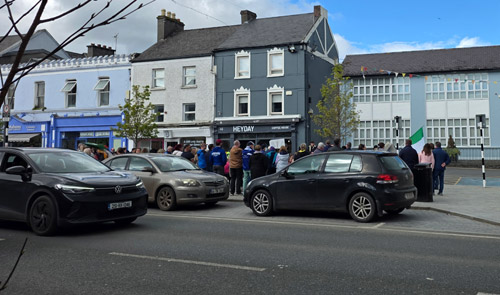
Thousands gathered in Dublin on Saturday, 21 November 2026, to protest against the Government’s proposed changes to Ireland’s triple lock and to defend Irish neutrality.
Everyone has a democratic right to protest peacefully. However, with repeated demonstrations taking place in Dublin, there are legitimate questions about who is organising these campaigns, how they are financed, and how representative they are of the wider Irish population.
Who Is Organising These Protests?
Saturday’s demonstration was not a spontaneous event. It was an organised campaign involving several established activist groups, including:-
Irish Neutrality League.
Irish Anti-War Movement.
Ireland Palestine Solidarity Campaign (IPSC)
Tonn na Clé (“Wave of the Left”)
Political parties supporting or participating included Sinn Féin, People Before Profit, Labour, the Social Democrats, the Green Party and Aontú.
Opposition politicians and campaign activists have been coordinating through weekly meetings, telephone campaigns, emails to TDs and planned demonstrations.
Those identified in the wider campaign include Sara O’Rourke of the Irish Neutrality League, Michelle Ní Chléirigh of Tonn na Clé, latter a Galway-based grassroots movement and activist network, founded by Michelle Ní Chléirigh in late 2025, following Catherine Connolly’s election as President of Ireland. Helen O’Mahony of the Palestine solidarity movement, and TDs from Labour, Sinn Féin, People Before Profit and the Social Democrats.
Clearly, there is an organised political and activist network behind this particular campaign.
The Big Question: How Transparent Is Their Funding?
So who pays for these activities?
Organising demonstrations can involve advertising, printed materials, sound systems, transport arrangements and other expenses. The Ireland Palestine Solidarity Campaign (IPSC) states that it is financed through membership subscriptions, donations, standing orders and merchandise sales.
Importantly, IPSC is a registered company, number 471534, with financial filings available through Ireland’s Companies Registration Office. That provides a measure of public financial accountability. However, it does not, by itself, tell the public who paid for Saturday’s demonstration or how much was spent.
The organisers should be willing to answer some straightforward questions:-
What was the total cost of organising the demonstration?
Which organisations contributed financially?
Were any substantial contributions received from overseas?
Did political parties, trade unions or other organisations provide financial or practical assistance?
Are detailed income and expenditure figures for these campaigns publicly available?
Have all applicable political donation disclosure requirements been met?
Ireland has rules governing political donations and disclosures, administered by the Standards in Public Office Commission. Transparency should apply to all organisations seeking to influence Government policy, regardless of their political position.
To be clear, no verified evidence that foreign governments or undisclosed interests financed this particular protest. But the absence of evidence of wrongdoing does not remove the value of voluntary financial transparency.
Another Question: Who Actually Attends These Repeated Protests?
There is also a question worth examining about the profile of those participating. Are these demonstrations attended mainly by working people, students, pensioners, unemployed people, professional activists, or a mixture of all these groups? At present, no credible statistical breakdown is known of the employment status of those attending Saturday’s neutrality demonstration. It would therefore be wrong to claim that most protesters are unemployed without evidence. Saturday demonstrations are also accessible to people who work Monday to Friday. Attendance at a protest tells us nothing reliable about someone’s employment circumstances. Nevertheless, independently conducted surveys of protest participants could help establish how representative these events are, rather than relying on assumptions or impressions.
Why Are So Many Different Campaigns Coming Together?
The involvement of anti-war organisations, Palestine solidarity groups and opposition political parties demonstrates that different campaigns have found common ground. Their stated concerns include Irish neutrality, overseas military deployments, international conflicts and military cooperation. The Government, meanwhile, argues that removing the UN Security Council approval requirement would strengthen Ireland’s ability to decide independently when to deploy its Defence Forces, while retaining military neutrality. Both positions deserve serious public examination. But coordination between political organisations and activist groups also raises a legitimate question: where does independent civic campaigning end and organised party-political campaigning begin?That is not an accusation of improper conduct. It is a question about transparency, accountability and political influence.
The Public Deserves Answers
All fully accept everyone’s democratic right to protest.
However, the public also has every right to ask who organises major demonstrations, who finances the campaigns, what political interests are involved, and how decisions are made. We should not assume demonstrators are unemployed. We should not assume hidden foreign funding, and we should not confuse legitimate political organisation with wrongdoing.
But neither should legitimate questions about funding transparency and political coordination be dismissed.
If these organisations seek to influence Ireland’s national defence and foreign policy, openness about their finances and campaign activities would help strengthen public confidence. Peaceful protest is a democratic right. Financial transparency and political accountability are reasonable public expectations.
The question is simple; will the organisers publish clear, accessible details of who funded these campaigns and how the money was spent?





Leave a Reply