“Give me your tired, your poor, your huddled masses yearning to breathe free.”
Poet Emma Lazarus, The New Colossus, 1883.
These words have long expressed one of America’s most cherished ideals; that people escaping persecution, poverty and oppression might find freedom and opportunity on its shores. Yet in 2026, amid immigration raids, detention and record deportations, they pose an uncomfortable question. How closely does the America of today resemble the nation of welcome once imagined by Emma Lazarus?
The Statue of Liberty originated in France. Proposed by abolitionist Édouard de Laboulaye and designed by sculptor Frédéric Auguste Bartholdi, it celebrated liberty, democracy and friendship between France and the United States. France paid for the statue, while Americans were expected to finance its pedestal. Fundraising stalled, however, and the statue’s future became uncertain. The monument that now symbolises American freedom nearly foundered because Americans struggled to pay for the platform on which it would stand.
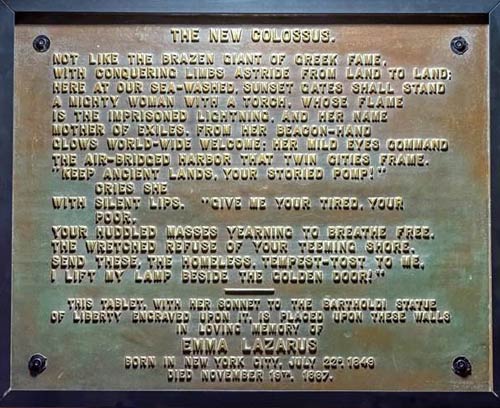
The New Colossus – By Emma Lazarus.
Not like the brazen giant of Greek fame,
With conquering limbs astride from land to land,
Here at our sea-washed, sunset gates shall stand,
A mighty woman with a torch, whose flame,
Is the imprisoned lightning, and her name,
Mother of Exiles. From her beacon-hand,
Glows world-wide welcome; her mild eyes command,
The air-bridged harbour that twin cities frame.
“Keep, ancient lands, your storied pomp!” cries she
With silent lips. “Give me your tired, your poor,
Your huddled masses yearning to breathe free,
The wretched refuse of your teeming shore.
Send these, the homeless, tempest-tost to me,
I lift my lamp beside the golden door!”
END
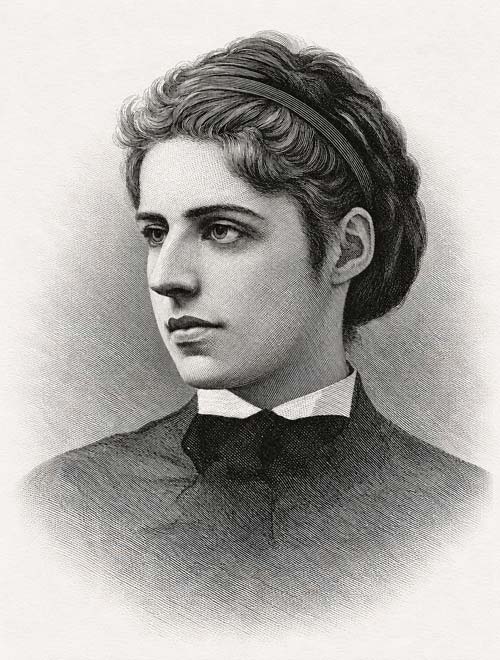
In 1883, Jewish-American poet Ms Emma Lazarus was asked to contribute to a fundraising exhibition. Initially reluctant, she was encouraged to consider the Jewish refugees arriving in New York after fleeing persecution in the Russian Empire. She had helped newly arrived immigrants and understood something of the hardship they faced. Her response was “The New Colossus”, a sonnet that gave the proposed monument an extraordinary new meaning.
Lazarus did not portray Liberty as a conquering giant or an emblem of military power. She called her the “Mother of Exiles”, a compassionate figure raising her torch for the displaced, the poor and those yearning to breathe free. The poem was not an immigration law or a description of America’s everyday conduct. It was a moral vision; a challenge to be generous as well as strong, and to recognise humanity in the stranger arriving at the gate.
In 1885, newspaper publisher Mr Joseph Pulitzer appealed to ordinary Americans to help finish the pedestal. More than 120,000 people contributed, many giving modest amounts, and the necessary funds were raised. The statue was dedicated in New York Harbour on October 28th, 1886. Ms Lazarus died in 1887, aged just 38 years. Her poem gained wider recognition after her friend Ms Georgina Schuyler helped secure its installation on a bronze plaque inside the pedestal in 1903, forever linking Liberty with the hopes of immigrants.
From 1892, millions of newcomers passed through nearby Ellis Island. They arrived here from Ireland, Italy, Germany, Poland, Russia and elsewhere, often with little money and limited English. Some had fled hunger, violence or discrimination; others sought work and a better future. They built businesses, worked in factories, raised families and contributed immeasurably to America’s economy and culture. Their descendants became part of the country’s very identity.
But history should not be romanticised. In 1882, just before Lazarus wrote her poem, the United States enacted the Chinese Exclusion Act, restricting Chinese labour immigration. Other groups also encountered prejudice and discriminatory laws. America has never perfectly fulfilled the promise of the “golden door”. The enduring power of Ms Lazarus’s poem lies precisely in that contradiction; it describes not a flawless past, but an ideal against which that country can be judged.
That same tension is apparent today. Under President Mr Donald Trump’s administration, Immigration and Customs Enforcement, (ICE), has intensified immigration arrests and removals. According to figures released by the Department of Homeland Security in November 2026, ICE made more than 491,000 immigration arrests and carried out approximately 483,200 deportations during the fiscal year ending in September; record annual totals for the agency. Detention capacity has expanded, while the Government Accountability Office has questioned whether changes to facility inspections provide adequate oversight.
The administration argues that strong enforcement protects national security, public safety and the rule of law. Every nation has a legitimate responsibility to manage its borders. Yet border enforcement and compassion need not be opposites. Due process, fair treatment and humane detention conditions remain essential, particularly when the consequences can separate families or send people back to places they fear.
People affected by immigration enforcement are not a single category. Some have no legal permission to remain; others are pursuing claims for protection or have longstanding family and community ties. Not everyone arrested is accused of a violent offence. Behind the numbers are parents, children, workers and people carrying stories of loss and hope. Their circumstances deserve consideration, even when immigration laws must be applied.
This is the contrast that makes the Statue of Liberty’s message so relevant. Ms Lazarus asked Americans to see the vulnerable newcomer as a person before seeing a problem. Today’s debate too often reduces lives to statistics, slogans and political arguments. Immigration policy can be discussed seriously without treating the human beings affected by it as disposable.
Lady Liberty still stands with her torch raised and broken chains at her feet. Yet a monument’s meaning depends on more than bronze, copper or ceremonial speeches. The question is not whether America should have laws or secure borders, but whether it can enforce them without sacrificing justice, dignity and compassion. Its immigrant heritage and its obligations to protect the public are not mutually exclusive.
Emma Lazarus imagined a country whose greatness would be measured not only by its power, but also by its willingness to offer hope. In 2026, her words remain a challenge rather than a comforting description of history. The torch still burns; the question is whether the nation beneath it will honour the promise it represents.
“I lift my lamp beside the golden door!” — Emma Lazarus, 1883.





Leave a Reply