From Dalkey to the Fields of Flanders: Remembering Fr Willie Doyle and Tipperary’s Forgotten Heroes of Passchendaele.
“Bent double, like old beggars under sacks,
Knock-kneed, coughing like hags, we cursed through sludge,
Till on the haunting flares we turned our backs,
And towards our distant rest began to trudge.
Men marched asleep. Many had lost their boots,
But limped on, blood-shod. All went lame, all blind;
Drunk with fatigue; deaf even to the hoots
Of tired, outstripped Five-Nines♦ that dropped behind”.
Above verse is an extract from “Dulce et Decorum Est”, a poem by Wilfred Owen. [Latin poem title is taken from a verse written by the Roman poet Horace: “dulce et decorum est pro patria mori”. English translation means “It is sweet and proper to die for one’s country”.]
♦ Five-Nines: Refers to 5.9-inch German explosive and gas artillery shells (15cm calibre) commonly used on the Western Front during World War I.
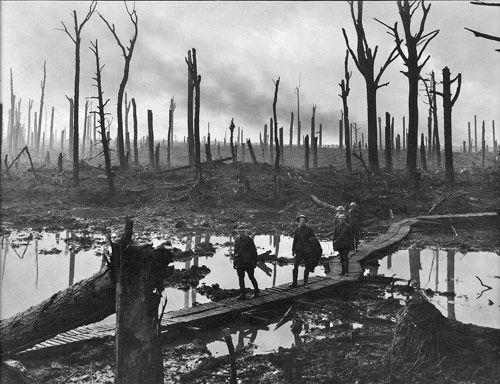
More than 109 years after his death on the battlefields of Belgium, an extraordinary Irish priest is once again making headlines as the Roman Catholic Church prepares to advance his cause for sainthood in Rome, Italy.
But the story of Fr Willie Doyle also provides an opportunity to remember the soldiers and chaplains from Thurles and County Tipperary who lost their lives during one of the bloodiest campaigns of the First World War. Their names, sacrifices and family connections deserve to be remembered.
A Brave Irish Priest from Dalkey
Father William Joseph Gabriel Doyle was born on March 3rd, 1873, at Melrose, Dalkey Avenue, County Dublin, the youngest of seven children; parents Hugh Doyle and Christine Byrne. He entered the Society of Jesus in 1891 and was ordained in Dublin in 1907. During the First World War, Fr Doyle volunteered as a military chaplain with the 16th (Irish) Division, providing spiritual comfort and practical assistance to soldiers facing unimaginable suffering. His bravery earned him the Military Cross.
On August 16th 1917, during the Battle of Langemarck, part of the wider Passchendaele campaign, Fr Doyle was killed while attempting to assist two wounded protestant officers, while under German shellfire. He was just 44 years old. His body was never recovered. His compassion extended to Catholic and Protestant soldiers alike, making him an enduring symbol of courage that transcended religious divisions.
Thurles and Tipperary’s Forgotten Heroes Remembered.
The Battle of Passchendaele, officially the Third Battle of Ypres, raged from July 31st until November 10th 1917. Among those who died during the campaign were men with strong connections to Thurles and surrounding County Tipperary.
James (Jim) Maher – Thurles, Co. Tipperary.
Mr James Maher died on August 11th 1917, (5 days previous to Father William Doyle), during the opening weeks of the campaign. In June 2025, saw the remarkable discovery of his wartime letters and medals during a house clearance near Thurles. His grandnephew Mr Denis Kenny helped bring the story to public attention.
Remarkably, while James served in the British Army, his sister Josephine was a member of Cumann na mBan, in Thurles [(The Irishwomen’s Council), latter an Irish republican women’s paramilitary organisation founded in Dublin on April 2nd, 1914], , supporting the struggle for Irish independence. Their correspondence reveals how families could remain close despite profoundly different political circumstances.
Lance Corporal John Cooke – Bonlea (Bawnlea), The Commons, Thurles, Co. Tipperary.
Born on 5 February 1894, Mr John Cooke emigrated to Canada and enlisted in the Canadian Expeditionary Force.
Serving with the 27th Canadian Infantry Battalion, he was killed at Passchendaele on November 6th 1917, aged just 23 years.
He has no known grave and is commemorated on the Menin Gate Memorial at Ypres.
Fr Michael Bergin SJ — Fancroft, Roscrea, Co. Tipperary.
Born in 1879 at Fancroft near Roscrea, Fr Michael Bergin became a Jesuit priest and served as a military chaplain with Australian soldiers. He had previously served during the Gallipoli campaign. On 11th October 1917, he was killed by German shellfire near an aid post during the fighting at Passchendaele, aged 38. He received the Military Cross posthumously and is buried in Reningelst Churchyard, Belgium.
Like Fr Willie Doyle, his ministry was marked by extraordinary courage and devotion to wounded soldiers.
Fr Patrick Looby — Cahir, Co. Tipperary.
Born in Cahir in 1889, Fr Patrick Looby studied for the priesthood in Waterford and Paris before his ordination in 1914.
Serving as a British Army chaplain attached to the Northumberland Fusiliers, he was killed during the Passchendaele fighting on October 26th 1917, aged just 28years. He is buried in Poelcapelle British Cemetery and commemorated on the Cahir War Memorial.
Private William Quinn — Clogheen, Co. Tipperary.
Mr William Quinn, recorded as having come from Clogheen, County Tipperary, served with the 2nd Battalion, Royal Munster Fusiliers. He died on November 10th 1917, aged just 27years, the final day of the Passchendaele campaign.
His story reminds us that Tipperary’s wartime losses extended to the very end of this devastating battle.
A Possible Irish Saint.
Tomorrow, Sunday, October 18th 2026, an important ceremony will take place at the Cathedral of Christ the King, Mullingar, Co. Westmeath, at 4:00pm. Bishop Tom Deenihan will preside over the formal conclusion of the diocesan investigation into Fr Willie Doyle’s cause for beatification and canonisation. The gathered evidence will subsequently be forwarded to Rome for examination.
Although the Church has not yet declared Fr Doyle a saint, this represents a significant milestone in recognising his life and sacrifice.
Their Sacrifice Must Never Be Forgotten
From Dalkey, Co Dublin, to Thurles, Roscrea, Cahir, and Clogheen in Co. Tipperary, these stories reveal the human cost of a war fought far from home.
These men were not simply names on military memorials. They were sons, brothers, priests, friends and neighbours whose deaths left grieving families and communities across Ireland.
Their experiences also remind us of the complexity of Irish history, when men serving in British, Australian and Canadian forces could belong to families deeply involved in Ireland’s struggle for independence.
As Fr Willie Doyle’s remarkable story receives renewed recognition, let us also remember the Tipperary men who died in the mud of Flanders. Their courage, suffering and sacrifice form an important part of our shared history.
May Fr Willie Doyle and all the fallen soldiers of Passchendaele rest in peace.
We will remember them.





Leave a Reply