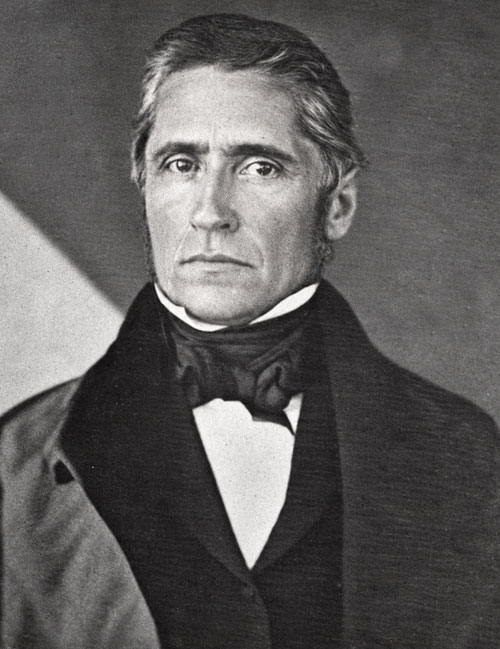
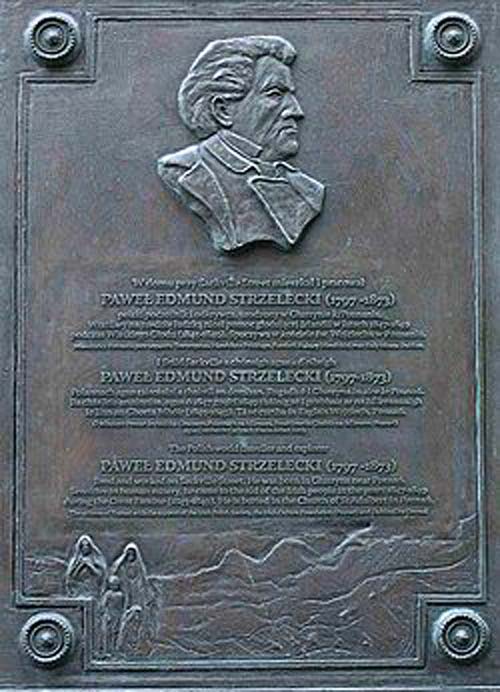
A plaque is being unveiled in Glenties, Co. Donegal, honouring one of the most remarkable humanitarian figures of the Irish Great Famine; the Polish explorer, scientist and relief worker Sir Paweł Edmund Strzelecki (KCMG CB FRS FRGS DC), also known as Paul Edmund de Strzelecki and Sir Paul Strzelecki, (1797–1873).
Strzelecki became the principal agent in Ireland for the British Association for the Relief of Distress in Ireland and Scotland, better known as the British Relief Association.
Born near Poznań, capital of the Wielkopolska region, he was already internationally known as an explorer and scientist when, in January 1847, he volunteered for unpaid relief work in Ireland.
He was initially given responsibility for the desperately affected western counties of Donegal, Mayo and Sligo, and based himself for a time in Westport, Co. Mayo.
[Strzelecki was also later associated with Florence Nightingale and helped her in facilitating the publication of a series of her articles.]
There he saw at first hand the devastation caused by hunger, disease and the collapse of ordinary life. His most important humanitarian initiative was the development of a scheme to feed starving children directly through schools. By March 1848, nearly 200,000 children were receiving school meals, while clothing was also distributed. The scheme was non-denominational and contemporary colleagues believed that it saved many young lives.
The British Relief Association’s funds were largely exhausted by the summer of 1848, and its main operations came to an end. But Strzelecki’s work for Ireland did not. Following another disastrous potato failure, he returned to Ireland in June 1849, using charitable money raised in Britain, through his own advocacy, and it is this return that raises a fascinating question for County Tipperary.
Did Strzelecki Visit the town of Cashel?
Between June and September 1849, Strzelecki undertook an extraordinary relief journey. Research by historians Professor Peter Gray and Dr Emily Mark-FitzGerald records that he travelled approximately 2,700 miles across Connaught and Munster, distributing a further £6,400 (approximately £1,055,509.76 in 2026), in charitable aid.
Strzelecki was not confined to the western counties he had first visited in 1847. In 1849 he was travelling extensively through Munster as well as Connacht, and County Tipperary, of course, is part of Munster.
So could that 2,700-mile journey have brought him to Cashel? At present, we cannot say that it did.
No document yet identified explicitly states that Strzelecki visited Cashel. No known letter headed “Cashel”; newspaper report of his arrival; or other contemporary source presently allows us to claim a visit as historical fact. But there is a genuine reason for asking the question.
At exactly the time Strzelecki was travelling through Connacht and Munster, Cashel Poor Law Union in Tipperary was itself facing a severe humanitarian and financial crisis and Cashel was being discussed in Parliament because of that crisis.
It is important to be clear about this point. Parliament was not discussing Cashel because Strzelecki was known to have visited.
Cashel was being discussed because thousands of people were dependent on poor relief and because the Union’s ability to finance that relief had become gravely strained.
On 17 May 1849, the House of Commons heard that 12,000 poor people in Cashel Union, Tipperary were receiving outdoor relief.
The situation was described in stark terms: even this relief was said to be insufficient to keep people alive, and some recipients were reportedly selling part of their ration of yellow meal simply to obtain clothing. This was not merely a hunger crisis. It was also a crisis of the Poor Law system itself.
Poor Law Unions were expected to raise much of their money locally through rates, but years of famine had devastated tenants, occupiers, landlords and the productive capacity of the land.
Large numbers remained dependent upon relief while the people expected to finance that relief were themselves increasingly impoverished. Cashel came before Parliament again on July 13th1849, right in the middle of Strzelecki’s 1849 journey. The House of Lords considered estimates for a number of distressed Poor Law Unions. For Cashel, Poor Law Commissioner Sir Edward Twisleton estimated that £20,000 might be collected in rates over the following six months.That estimate was strongly challenged in debate as unrealistic.
The wider figures were alarming: thirty-two unions were said to have debts of about £231,000, (£38,097,298.65 in 2026), while their estimated expenditure for the next six months was £464,000, (£76,524,458 in 2026). Even if projected rate collections were achieved, an enormous deficit would remain.
So Cashel’s appearance in Parliament tells us something very important. The Union was part of the continuing famine emergency, a landscape of mass outdoor relief, indebted Poor Law Unions and exhausted local ratepayers, and at precisely that moment, Strzelecki was travelling 2,700 miles across Connacht and Munster distributing private charitable aid. That coincidence is what makes the Cashel question worth investigating.
The Surviving Cashel Records
There is another important development. The original Cashel Poor Law Union Board of Guardians minute books for the famine period survive, and Tipperary Studies has digitised them for public access.
The online Cashel collection includes both the 1848–1849 and 1849–1850 minute books, precisely the records covering Strzelecki’s return to Ireland. An original Cashel Rate Book for 1849 also survives online. It runs to 232 pages and records property and rating information for the Cashel electoral division, during the very year in question.
Other 1849 rate books survive for electoral divisions within Cashel Union, including places/villages such as Fethard, Drangan, Graystown, Kilpatrick and Tullamain.
So far, however, no reference to Strzelecki has been identified in the searchable or indexed portions of the Cashel records.
That does not settle the question.
The Board of Guardians minute books are large handwritten manuscript volumes, and not every name, letter, visitor or donation can reliably be found through ordinary text searching.
A reference could appear under a variant spelling, as “Count Strzelecki”, in a piece of incoming correspondence, in the record of a donation, or simply in handwriting that has never been indexed.
The proper next stage is therefore a page-by-page examination of the Cashel Guardians’ minutes for the summer of 1849, particularly from July to early September. Historians should look not just for Strzelecki’s name but for:- letters from London or Dublin; private charitable donations; relief remittances; visiting relief agents; special grants; outside assistance; and references to individuals distributing charitable funds.
So, Did Strzelecki Come To Cashel, in Co. Tipperary?
We still cannot say yes. But we can now state the historical circumstances much more clearly. In the summer of 1849 Paul Strzelecki travelled approximately 2,700 miles across Connacht and Munster distributing charitable aid. During those same months Cashel Poor Law Union was supporting around 12,000 people on outdoor relief and was being discussed in Parliament because of the enormous financial strain created by continuing famine distress.
The original Cashel Board of Guardians records for that period survive, and are publicly available for investigation. What remains missing is the final documentary link placing Strzelecki himself in Cashel.
So the responsible conclusion remains: Did Paul Strzelecki Visit Cashel In 1849? Possibly, but not yet proven. What makes the possibility so intriguing is that we now know the scale of his movements. This was not a short journey through a handful of familiar western districts. It was a 2,700-mile humanitarian journey across Connacht and Munster, undertaken during a summer when Cashel was experiencing exactly the type of continuing distress Strzelecki had returned to Ireland to relieve.
As Glenties commemorates this remarkable Polish humanitarian, perhaps it is also an appropriate time for Cashel and County Tipperary to examine their own surviving famine records.
Somewhere in those handwritten pages may yet lie the answer to one fascinating local question; “Did Paul Strzelecki Travel To Cashel?“





Leave a Reply