A Tipperary Farmer Who Helped Change Irish Agriculture.
As Ireland marked the 60th anniversary, yesterday October 3rd, of the historic Farmers’ Rights Campaign in Bantry Co Cork, it is fitting to remember the remarkable life and legacy of Mr Rickard Joseph Gerard Deasy (1916–1999).
Although born in Leeson Street, Dublin, on March 13th, 1916, Rickard Deasy was brought up on his family’s farm at Carrigahorig, near Nenagh, Co. Tipperary. It was in North Tipperary that his life as a farmer and farmers’ leader was firmly rooted.
Mr Deasy was educated at Ampleforth College in Yorkshire and Christ Church, Oxford, where he studied politics, philosophy and economics. He later joined the Irish Defence Forces and served as an artillery officer. Following the death of his mother in the 1940s, he left the Army and returned to Carrigahorig, Nenagh, Co. Tipperary, where he developed the family holding to almost 200 acres.
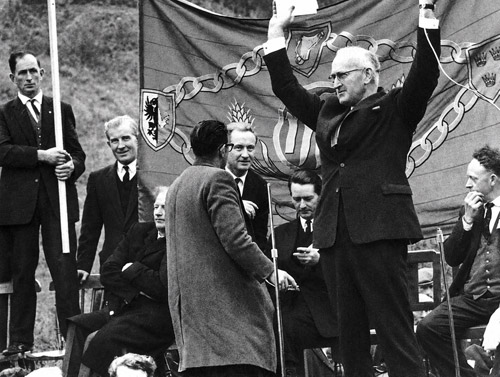
He became involved in the National Farmers’ Association through its Terryglass, Nenagh branch and rose through the organisation to become President in 1961. His defining moment would came in October 1966.
On October 7th, Deasy and 16 local farmers set out from Bantry, County Cork, on a 217 mile march to Dublin. As the march progressed, farmers joined from across the country, with around 30,000 participating along the route before the campaign converged on the capital.
The campaign sought something fundamental; recognition of farmers’ right to negotiate directly with Government, rather than merely being consulted on decisions affecting their livelihoods. Its ‘Declaration of Farmers’ Rights’ called for recognition of 11 basic rights for rural and farming families.
The movement drew inspiration from the international civil-rights movement and, in particular, Martin Luther King Jr.’s March on Washington in 1963. The declaration also invoked the promise of equality contained in the 1916 Proclamation.
When the Government initially refused to meet the NFA leadership, nine farmers began a sit-in at Government Buildings which lasted for three weeks.
The dispute subsequently escalated into road and bridge blockades, a rates strike and the imprisonment of dozens of farmers. Eventually, significant progress was made on the right to negotiate, while farmer representatives secured places on important marketing and advisory bodies. The IFA today regards the campaign as one of the decisive events in the history of organised Irish farming.
Mr Deasy and Mr Charles Haughey
The campaign also brought Mr Deasy into direct confrontation with the then Minister for Agriculture, Mr Charles J. Haughey.
Mr Haughey’s initial refusal to meet the farmers helped turn the protest into a major political confrontation. The episode was damaging to his standing as Minister for Agriculture, although this did not prevent Mr Haughey’s later rise to become leader of Fianna Fáil and Taoiseach. But it is reasonable to regard the Farmers’ Rights Campaign as a serious setback for Mr Haughey at that stage of his political career.
The Political Price Paid by Mr Deasy.
There was a striking irony in Mr Rickard Deasy’s later career. Although he had successfully mobilised thousands of farmers nationally, he was unable to convert that prominence into electoral success.
In the 1969 general election, Mr Deasy stood for the Labour Party in Tipperary North, but received only 517 first-preference votes, about 1.8% of the poll, and was not elected.
His poor showing was extraordinary for a man who had been one of Ireland’s best-known farming leaders just three years earlier.
Some later accounts suggest that his image as a militant campaigner worked against him politically, while he was also portrayed by some critics as a “Marxist”. What is beyond doubt is that Mr Deasy’s electoral failure contrasted sharply with the success of the movement he had previously led.
Sixty Years Later
At the 60th-anniversary commemoration in Bantry, yesterday October 3rd, 2026, IFA President Mr Francie Gorman described the Farmers’ Rights Campaign as a seminal event in the history of the NFA and IFA.
He said the right to negotiate, fought for in 1966, remained as important to farmers six decades later. Several surviving participants in the original march were also present at the event.
For County Tipperary, there is particular reason to remember Rickard Deasy of Carrigahorig and Terryglass; farmer; Army Officer, campaigner, and national farming leader.
From his Tipperary farm he rose to lead one of the most significant rural protest movements in modern Irish history. The campaign helped secure a recognised voice for Irish farmers in their dealings with Government and strengthened the organisation that later became the Irish Farmers’ Association in 1971.
Mr Rickard Deasy died at Nenagh Hospital on July 13th, 1999. His contribution to Irish farming, and his deep association with North Tipperary, remain an important part of our local and national history.
Mr Deasy never became a TD, but his legacy is arguably more enduring; he helped ensure that Irish farmers had a recognised voice at the table of Irish Government.





Leave a Reply