But First River Suir Latest Update.
The issue which was outlined by Cllr. Jim Ryan at the recent Municipal District meeting:
NOTE: The Environment & Climate Action Section, in conjunction with the River Basin Management Service (formerly LAWPRO), and Thurles Municipal District, has now committed to carrying out a misconnection survey in partnership with Uisce Éireann as part of the Catchment Management Plan for the Upper River Suir.
Many of the pipes inspected were found to have little or no flow at the time of inspection, making it difficult to determine their source or to establish whether any misconnections are present.
Further investigations are scheduled to take place towards the end of October. It is anticipated that higher flows at that time will assist in tracing the source of any discharges and identifying potential misconnections.
The relevant agencies will continue to work collaboratively to support the protection and improvement of water quality in the Upper River Suir neglected over the past 13 years.
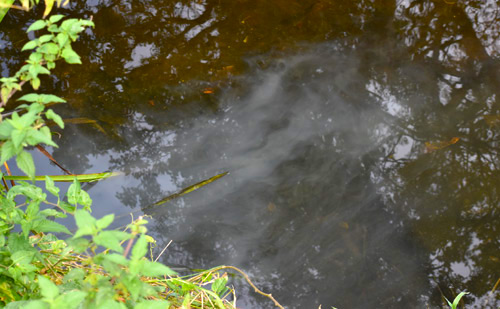
Picture: G. Willoughby.
Wildlife Was There Before – Thurles Deserves Clear Answers on the River Suir.
Time to name and shame.
The debate over the condition of the River Suir in Thurles risks becoming trapped in a false choice; either protect wildlife or maintain the river. Surely Thurles can do both.
Nobody seriously concerned about the Suir is asking Tipperary County Council to destroy valuable habitat or recklessly interfere with a living river. What residents are asking for is something far more reasonable:- remove litter, investigate and stop pollution, deal appropriately with fallen trees and serious obstructions, manage excessive growth where environmentally justified, and restore the river to a healthier condition.
That is not an attack on conservation. It is part of conservation.
At the September meeting of Thurles Municipal District, Independent Cllr Mr Jim Ryan again raised grave concerns about large trees, branches and vegetation obstructing the River Suir. He recalled a river in the 1990s that was considerably more open and where activities such as kayaking could actively take place.
Mr Thomas Duffy, District Engineer with Tipperary County Council’s Thurles Municipal District, (him who reigns over current Thurles technocracy, town renowned for 90% of its road signs, for months, either pointing in the wrong direction or otherwise just misleading), reportedly responded by pointing to the wildlife and habitats supported by trees and vegetation and to representations from people opposed to cutting back that growth. Yes, those concerns deserve to be taken seriously, but Mr Duffy’s response leaves the central questions unanswered.
(1) Was he concerned about the wildlife living in the filthy, abandoned clothing, same strewn about the river banks on either side of the river which we photographed this morning, Sat 26th September?
(2) Was he referring to the fallen trees, the growing trees and oxygen stealing reeds within the river itself ?
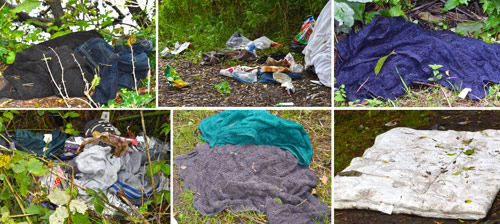
Picture: G. Willoughby.
Cllr Jim Ryan had made an obvious but important point; wildlife also existed in and around the Suir when the river was properly maintained, under the governance of now retired Mr Michael Ryan, former Thurles Town Clerk.
So the issue is not whether wildlife should be protected. Of course it should. The real questions for Mr Duffy and his officials, in his role as District Engineer, and for Tipperary County Council now remain much more specific.
- Which habitats require protection?
- Which trees and branches have actually been assessed?
- Which obstructions can safely be removed?
- What maintenance can proceed without damaging important habitat?
- What work cannot proceed, and what scientific evidence supports those decisions?
Thurles residents are entitled to answers. Simply referring to biodiversity, whenever river maintenance is raised, risks giving the impression that conservation has become a reason for continued inaction. That would be unfair both to genuine conservation and to the people who have been raising legitimate concerns about the condition of the River Suir for 13 years.
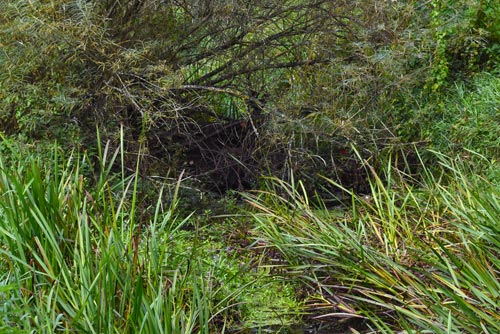
Picture: G. Willoughby.
There is nothing natural about litter, sewage, incorrectly connected drainage pipes or other pollutants entering a river.
There is nothing environmentally responsible about allowing pollution to remain simply because vegetation has subsequently developed around parts of the river.
There is little comfort in being told that existing vegetation provides habitat without an equally clear explanation of what Tipperary County Council and the relevant agencies are doing to improve the quality of the water supporting that habitat.
Conservation Must Not Become An Excuse for Neglect.
This is where Mr Duffy’s explanation requires greater clarity. Nobody is suggesting that every tree should be cut down or every piece of vegetation removed. Equally, however, the presence of wildlife cannot automatically mean that every fallen tree, obstruction or area of excessive growth must remain untouched indefinitely. That is not an intelligent management strategy.
- A professional river-management approach should identify what needs protection, what requires intervention and how both objectives can be achieved together.
- If particular trees are ecologically important, tell the public.
- If particular branches can safely be removed, remove them.
- If environmental assessments are required before work can proceed, explain which assessments are needed and when they will be completed.
- And if Tipperary County Council believes that certain sections of the Suir should no longer be maintained in the manner residents remember from previous decades, it should explain clearly why that policy has changed and what evidence supports the new approach.
- Residents should not be left trying to interpret vague references to habitats while the visible condition of the river continues to cause concern.
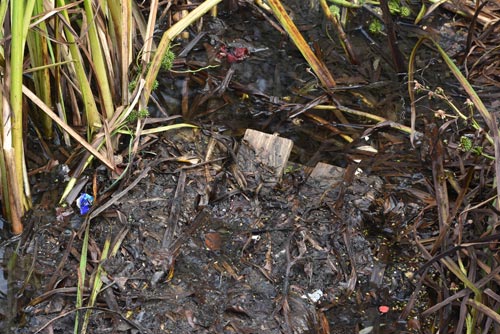
The Aim Should Be Restoration
Perhaps the better word for what Thurles needs is restoration. When severe air pollution was tackled in Ireland, nobody argued that polluted air should somehow be preserved because it had become part of the existing environment. The sources of the pollution were tackled so that cleaner air could return.
Why should our rivers be treated differently?
- Protect what is genuinely ecologically valuable.
- Remove what does not belong there.
- Stop pollution at source.
- Improve water quality.
- Carry out appropriate maintenance under proper environmental supervision.
The River Suir should not be forced into an artificial argument between “cleaning” and “conservation”. The real objective should be restoration based on evidence.
If Work Cannot Be Done, Mr Duffy and the Council Should Explain Why.
For every significant obstruction or area of concern identified along the Suir through Thurles; Tipperary County Council should be capable of answering some simple, straightforward questions.
- Has it been inspected?
- Has its ecological importance been assessed?
- Does it present a flooding, pollution, amenity or maintenance issue?
- Can any work safely be undertaken?
- Which authority is responsible?
- If work cannot proceed, what specific environmental consideration prevents it?
- And, where work can proceed, when will it happen?
- These are reasonable questions to put to Mr Thomas Duffy as District Engineer and to the wider management of Tipperary County Council.
Indeed, Tipperary council records show that concerns about the condition and maintenance of the River Suir are not new. Mr Duffy has served as District Engineer for Thurles Municipal District over a period in which these issues have repeatedly been discussed at council level.
That makes it all the more important that the council now moves beyond explanations of constraints and tells residents what practical programme of work is actually possible.
Why Does Thurles Appear Different?
Cllr Ryan has also questioned why stretches of the River Suir through Cahir and Clonmel appear to be maintained differently.
Again, both Mr Duffy and Tipperary County Council should be able to provide a factual explanation.
If the difference arises from flood-management requirements, ecological designations, ownership, OPW involvement, Inland Fisheries advice, engineering considerations or simply different physical conditions in the river, then say so.
If different maintenance regimes are being applied in different towns, explain why.
There may be perfectly legitimate reasons.
But without a clear explanation, residents will understandably continue asking why work apparently possible elsewhere along the Suir appears so difficult to undertake in Thurles.
Water Quality Cannot Be Secondary to Vegetation.
This is another important issue which must not be lost in the discussion about trees and vegetation.
Pollution.
The investigation into pipes apparently discharging into the Suir south of The Source Arts Centre is therefore particularly important.
Following repeated representations from Cllr Jim Ryan, a preliminary investigation has at last begun, with further investigations expected to try to determine the source of suspected misconnections.
This is progress, but investigation cannot be the end of the process.
If a pipe is discharging inappropriate material into the River Suir, residents should ultimately be told what was discovered, where the discharge originated, what remedial action is required, which organisation is responsible for that action and when the problem will be corrected. Otherwise, another survey simply becomes another entry in a dusty file cover.
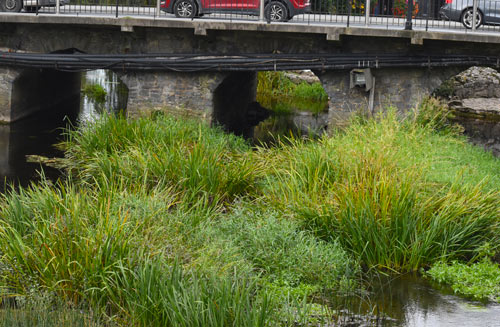
Picture: G. Willoughby.
Mr Duffy’s Role Carries a Responsibility to Explain What Can Be Done.
As District Engineer for Thurles Municipal District, Mr Thomas Duffy is understandably required to take account of engineering requirements, environmental obligations, habitat protection and the advice of other statutory bodies.
Nobody should expect him to disregard those responsibilities. But those same responsibilities also place him in an important position to explain clearly to councillors and the public what exactly can be achieved.
The response cannot end at: “There is wildlife there.” The next sentence must be: “Therefore, this is what we can safely do”. That is the missing part of the present discussion. If complete clearance would be environmentally damaging, nobody reasonable should demand complete clearance. But if selective tree work, removal of obstructions, litter clearance, bank management or other interventions can take place safely, residents deserve to know why those measures are or are not being undertaken.
Conservation should define how appropriate maintenance is carried out. It should not automatically become an argument against maintenance itself.
Accountability Must Follow Investigation
There is also a wider question of accountability. The problems now being discussed did not emerge overnight. Concerns about water quality, pollution, vegetation and the physical condition of the river have been raised over a 13 year period.
Mr Duffy has occupied the role of District Engineer during much of that period. That does not mean every problem with the Suir falls personally at his door; responsibility is plainly shared between Tipperary County Council, water authorities, environmental agencies, landowners and other bodies.
But it does mean that residents are entitled to expect a clear engineering and management response from the local authority responsible for the district.
The answer cannot perpetually be another study, another consultation or another explanation of why something is complicated.
At some stage complexity has to produce a plan, and that plan has to produce results.
Give Thurles a River Plan People Can Measure.
What Thurles now needs is a River Suir management and restoration programme that ordinary residents can understand.
- It should identify the problems.
- It should publish the evidence.
- It should state what work is permitted.
- It should identify what work is environmentally unsuitable.
- It should name the authority responsible for each action.
- It should include target dates.
- And it should report publicly on whether those targets have been achieved.
- Where vegetation must remain for ecological reasons, explain why.
- Where trees or branches can safely be removed, deal with them.
- Where litter has accumulated, clear it.
- Where misconnections are identified, correct them.
- Where nutrient pollution is contributing to excessive plant growth, tackle the source rather than repeatedly treating the symptom.
- Where additional assessments are required, give residents a date for their completion.
- And where responsibility rests with another agency, identify that agency clearly instead of leaving residents caught between different authorities.
The River Suir does not need a battle between conservationists and people calling for action.
Most people want exactly the same thing:
A cleaner, healthier, living River Suir flowing through Thurles. Wildlife was there before the present level of overgrowth.
Wildlife existed when the river was more open. People enjoyed the river then too. And wildlife ultimately depends not simply on trees and vegetation but on the quality of the water flowing between them.
So the question for Mr Thomas Duffy, District Engineer for Thurles Municipal District, and for Tipperary County Council is not: “Why can’t you clear everything?” It is a much more reasonable question; “Having identified what must be protected, what exactly can be maintained and restored and when will that work actually be carried out?”
This post has been forwarded to EPA; Tipperary Co. Co. and to River Basin Management Service (formerly LAWPRO).
After 13 years of concern about the River Suir, Thurles deserves more than explanations of what cannot be done. It deserves a clear explanation of what can be done, who will do it and when can the public expect to see results.





Leave a Reply