Austen, Boelo and Chloe are first in line to name major storms affecting Ireland, the UK and the Netherlands during the 2026/27 season.
Met Éireann unveiled the list alongside the UK Met Office and Dutch forecasting service KNMI after the public submitted more than 40,000 suggestions. The official list contains 21 names, beginning with Austen and ending with Wende.
Met Éireann confirmed the names on 1st September 2026.
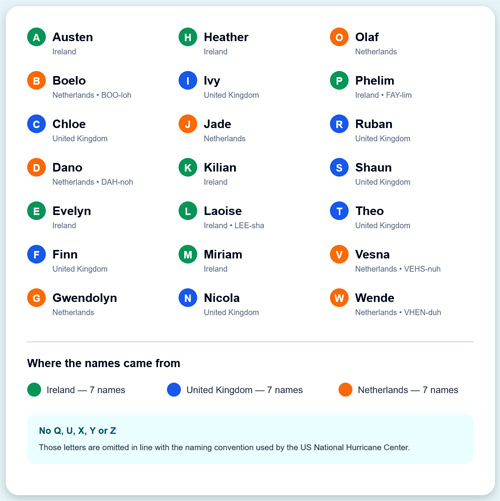
Many of the nominations pay tribute to loved ones, pets and notable figures from meteorological history.
Chloe, the third name on the list, was suggested more than 120 times. One nomination came from the mother of a five-year-old weather enthusiast who is fascinated by forecasts but, according to her family, can “create a storm by herself” when tired.
Finn was proposed for a two-year-old boy described by his family as wild and a force to be reckoned with. Ivy commemorates a nine-month-old Labrador puppy affectionately nicknamed “the absolute destructor”.
Nicola honours a mother who has “weathered many a storm and only come out stronger”, while Theo was inspired by a cat that would hide before thunderstorms, leading its owner to joke that it could predict the weather.
Shaun also appears on the list after winning a public vote held through a partnership between the Met Office and Aardman, the British animation studio behind Shaun the Sheep and Wallace & Gromit. The collaboration is intended to introduce weather preparedness to new audiences through Aardman’s storytelling.
Met Éireann selected several names connected to the history of Irish weather forecasting as it celebrates the 90th anniversary of the establishment of the Irish Meteorological Service.
Austen honours Austen Nagle, its first director, while Evelyn recognises Evelyn Murphy, the first woman to present a weather forecast on RTÉ.
KNMI chose its names from more than 3,000 public suggestions. They include Boelo,pronounced “Boo-loh”—a traditional but now almost extinct name from the eastern Groningen region. The name has been passed through the nominator’s family for generations.
Although the stories behind the names are often warm and personal, meteorologists emphasise that storm naming serves a serious purpose. Giving a potentially dangerous weather system a distinctive name helps the public follow forecasts, understand warnings and prepare for possible disruption.
A storm is named when forecasters believe it could produce medium or high impacts in Ireland, the UK or the Netherlands. Strong winds remain the main consideration, although the potential effects of heavy rain and snow are also assessed.
The three forecasting organisations have named storms jointly since 2015. Each annual list operates from the beginning of September until the following August.
The letters Q, U, X, Y and Z are omitted in keeping with North Atlantic naming conventions.





Leave a Reply