The Government’s decision to designate the proposed Shannon water pipeline, as “critical infrastructure”, represents a significant new development in a project that could profoundly affect North Tipperary and the wider Shannon region.
Officially known as the Water Supply Project for the Eastern and Midlands Region, the scheme is now one of the first nine projects placed at the “top of the queue” under the Critical Infrastructure Act 2026.
It is one of three water projects selected, alongside the Greater Dublin Drainage Project and the upgrade of the Bunlicky Wastewater Treatment Plant in Limerick.
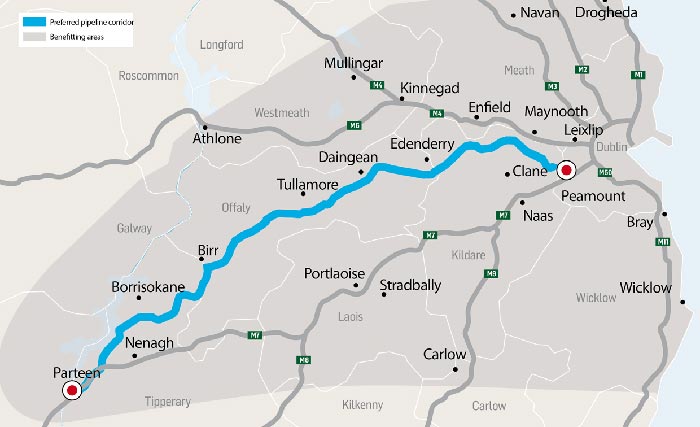
The proposed scheme would take water from the lower River Shannon at the Parteen Basin in County Tipperary, treat it at Birdhill and carry it through a pipeline running across Tipperary, Offaly and Kildare to Peamount in County Dublin.
Uisce Éireann says the project would provide a second major water source for the eastern and midlands region, reduce its heavy dependence on the River Liffey and help meet future housing, population and economic demands.
However, the scale of the proposal remains enormous.
The planning application involves the abstraction of more than 300 million litres of water on certain days, according to reported project figures. Uisce Éireann describes this as a maximum of approximately 2% of the Shannon’s average flow at Parteen Basin.
The utility’s current estimated cost is between approximately €4.6 billion and €6 billion. However, documents previously supplied by the Department of Housing to the Public Accounts Committee indicated that the final bill could exceed €10 billion under a worst-case risk scenario.
This new designation does not automatically grant planning permission, nor does it direct An Coimisiún Pleanála to approve the application.
What it does is place a legal obligation on relevant State bodies to prioritise the project, allocate the necessary administrative and technical resources and reduce the time taken to process decisions, licences, consents and other authorisations.
Public bodies are also expected, where possible, to carry out different approval processes simultaneously rather than waiting for one process to finish before beginning another.
That distinction is important.
The project must still comply with planning law, environmental assessment requirements and Ireland’s obligations under European Union law. The designation is intended to accelerate decision-making, not predetermine its outcome.
Nevertheless, from a Tipperary perspective, the Government’s announcement clearly increases the political and institutional pressure surrounding the project.
Only weeks ago, An Coimisiún Pleanála postponed its expected decision on the application. Its official case record now states that a decision is due by 2nd July 2027.
That postponement is not merely an administrative delay. It provides crucial breathing space for communities, farmers, environmental organisations, public representatives and independent experts to examine the proposal in full.
The central questions have not disappeared simply because the Government has labelled the pipeline nationally important.
► What would sustained abstraction mean for the Parteen Basin, Lough Derg and the lower Shannon during drought or unusually low-flow conditions?
► Have alternatives; including stronger leakage reduction, greater use of existing regional water sources and less centralised supply options, been adequately examined?
► What protections and enforceable guarantees will be provided to communities in Tipperary?
► How reliable are the cost projections for a project stretching approximately 170 kilometres and potentially lasting many years?
► Does placing the project at the “top of the queue” risk creating pressure for speed at the expense of proper scrutiny?
The eastern and midlands region undoubtedly needs a secure and resilient water supply. That need, however, cannot be used to silence legitimate questions from the county, where the water would be taken, treated and initially transported.
Critical infrastructure status should demand a higher standard of evidence, transparency and accountability, not a lower one.
The period before July 2027 must therefore be used constructively. Tipperary needs clear hydrological evidence, independent environmental analysis, transparent costings and binding commitments concerning local water security and the protection of the Shannon system.
The Government may have accelerated the project politically, but it has not answered the fundamental questions surrounding it.
For Tipperary, the planning postponement remains a vital opportunity to ensure those questions are heard before any irreversible decision is made.







Leave a Reply