More than a century after the destruction of the Public Record Office of Ireland at the Four Courts, another major piece of Ireland’s lost documentary heritage has been restored to public view.
The Virtual Record Treasury of Ireland has released 194,000 newly digitised historical records, bringing the total number of freely available records on the platform to 544,000. The material spans seven centuries of Irish history and now amounts to around 340 million words of searchable content.
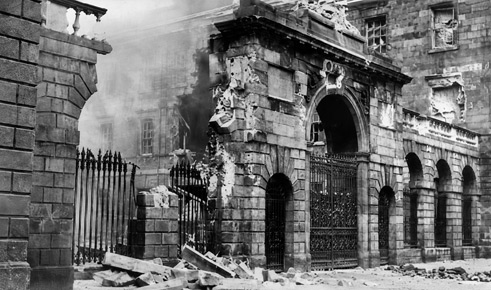
The release marks the 104th anniversary of the destruction of the Public Record Office, which was lost on 30 June 1922 during the opening stages of the Irish Civil War. The building, located within the Four Courts complex in Dublin, had housed a vast archive of census material, taxation records, legal papers, land ownership documents and state records dating back to the medieval period.
For generations, the loss was regarded as one of the greatest archival disasters in Irish history. But the Virtual Record Treasury is rebuilding what was lost by tracking down copies, transcripts and related material preserved in archives, libraries and private collections across Ireland and around the world.
The 2026 release includes records ranging from medieval Ireland to the age of revolution and emancipation. Among the new material are records connected to Catholic Emancipation, Ireland’s links with the American Revolution, early local history, State Papers from 1660 to 1715, and documents from the Norman and medieval period.
The project is hosted by Trinity College Dublin and funded by the Department of Culture, Communications and Sport. It brings together more than 100 partner archives, libraries and memory institutions worldwide, including the National Archives of Ireland, the Public Record Office of Northern Ireland, The National Archives UK, the Irish Manuscripts Commission and the Library of Trinity College Dublin.
One of the most important developments is the expansion of the VRTI Knowledge Graph for Irish History. This digital research tool now includes more than 15,000 people from Irish history and 3.5 million linked historical facts, allowing users to follow connections between people, places, events and surviving records.
The latest update also adds thousands of historical individuals, including women from the early modern period and figures from the medieval and Norman eras. This gives researchers, students, family historians and the wider public new ways to explore lives that were once buried in fragile, scattered or forgotten documents.
The Virtual Record Treasury is also looking beyond Ireland. A new two-year project, “Journey to Europe: Archives of the Irish in France,” will search French archives for records connected to Irish history, including material on Wolfe Tone, the Irish Brigade, Irish colleges in France and Irish merchants along France’s Atlantic coast.
What was once thought to have vanished in smoke and fire is now being digitally reunited. More than 100 years after records fell from the sky over Dublin, Ireland’s lost archive is being pieced back together — page by page, name by name, and story by story.
The records are free to explore here through the Virtual Record Treasury of Ireland.





Leave a Reply