Every time a vaccine is given, every time an anaesthetic is injected, every time a patient receives insulin, antibiotics, chemotherapy, adrenaline, morphine, or life-saving fluids through a line, there is a quiet piece of Irish history at work and it begins in Co. Dublin.
Long before modern hospitals, vaccination centres, intensive care units, emergency departments, operating theatres, and community clinics became part of everyday life, doctors faced a simple but enormous problem; how could medicine be delivered precisely into the body, beneath the skin, where it could act quickly and effectively? For much of medical history, treatments were limited by the routes available. A patient could swallow a medicine. A substance could be rubbed onto the skin. A wound could be dressed. But getting a measured treatment through the skin and into the tissues, close to the source of pain or disease, was a different challenge entirely.
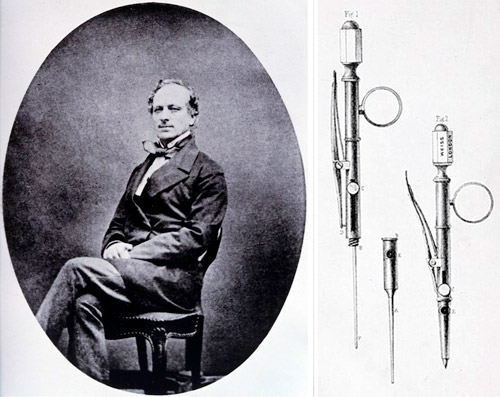
That challenge was answered in Ireland.
The late Dr Francis Rynd, (1801-1861), an Irish physician and surgeon working at the Meath Hospital in Dublin, developed a hollow needle that made hypodermic injection possible. In 1844, Rynd used his new instrument to treat a woman suffering from severe neuralgia, a crippling nerve pain that had resisted the treatments then available. Rather than relying on medicine taken by mouth, he introduced a pain-relieving solution beneath the skin, close to the affected nerves.
The effect was remarkable. A patient who had been suffering intensely finally experienced relief.
It was a small procedure by modern standards, but its consequences were vast. With that act, medicine crossed a threshold. The skin was no longer an almost impenetrable barrier between doctor and disease. The body could now be reached more directly, more precisely, and often more quickly.
Dr Rynd’s newly developed instrument was not the modern disposable syringe we know today. It was a pioneering device, developed at a time when medicine was still learning how to control pain, infection, and dosage. But the principle was revolutionary; a hollow needle could carry fluid into the human body, and from that principle came a medical transformation.
Today, the hollow needle is so familiar that we often forget how extraordinary it is. It is present at birth, in childhood immunisation, in dental surgeries, in ambulances, in cancer wards, in diabetes care, in blood tests, in epidurals, in emergency medicine, in intensive care, and in operating theatres across the world.
The story became even more powerful during our recent COVID-19 pandemic.
When COVID vaccines were developed and rolled out at historic speed, the world focused on the science of messenger ribonucleic acid (mRNA), viral vectors, immune response, public health logistics, cold-chain storage, and global vaccine access. All of those mattered enormously. But the final act; the moment science became protection, depended on the needle.
Billions of times, in clinics, pharmacies, sports halls, hospitals, GP surgeries, care homes, schools, airports, and temporary vaccination centres, a tiny hollow needle carried a vaccine from vial to arm. That simple delivery system helped protect people from severe illness and death on a scale almost impossible to imagine.
Over 13 billion COVID-19 vaccine doses have been administered globally. Each one was a modern event, shaped by cutting-edge immunology, global manufacturing, public health systems, and data science. Yet each one also belonged to a much older story: the story of a Dublin doctor who showed that medicine could be placed directly beneath the skin.
The same is true of countless other vaccines. Measles. Polio. Tetanus. Diphtheria. Influenza. HPV. Hepatitis. Pneumococcal disease. Childhood immunisation programmes across the world depend on the ability to deliver vaccines safely and reliably into the body. The needle is not the whole story of vaccination, but without it modern vaccination would not look the way it does today, and that is why Francis Rynd deserves to be better known.
Ireland has given the world poets, revolutionaries, scientists, teachers, nurses, doctors, inventors, and reformers. Among them stands a Dublin physician whose invention became one of the most important tools in the history of medicine.
While most people know the feeling of a needle; very few know the name Francis Rynd. But his legacy is everywhere.
It is in the child receiving a routine vaccine. It is in the older person receiving a seasonal COVID or flu booster. It is in the patient being prepared for surgery. It is in the diabetic injecting insulin. It is in the emergency doctor administering adrenaline. It is in the cancer patient receiving treatment. It is in the drip beside a hospital bed.
A hollow needle may look ordinary. In truth, it is one of the great medical inventions and it began in Ireland and the world should remember the name Dr Francis Rynd.





Leave a Reply