History does not repeat itself exactly, but it often rhymes in the ways hatred is excused, renamed, or redirected.
In the autumn of 1941, a ravine on the edge of Kyiv became one of the most devastating killing sites of the Holocaust. German forces had occupied the city on September 19th, and within days the Nazi campaign of persecution turned into mass murder. Notices appeared ordering Kyiv’s Jews to report with documents, clothing, money, and valuables. Many believed they were being deported or resettled. Instead, they were being led to Babi Yar.
On September 29th and 30th, Jewish families moved through the city in long, fearful columns. Parents carried children. Elderly people walked beside relatives. Others brought small bundles containing whatever remained of their lives. At the ravine, they were stripped of their possessions and clothing, forced toward the edge in groups, and shot. In only two days, 33,771 Jewish men, women, and children were murdered there, making Babi Yar one of the largest single massacres of the Holocaust.
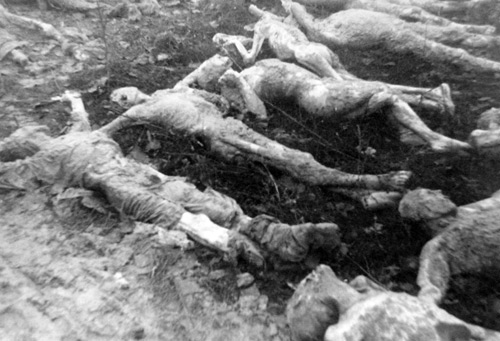
The killing did not end with those two days. During the Nazi occupation, Babi Yar continued to be used as an execution site. Jews who had survived or hidden were later brought there and killed. Soviet prisoners of war, Roma people, resistance members, civilians, and others targeted by the occupiers were also murdered in or near the ravine. What had once been a natural landmark became a mass grave and a symbol of the “Holocaust by bullets,” the campaign of open-air shootings carried out across Nazi-occupied Eastern Europe.
After the war, Babi Yar’s memory was itself subjected to silence. Under Soviet rule, public commemoration often avoided naming the Jewish victims specifically, presenting the dead mainly as Soviet citizens. For survivors, relatives, and historians, this omission deepened the wound. The ravine held not only the bodies of the murdered but also a history that official memory struggled to acknowledge.
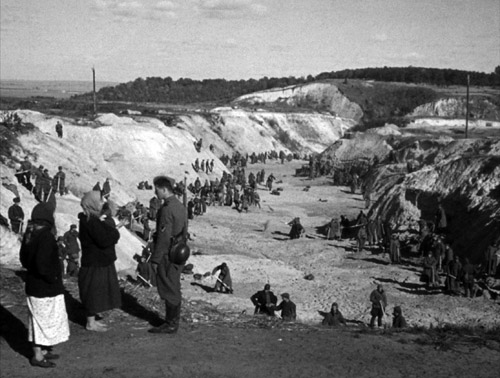
Pic: Johannes Hähle.
Today, Babi Yar stands as a place of mourning and warning. Its story reveals how quickly ordinary streets can become routes to destruction when hatred is organised by the state and human beings are reduced to targets. Behind the number 33,771 were families, neighbours, children, workers, students, grandparents, and entire communities whose lives were ended together at the edge of a ravine.
To remember Babi Yar is to restore their humanity against the machinery that tried to erase them.
That silence also speaks to the present. History does not repeat itself exactly, but it often rhymes in the ways hatred is excused, renamed, or redirected. Anti-Semitism rarely begins with violence at the edge of a ravine. It begins with language that turns Jews into a collective blame, with suspicion cast over Jewish identity, with the idea that Jewish fear is exaggerated, or that hostility toward Jews can be justified by events elsewhere. In Ireland today, where public feeling about Israel and Gaza is often intense, there must still be a clear moral line; criticism of any government is legitimate, but blaming Irish Jews for the actions of the Israeli state, intimidating Jewish people, distorting Holocaust memory, or treating Jewish belonging as conditional is antisemitism.
To remember Babi Yar is therefore not only to look back at 1941, but to ask what kind of society we are becoming now. The lesson is not that today is the same as then; it is that dehumanisation must be challenged long before it becomes catastrophe. A country can defend Palestinian lives and rights while also defending Jewish safety, dignity, memory, and belonging.
The measure of moral seriousness is whether we can hold both truths at once, refusing to let grief for one people become hatred of another.





Leave a Reply