Local History Group Celebrates Littleton’s Bord na Móna Heritage.
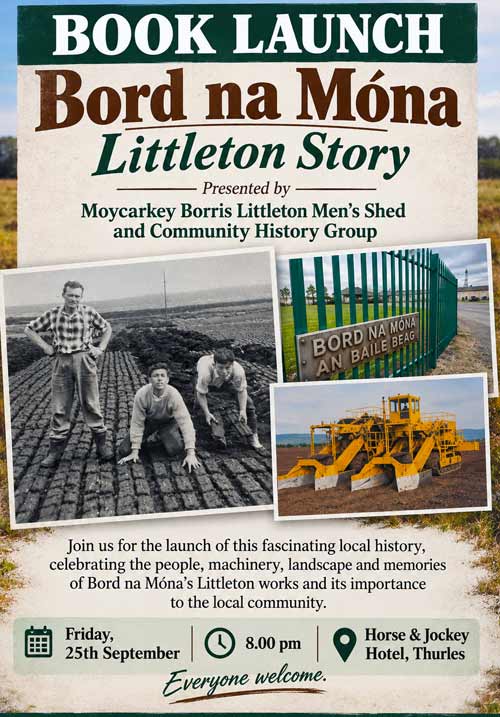
The people, places and memories of Littleton’s peat industry will take centre stage at the book launch of “Bord na Móna: Littleton Story” in the Horse & Jockey Hotel, Thurles, on Friday, 25th September, at 8.00 pm.
Presented by the Moycarkey / Borris Littleton Men’s Shed and Community History Group, this local history publication celebrates the men and women whose working lives helped shape the community, preserving stories of the bogs, the machinery and a legacy that reaches far beyond the workplace. Former employees, their families and everyone with an interest in the area’s heritage are warmly invited to attend.
The Littleton Bog complex is a term used by the Moycarkey / Borris / Littleton Men’s Shed and Community History Group to outline the area of peatlands worked on an industrial scale by Bord na Móna since the company was founded in 1946. With the cessation of works at the the Littleton Briquette Factory and milled peat operations in April 2018, it brought to a close sixty-two years of peat extraction works at this area of peatlands.
This book, while not endeavouring to be an in-depth historical analysis of Bord na Móna operations in the middle of Tipperary; provides a snapshot of its impact on the parish of Moycarkey / Borris / Littleton. Other parishes in the area such as Moyne / Templetuohy; Gortnahoe / Glengoole and Killenaule also had very important roles in the growth and development of the bogs as areas of employment and add greatly to the overall story of the relevance and importance of Bord na Móna to these communities. People from Thurles and other surrounding parishes were also employed on the bog or in the briquette factory. Indeed, it must also be recognised that the site of Littleton Briquette Factory is in the townland of Killeens, which is part of Killenaule parish.
This booklet gives a brief overview of the turf cutting operations at the outset of the development of the bogs, with the main focus being on the offices and yard at Ballybeg. This new industry meant that many men were required to get operations up and running, with the result that several of these came from outside Tipperary, many of whom resided in a billet camp, which was sited across the road from the main office and yard. It is not meant to be an exhaustive account of the work which took place in the Littleton Bog complex or within the area of work associated with the briquette factory. For a comprehensive overview of the history of Bord na Móna readers are encouraged to read Brown Gold: (A History of Bord na Móna and the Irish Peat Industry by Donal Clarke).
The type of work engaged on the bogs is explored, as is a brief exploration of the various machines which were required to work the bogs on such an industrial scale. Coupled with the influx of workers and families was a need for social housing and this is also chronicled with an overview of housing schemes, school development and an associated impact on sporting and social organisations across the parish.
It is also recognised that the peatlands of mid-Tipperary have a rich and vibrant history, which have engaged all peoples across the generations. A sample overview of the flora and fauna of the bogs, its relevance as a carbon sink in the modern era and how the rich tapestry of its past can be used to educate and inform people as the impact of climate change is felt locally and globally.
Many parts of the bog were given local place names, which were readily identifiable to the Bord na Móna workers. Many of these are also recorded so that this local knowledge is not lost and can continue as part of the vibrant folklore associated with a lifetime for many of working on the bogs.
Lastly, an overview of archaeological finds in the bog, both before and during Bord na Móna operations are also recorded. These assist in demonstrating the relevance of the bogs as spiritual, votive, social, energy and recreational areas, which are all intertwined across the generations.
Acknowledgments
The Moycarkey Borris Littleton Men’s Shed and Community History Group are thankful to everyone who assisted with this Bord na Móna story in the parish community.
To those who supplied articles and photographs: Colm Dempsey BnM, Ray Yates, Tommy Maguire, Frank Connolly, Liam Dempsey, Fr. Tomás O’Connell, Christy Bracken, Ann Slattery, Billy Loughnane, Peggy Kirby, Billy Ryan, M. Skehan Ruddy, Tom Kelly, Ed. O’Shea, Sean Ryan, Sadie Dwyer, John O’Loughlin, Martin Cooney and members of the group who also contributed articles.
A special word of thanks to Clare McNamara, Image Library Officer, National Museum of Ireland for her support and for the kind permission of the National Museum to reproduce images of some items discovered in the Littleton Bog Complex.
Thanks to Dr. Charles Mount for his kind permission to reproduce a ‘Togher/Tocher’ (wooden trackway), following excavation at Longfordpass. The MBL Men’s Shed and Community History Group are Michael Dempsey, Jim Flanagan, Seamus Bourke, John Fogarty, Liam O’Donnchú, Mary Ryan, Mary and Frank O’Regan, Billy Purcell, Joe Moran and Pat Bracken. Thanks also to Tommy Britton for his support and a special word of thanks to Bernie Lonergan who co-ordinated the project at the outset.
Dedication
This overview of the impact of the bogs of mid-Tipperary on the community of Moycarkey / Borris / Littleton could not have been possible without telling some of the stories of the life and times of the men and women who worked in the Littleton Bog complex under the employment of Bord na Móna. This booklet is dedicated to all these people, and to the legacy which they have left behind. To those still living, we salute and thank you. To those who have gone to their eternal reward; Ar dheis dé go raibh a n-anamacha. (Irish translation – “May their souls be on the right hand of God”).





Leave a Reply